On this page
How to identify it
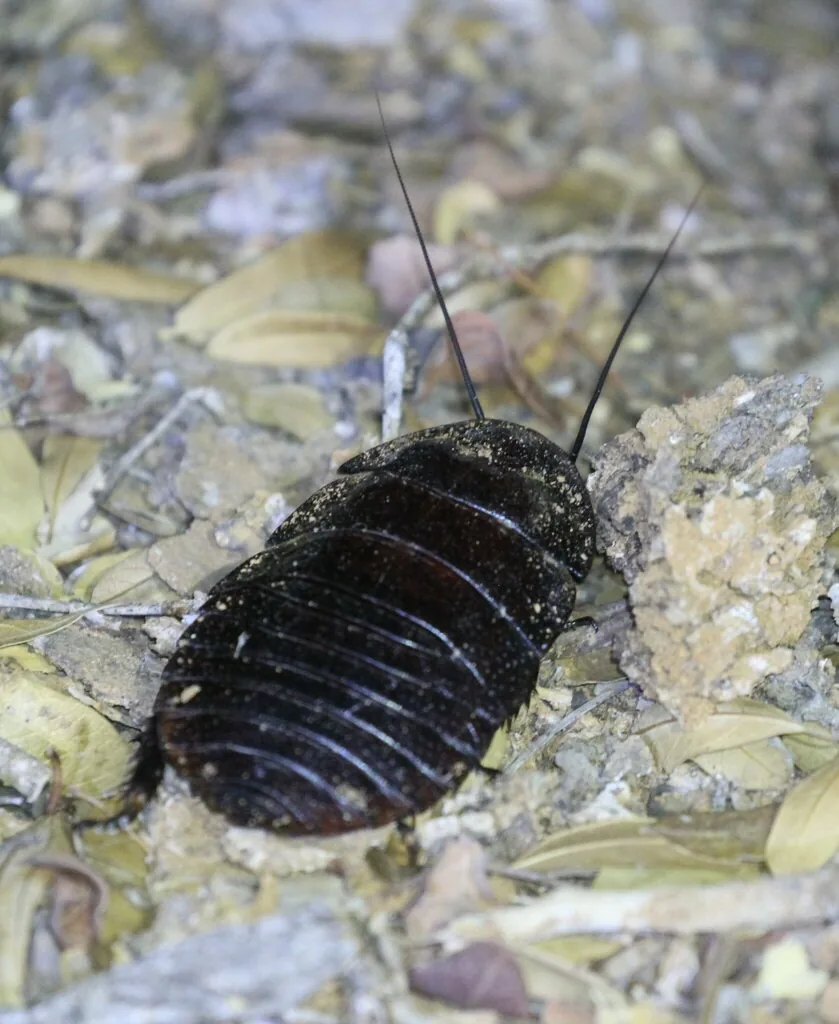
- A large, slow-moving cockroach with no functional wings, unlike many pest cockroaches such as the American cockroach, which can fly.[1][2]
- It hisses. When frightened it forces air out of the breathing pores (spiracles), the small black dots along the sides of the abdomen, making a loud hissing sound.[1][2]
- Males have bumps (protrusions) on the thorax and feathery antennae, which females lack.[2]
- Small mites are often seen crawling over the body; they live on the cockroach and do not harm it.[1]
Look-alikes
| Look-alike | How to tell them apart |
|---|---|
| American cockroach | The American cockroach is a fast-moving pest that can fly, thrives in garbage and spreads germs, while the hissing cockroach is a larger, slower, wingless forest species that feeds on fruits and vegetables.[1][2] |
Where it lives
Native to Madagascar, where it lives in forests inside fallen logs. Elsewhere it is known from captivity: it is widely available from commercial breeders and is used in classrooms and as a research animal.[1][2]
Biology and life cycle
It does not lay eggs. The eggs develop inside an egg case held within the female's body, and she gives birth to 15 to 60 live nymphs.[1][2]
The newborn nymphs are about 6 to 8 mm long and look like small adults. They molt several times and reach adulthood and sexual maturity in about six months; there is no pupal stage.[2][1]
Adults are long-lived for an insect, up to about five years, and the life cycle can exceed four years in captivity.[2]
Males hiss at one another to establish dominance, as well as hissing when disturbed.[1]
It feeds on fruits and vegetables. In captivity it is kept at room temperature (about 75 to 82°F) and moderate humidity and fed fruits, vegetables and dry food such as pet food.[1][2]
Damage and signs
- None in homes. University of Kentucky entomologists point out that, unlike German and American cockroaches, it is not a garbage-feeding species and is not 'dirty'.[1]
Health risk
It is harmless: it does not bite or sting. The mites that ride on hissing cockroaches cannot bite or infest people.[1]
Control
Prevention
No control is needed. It is a harmless forest cockroach that many people have grown to love, and a scientific review notes that it is classified as an exotic species rather than an invasive pest.[1][2]
Common questions
- Do Madagascar hissing cockroaches bite?
- No. They do not bite or sting and are considered harmless.[1]
- Why do hissing cockroaches hiss?
- When frightened they push air out of their spiracles, the breathing pores along the sides of the abdomen, to make a loud hiss. Males also hiss at each other to establish dominance.[1]
- Are the mites on my hissing cockroach dangerous?
- No. The small mites that crawl over hissing cockroaches do not harm the roach and cannot bite or infest humans.[1]
Sources
- University of Kentucky Department of Entomology, “Madagascar Cockroach.” entomology.ca.uky.edu/content/madagascar-cockroach (accessed 2026-11-09)
- Animals (MDPI); PMC13255750, “Cockroaches as an Emerging Invertebrate Model in Bioscience Research: Gromphadorhina portentosa. Animals (Basel), 2026.” pmc.ncbi.nlm.nih.gov/articles/PMC13255750/ (accessed 2026-11-09)
- iNaturalist, “Gromphadorhina portentosa taxon page (order and family).” www.inaturalist.org/taxa/322550 (accessed 2026-11-09)