On this page
How to identify it
- Females are light brown and about 1/8 inch (3 mm) long, smaller than a grain of rice. Males are a little smaller, have a horn-like bump and cannot fly, so they stay inside the tree.[1][2][3]
- The first sign is usually a whole branch whose current-year leaves turn red or brown in an otherwise full, green canopy.[1]
- Pale boring dust collects in bark cracks or around the base of the trunk, and the beetles leave perfectly round holes about 1/16 inch (1.3 to 1.5 mm) across, often hidden in bark crevices.[1][3]
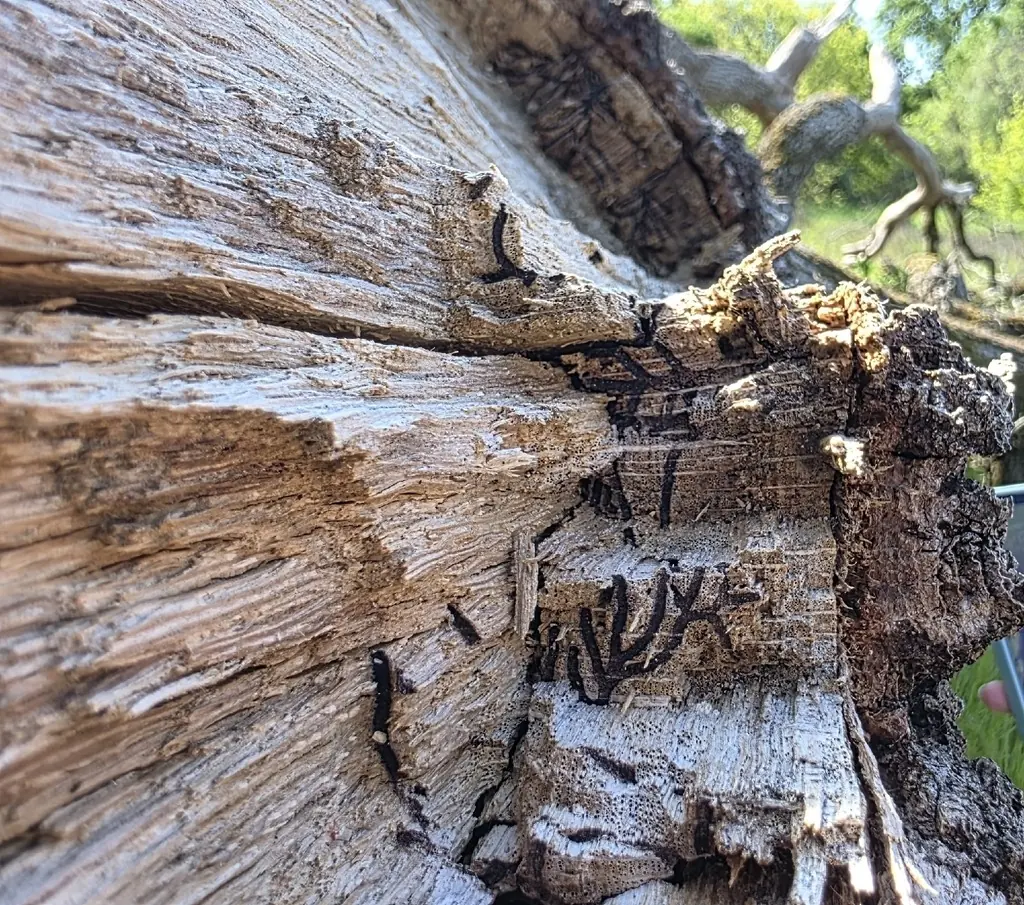
- In cut wood, the tunnels are black-stained, crowded and crisscrossing, fanning out in one plane like a trellis, each about 1.2 to 1.5 mm wide.[2][1]
Look-alikes
| Look-alike | How to tell them apart |
|---|---|
| Native Monarthrum ambrosia beetles | Two native Monarthrum ambrosia beetles also make black-stained tunnels in California oaks, but their tunnels branch from a single point like a palm leaf and do not cross each other. They usually attack trees that are already dead, dying or diseased.[2] |
| Other ambrosia beetles and oak borers | Many native and introduced ambrosia beetles make similar boring dust, stained tunnels and holes in oak, but none is known to cause major crown dieback in an otherwise healthy tree. Look for the sudden death of whole branches together with these signs.[1] |
Where it lives
Native to Europe, western Asia and northern Africa; also introduced to Korea. Its first established population in North America was found in Napa County, California, where it had probably been present for several years. In the United States it is established in central California, in Napa, Sonoma, Lake and Sacramento counties, and has been detected in Multnomah, Clackamas, Washington, Marion, Yamhill and Polk counties in Oregon.[1][5]
Biology and life cycle
Like other ambrosia beetles, it does not eat wood. Females carry fungal spores in pockets on their mandibles and plant them in their tunnels, and the larvae and adults feed on the fungus that grows there.[1][3]
It takes 5 to 8 weeks to go from egg to adult and can have two or more generations a year. In California, mated females spend the winter in their tunnels and come out in late winter or spring as temperatures approach 80°F.[2]
In Xyleborus beetles, females can mate with their brothers before leaving the tree, and an unmated female can lay eggs that develop into males. The flightless males stay in the tunnels and do not build new ones.[3][1]
In California it most often attacks valley oak and, less often, blue oak; in Oregon it has been found only in Oregon white oak. In its native range it also uses other oaks, chestnut and beech.[1][2][3]
Damage and signs
- The fungi it brings in, suspected to include Raffaelea montetyi and Fusarium solani, clog the tree's water-conducting tissue and cause wilting. Attacks start in the crown, kill individual limbs and later move into the trunk and kill the tree.[1][2]
- Unlike most ambrosia beetles, which use dead or dying trees, it has killed mature oaks that seemed healthy. Trees with many tunnels can drop limbs and become a safety hazard.[4][1][2]
- Attacks have been concentrated on mature oaks in urban areas, especially where roads, sidewalks or buildings crowd the roots.[1]
Health risk
The sources describe it only as a tree pest; they mention no harm to people.[1][2]
Control
Prevention
Keep oaks healthy. Avoid wounding exposed roots and the lower trunk, and avoid soil compaction or digging within about twice the crown's diameter. During peak summer heat, one slow, deep watering may help some trees; avoid frequent shallow sprinkler watering.[1]
Keep them out
Do not move firewood. The beetle probably arrived in untreated oak wood such as timber, pallets, crates or firewood; Oregon advises not moving firewood more than 10 miles from where it was cut.[1][2]
Sanitation
The only methods confirmed to kill all beetles in infested wood are to cut infested trees, including the stump, and burn or chip them on site. Oregon advises chipping to 1 inch; California advises chipping as small as possible and burying (under about 8 inches of soil) or burning wood too large to chip.[1][2]
Pesticides
Trunk injections of an insecticide such as emamectin benzoate combined with a fungicide such as propiconazole, and chemical repellents, have not been shown to work against this beetle; testing continues.[1]
When to call a professional
Report suspected infestations: in California to the County Agricultural Commissioner or CDFA, in Oregon to the state invasive species hotline with location, photos and contact details.[2][1]
Common questions
- A whole branch on my oak turned brown in summer. Is it the Mediterranean oak borer?
- It could be, if you are in central California or northwest Oregon. Look for pale boring dust in the bark cracks or at the base, tiny round holes, and black-stained tunnels in fallen branches, and report it. Oaks also lose scattered twigs and leaves to galls, squirrels and other insects, which does not cause sudden dieback of a whole branch.[1]
- Will cutting off the dead branch save the tree?
- Removing an infested branch has not been shown to stop the beetle spreading in the tree. By the time a branch is visibly dead, the beetles have often already reached the trunk.[1]
- What should I do with wood from an infested oak?
- Chip it as small as possible, or bury or burn pieces too large to chip, and do not move it as firewood. Moving infested wood spreads the beetle.[2][1]
Sources
- Oregon Department of Forestry, “Mediterranean oak borer fact sheet (May 2026).” www.oregon.gov/odf/Documents/forestbenefits/fact-sheet-mediterranean-oak-borer.pdf (accessed 2026-11-09)
- University of California Cooperative Extension and CAL FIRE, “Pest Alert: Mediterranean oak borer, Xyleborus monographus (Ewing, Dimson, Nobua-Behrmann, Oliver and Kabashima; updated July 2020).” ccfruitandnuts.ucanr.edu/sites/default/files/2024-09/330538.pdf (accessed 2026-11-09)
- California Department of Food and Agriculture, “California Pest Rating Proposal: Xyleborus monographus (Fabricius), ambrosia beetle (2020).” ccfruitandnuts.ucanr.edu/sites/default/files/2020-03/322738.pdf (accessed 2026-11-09)
- Environmental Entomology (Entomological Society of America), “Xyleborus monographus as an emerging forest pest in North America: a review (Monroe, Rassati and Riggins 2026, Environmental Entomology 55:nvag063), abstract.” pubmed.ncbi.nlm.nih.gov/42397972/ (accessed 2026-11-09)
- Zootaxa, “Establishment of a non-native xyleborine ambrosia beetle, Xyleborus monographus, new to North America in California (Rabaglia et al. 2020, Zootaxa 4786:269-276), abstract.” pubmed.ncbi.nlm.nih.gov/33056488/ (accessed 2026-11-09)
- iNaturalist, “Xyleborus monographus taxon page (order and family).” www.inaturalist.org/taxa/897753 (accessed 2026-11-09)