On this page
How to identify it
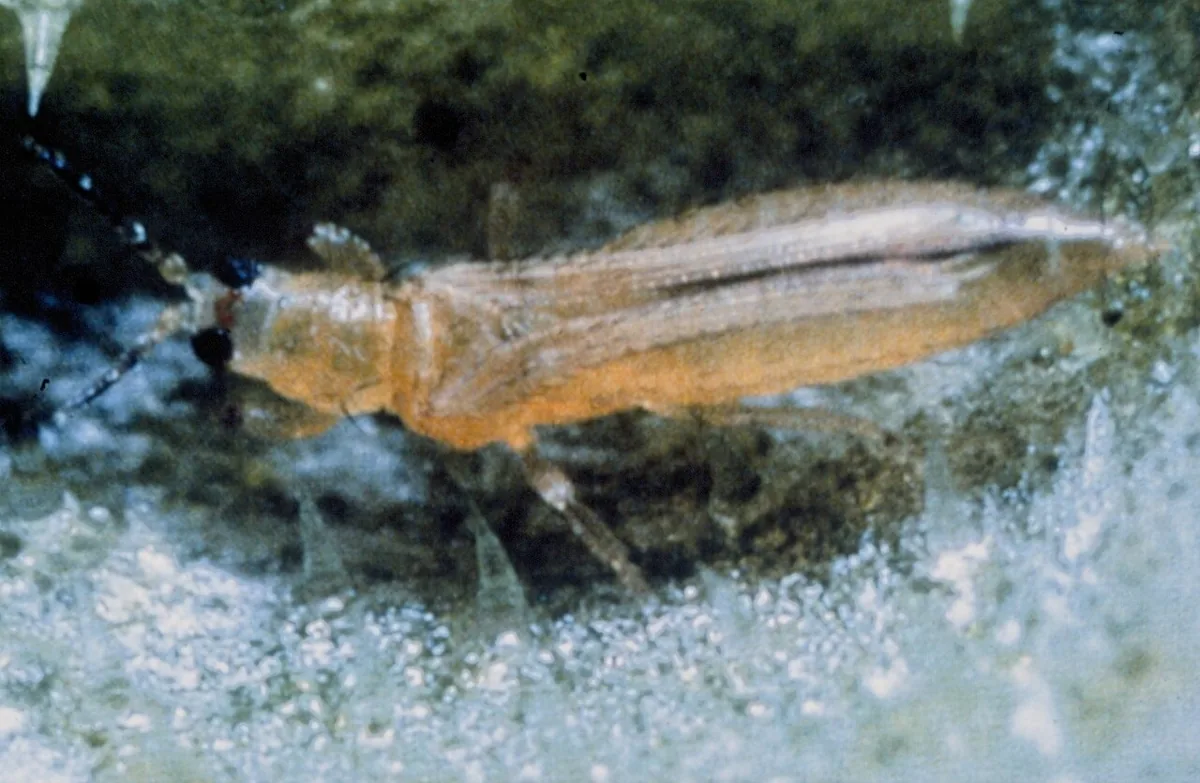
- Adults are 0.8 to 1.0 mm long, pale yellow or whitish, with many dark bristles on the body. Where the folded wings meet, they form a black line down the middle of the back.[1]
- The slender, fringed wings are pale, without bands, and the antennae have seven segments.[1][2]
- Under magnification the simple eyes on top of the head carry red pigment, and the pair of bristles near them sits outside the triangle they form; in onion thrips the simple eyes are grayish.[1]
- Larvae look like small, wingless adults and feed in groups along the midrib and veins, usually on older leaves. Adults tend to gather on young growth.[1]
Look-alikes
| Look-alike | How to tell them apart |
|---|---|
| Onion thrips | Very similar, but its body is yellowish gray to brown rather than yellow, its simple eyes are grayish, and the bristles near them arise inside the triangle the eyes form.[1] |
| Western flower thrips | A Frankliniella species with eight antenna segments instead of seven. It is reported to damage cucumber fruit more than melon thrips does.[1] |
| Asian bean thrips | Shares south Florida bean fields with melon thrips, but it is dark, has banded forewings and eight antenna segments.[2] |
Where it lives
Native to Asia and spread to many Pacific islands, North Africa, Australia, Central and South America and the Caribbean. In the United States it was first found in Hawaii (1982), Puerto Rico (1986) and Florida (1990). As of UF/IFAS's 2000 profile it was a field pest in Florida only south of Orlando, and outdoors it is expected to stay mostly in tropical areas, though it can infest greenhouse crops.[1][2]
Biology and life cycle
Females cut a slit in leaf tissue and lay pale, bean-shaped eggs in it. A female lays up to about 200 eggs, about 50 on average, and both mated and unmated females lay eggs.[1]
Development is fast in heat: a generation takes about 20 days at 30°C (86°F) but about 80 days at 15°C (59°F). Eggs hatch in about 4 to 8 days at 26° to 32°C (79° to 90°F).[1]
After two larval stages the larvae drop to the soil or leaf litter and make a small earthen chamber, where they pass through two non-feeding stages before emerging as adults. Females live about 10 to 30 days and males 7 to 20.[1]
In south Florida, numbers are higher in fall and spring than in summer, and it damages both fall and spring vegetable crops.[1][2]
In south Florida snap bean fields, melon thrips were most numerous in flowers, then leaves, then pods, and they tended to occur in clumps rather than spread evenly.[2]
Damage and signs
- Leaves turn yellow, white or brown, crinkle and die, and heavily infested fields can take on a bronze color. New growth may be discolored, stunted and deformed.[1]
- Fruit can be scarred or deformed, and young fruit may abort. On pepper, a less favored host, the thrips feed in the flowers rather than on the leaves.[1]
- It feeds on many crops but is best known on the squash and nightshade families: bean, cucumber, cantaloupe, melon, watermelon, squash, pumpkin, eggplant, pepper, potato, okra, onion, lettuce, cabbage, pea and cowpea, plus soybean, cotton, tobacco, citrus, mango, avocado, chrysanthemum and hibiscus. Tomato has been reported as a host in the Caribbean but not in the United States.[1]
- It can also spread some strains of tomato spotted wilt virus and bud necrosis virus.[1]
Health risk
UF/IFAS describes melon thrips as a crop pest and plant-virus carrier; it mentions no harm to people.[1]
Control
Prevention
Pepper varieties differ in tolerance: cubanelle and cayenne types still produced good fruit where sweet and jalapeño types were injured.[1]
Keep them out
Fine mesh and row covers keep thrips out of greenhouses and slow their settling on field crops. Organic mulch is thought to interfere with winged thrips colonizing a crop, and plastic mulch is reported to limit population growth.[1]
Traps and physical control
Check foliage for larvae and adults, and use sticky or water-pan traps to follow adults. Blue and white attract thrips, and yellow has also been suggested.[1]
Biological control
Predators matter a great deal. Minute pirate bugs and predatory thrips are important in Hawaii, a parasitic wasp has been introduced to Florida, and the predatory mite Neoseiulus cucumeris and fungi such as Beauveria bassiana also attack it. There are strong signs that some insecticide sprays increase melon thrips numbers and damage.[1]
Pesticides
Foliar sprays often give poor control, partly because the eggs inside leaves and the pupae in the soil are protected. Spraying is usually inadvisable when predators are present. See current UF/IFAS vegetable guides for products.[1]
Common questions
- Is melon thrips found in my state?
- In the United States it has been recorded in Hawaii, Puerto Rico and Florida, where UF/IFAS reported it in 2000 as a field pest only south of Orlando. Outdoors it is expected to stay mostly in tropical areas, but it can infest greenhouse crops.[1]
- Why don't insecticides control melon thrips well?
- The eggs are inside the leaves and the pupae are in the soil, where sprays don't reach. UF/IFAS also warns against spraying when predators are present, since some insecticides seem to make the problem worse.[1]
- How can I tell melon thrips from onion thrips?
- Use a strong lens. Melon thrips is yellow with red-pigmented simple eyes; onion thrips is yellowish gray to brown with grayish simple eyes.[1]
Sources
- University of Florida IFAS Extension (EDIS), “Melon Thrips, Thrips palmi Karny, Featured Creatures EENY-135 (J. L. Capinera, 2000; archival copy).” journals.flvc.org/edis/article/view/108309 (accessed 2026-11-09)
- Insects (MDPI), “Within-Plant and Within-Field Distribution Patterns of Asian Bean Thrips and Melon Thrips in Snap Bean (Adhikari et al. 2023, Insects 14:175).” pmc.ncbi.nlm.nih.gov/articles/PMC9960844/ (accessed 2026-11-09)
- iNaturalist, “Thrips palmi taxon page (order and family).” www.inaturalist.org/taxa/330696 (accessed 2026-11-09)