On this page
How to identify it
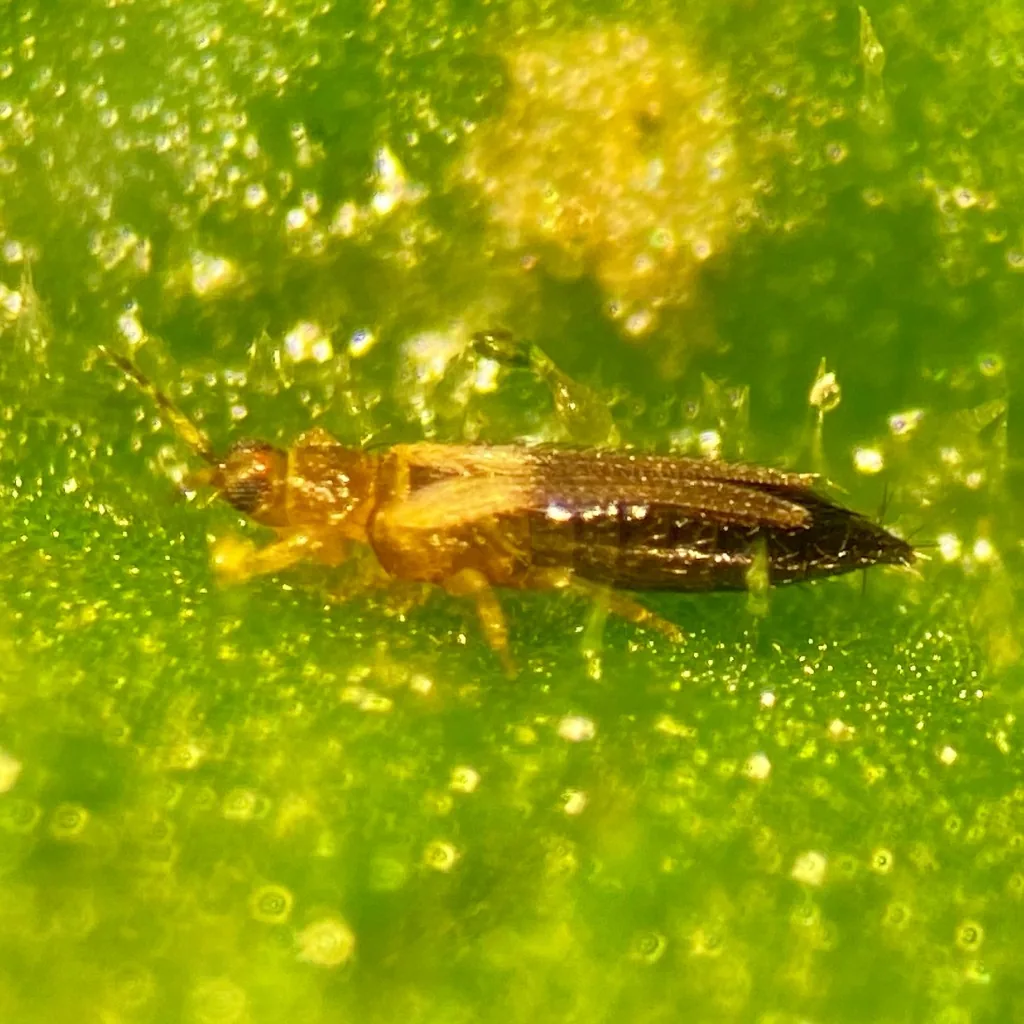
- Adult females are only about 1 mm long (Texas A&M gives 1 to 1.2 mm) and look two-toned to the naked eye: a light brown head and thorax over a much darker, almost black abdomen, with light legs.[1][2][3]
- Females' wings are pale near the base and dark beyond it, matching the body's light-to-dark contrast.[1][2]
- Males are much smaller, about 0.5 to 0.6 mm, slender and yellow. The larvae are pale: translucent white in the first stage and pale yellow in the second.[1][2][3]
Look-alikes
| Look-alike | How to tell them apart |
|---|---|
| Chilli thrips | Male Thrips parvispinus look much like chilli thrips adults, light tan to yellow, but are relatively small; the dark, two-toned females are the easier stage to recognize.[3][1] |
| Western flower thrips | Western flower thrips females are light-colored and about 1.5 mm long; Thrips parvispinus females are dark-bodied and about 1 mm.[3][2] |
| Broad mite damage | The leaf damage can look like broad mite injury, but Thrips parvispinus leaves silvery scars across the foliage, including fully developed leaves, while broad mite damage stays on the new growth where the mites feed.[3][2] |
Where it lives
Native to Southeast Asia and reported across tropical Asia, Africa and Oceania, with greenhouse records in Europe and Canada. In the US it became established in Florida in 2020; it has been confirmed in Georgia and Puerto Rico and reported from Colorado, Michigan, Wisconsin and the Carolinas, several of those finds on gardenias and mandevillas at garden centers and stores. It was found in California retail stores in 2024 (not known to be established there), only intercepted in Ohio and Pennsylvania, found in Dallas, Texas, in 2025, and is reported from Hawaii.[4][1][2][3][5]
Biology and life cycle
The life cycle has six stages: egg, two larval stages, prepupa, pupa and adult. Females insert their eggs one at a time into leaves, petioles, flower bracts, petals and developing fruit, about 15 eggs each.[1][2][3]
Eggs hatch in 4 to 5 days. The larvae feed on young leaves and flowers and do most of the damage. They pupate at least partly in the soil or leaf litter, and the adults return to nearby plants.[1][3][2]
A generation takes about 13 to 14 days on peppers in a greenhouse and can stretch past 30 days below about 70 degrees F. UGA reports 15 to 17 days at 27 degrees C (about 81 degrees F), or more than 20 generations a year.[1][3][2]
Adults and larvae feed mostly on tender new growth in the upper canopy, and adults are common in flowers.[1][2]
Chili peppers seem to be the preferred host. Others include eggplant, cucumber, potato, watermelon, beans and strawberries, and ornamentals such as hibiscus, gardenia, mandevilla, anthurium, hoya, chrysanthemum, gerbera and poinsettia. Counts of hosts vary: Texas A&M gives over 43 plants in 19 families, CDFA over 40 species, and UGA about 100 worldwide.[1][2][4]
Damage and signs
- Feeding leaves light spots on the leaves that turn brown or become silvery scars, and leaves curl, distort and may drop early. Heavily infested leaves can look scorched, and plants are stunted.[2][1]
- On peppers the scarred leaves curl downward and the fruit can be misshapen and scarred. Buds and flowers are discolored and deformed, which cuts vegetable yields and the value of ornamentals.[1][2]
- Egg-laying in flower bracts can leave small round brown spots, most visible on light-colored flowers, and white-flowered varieties are reportedly more susceptible.[3][1]
- The feeding wounds can let in secondary pathogens such as the fungus Cladosporium.[2]
- Fruit scarring is a major problem on papaya in Hawaii and on greenhouse peppers in Spain, and damage also includes flower loss and reduced fruit set.[4]
Health risk
It feeds only on plants; Texas A&M, UGA and UF/IFAS mention no risk to people.[1][2][3]
Control
Prevention
Start with clean plant material, look over new plants closely, especially their new leaves and flowers, and remove infested plants promptly. Growers rooting cuttings should use pest-free mother plants.[1][2]
Sanitation
Remove and destroy infested plant material and weeds that can support the thrips.[2][1]
Traps and physical control
Check by tapping new growth and flowers over white paper or a white clipboard and looking with a 20X hand lens, and open flowers to look for thrips. Yellow, blue or white sticky traps at canopy height help monitor adults.[2][1][3]
Biological control
Predatory mites such as Amblyseius swirskii, Neoseiulus cucumeris, A. andersoni and A. degenerans work best, mainly against the young larvae. Minute pirate bugs, lacewings and lady beetles may help, but their effect on this thrips varies.[2][1]
Pesticides
Insecticidal soaps, mineral or horticultural oils and spinosad have given promising results when applied before numbers build. In one study, 15-second dips of cuttings in the best mineral oil and Beauveria bassiana products dislodged 80 to 100 percent of larvae, and a follow-up dip at transplanting helps catch eggs and larvae.[1][2][7]
Most of the conventional insecticides found effective are labeled for greenhouses and nurseries; in containment tests spinosad and several others gave high mortality, and mineral oil at 3 percent and sesame oil were the best biorational products. Because the thrips reproduces fast and can develop resistance, rotate insecticides with different IRAC modes of action and follow the label.[2][1][8]
When to call a professional
It is a regulated pest. CDFA notes USDA lists it as reportable, and California has given it an "A" rating, meaning it isn't known to be established in the state and finds are subject to state action; CDFA asks that suspect samples go to the county agricultural commissioner. In Texas, AgriLife asks that suspected thrips be preserved in isopropyl alcohol or ethanol and sent to its Dallas Research Center lab; the Dallas find was reported to the Texas Department of Agriculture.[4][1]
Found in stores before it's found outdoors
A year-long survey of retail garden stores in San Diego and Orange counties found it on pepper, dipladenia, mandevilla and gardenia plants, though it had not been officially reported as present in Southern California. The authors say it can reach new areas undetected on nursery stock.[5][1]
CDFA counts such store finds as interceptions: a pest isn't considered established in California until an official sample is collected from the environment there.[4]
Where sources disagree
Virus spread: UF/IFAS says it is not reported to transmit any viruses. CDFA cites a 1996 study showing it can transmit the Ageratum strain of tobacco streak virus, and a 2025 Indian study found adults transmitted groundnut bud necrosis virus to tomato and cowpea, the first experimental evidence for that virus.[3][4][6]
Generation time: Texas A&M gives about 13 to 14 days on greenhouse peppers, UGA 15 to 17 days at 27°C (about 81°F), and CDFA 14 to 29 days across 26°C down to 18°C.[1][2][4]
Common questions
- My gardenia or mandevilla has silvery, curled new leaves. Is it this thrips?
- It could be, or broad mites. Tap the shoots over white paper and look for tiny two-toned thrips with a hand lens; thrips scars also show on fully developed leaves, while broad mite damage stays on new growth.[2][3][1]
- How does it get into new areas?
- Most likely on ornamental plants. Detections in Colorado, Georgia and the Carolinas came from gardenias and mandevillas at garden centers and stores, and the Colorado plants had come from South Florida.[3][1]
- Does Thrips parvispinus spread plant viruses?
- Possibly. UF/IFAS says it is not reported to transmit any viruses, but CDFA cites lab evidence for tobacco streak virus and a 2025 study from India showed it can spread groundnut bud necrosis virus to tomato.[3][4][6]
Sources
- Texas A&M AgriLife Extension Service, “Short-spined Thrips: A New Pest Alert.” agrilifeextension.tamu.edu/library/short-spined-thrips/ (accessed 2026-11-11)
- University of Georgia Cooperative Extension, “Thrips parvispinus Identification, Damage, and Management, Circular 1356 (N. Kaur, S. V. Joseph, E. Schoeller and P. Yu, October 7, 2025).” fieldreport.caes.uga.edu/publications/C1356/thrips-parvispinus-identification-damage-and-management/ (accessed 2026-11-11)
- University of Florida IFAS, Mid-Florida Research and Education Center, “Thrips parvispinus (Karny), an emerging invasive and regulated pest in the United States (M. Z. Ahmed, A. Revynthi, C. L. McKenzie and L. S. Osborne, updated March 12, 2024).” mrec.ifas.ufl.edu/lsolab/thrips/thrips-parvispinus/ (accessed 2026-11-11)
- California Department of Food and Agriculture, “California Pest Rating Profile: Thrips parvispinus (Karny), Pest Rating A (2025).” blogs.cdfa.ca.gov/Section3162/?p=14094 (accessed 2026-11-11)
- Journal of Insect Science, via PubMed, “Detecting Thrips parvispinus in retail plant stores in Southern California (2026).” pubmed.ncbi.nlm.nih.gov/42714251/ (accessed 2026-11-11)
- 3 Biotech, via PubMed, “First record of the transmission of groundnut bud necrosis virus (GBNV) in tomato by Southeast Asian thrips, Thrips parvispinus (2025).” pubmed.ncbi.nlm.nih.gov/41280478/ (accessed 2026-11-11)
- Journal of Economic Entomology, via PubMed, “Potential of dip treatments to disinfest cuttings of the invasive Thrips parvispinus (2025).” pubmed.ncbi.nlm.nih.gov/39879645/ (accessed 2026-11-11)
- Insects, via PubMed, “Efficacy of Conventional and Biorational Insecticides against the Invasive Pest Thrips parvispinus under Containment Conditions (Ataide et al. 2024).” pubmed.ncbi.nlm.nih.gov/38249054/ (accessed 2026-11-11)
- iNaturalist, “Thrips parvispinus taxon page (order and family).” www.inaturalist.org/taxa/1660251 (accessed 2026-11-11)