On this page
How to identify it
- The sign is a resinous blister on a current-year shoot of a branch or, sometimes, the leader. Pitch nodule moths as a group leave a round, dirty lump of pitch and frass at the point of attack, usually at a node or branch whorl, and the caterpillar pupates inside it.[1][2]
- Each caterpillar excavates only one feeding site, mining lengthwise within the twig or stem beneath its blister.[1]
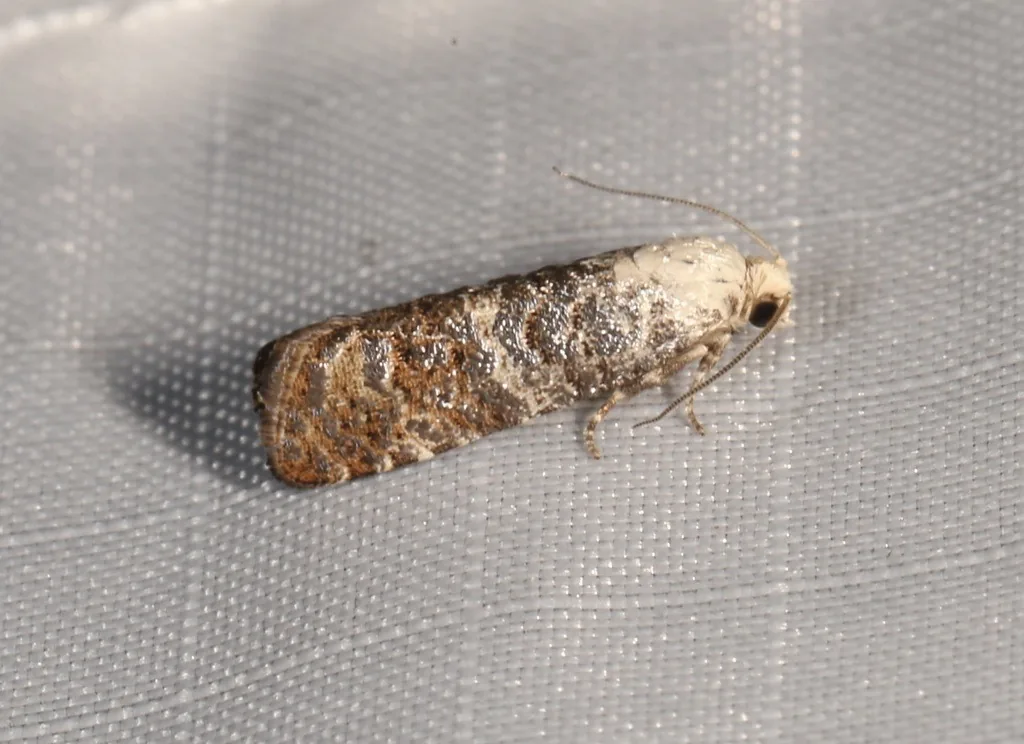
- The moths are small, mottled and metallic gray, with a wingspan of 14 to 21 mm, and are in the field in June and July. The USDA manual describes the group as speckled with brown, yellow or gray and spanning about 15 to 25 mm.[1][2]
Look-alikes
| Look-alike | How to tell them apart |
|---|---|
| Northern pitch twig moth | The northern pitch twig moth (Retinia albicapitana) is the other Petrova on lodgepole pine. Its feeding is mostly in the sapwood of the main stem, marked by a pitch mass at the base of a branch, and it has a two-year cycle in Manitoba and Saskatchewan. The metallic pitch blister moth works in current-year shoots of branches and leaders, and Natural Resources Canada says its primary hosts are ponderosa and lodgepole pines at higher elevations.[2][1] |
| Pine tip moths | Pine tip moths (Rhyacionia) damage young pines by mining in the buds and shoots, whereas the USDA manual says pitch nodule moths do not attack the buds but bore into stems, twigs and branches and leave the characteristic pitch nodule.[2] |
| Pitch moths | The sequoia pitch moth is a clearwing moth whose larvae bore in the cambium region of pines and Douglas-fir, causing masses of pitch to form; the pitch blister moth is a small tortricid whose single feeding site is in a current-year shoot under a resin blister.[2][1] |
Where it lives
It is widely distributed in western North America, from Minnesota, Colorado and California in the south, north throughout British Columbia and western Alberta to southern Yukon, and in the Cypress Hills of southwestern Saskatchewan. The USDA manual records it in British Columbia, Alberta, Montana and California. It seems to occur at higher elevations, at least 800 m above sea level.[1][2]
Biology and life cycle
The primary hosts are ponderosa and lodgepole pines, which the USDA manual also lists; jack, red, mugho and Scots pines are on the Canadian host list, with limber and shore pines as secondary hosts.[1][2]
Young caterpillars begin feeding on current-year shoots of branches and sometimes on leaders. Each excavates a single feeding site, covers it with a resinous blister for the whole of its development, and mines lengthwise within the twig or stem, frequently killing or injuring buds and some first-year cones.[1]
The moths fly in June and July. The life cycle is not fully understood but appears to take two years in the northern part of the range in Alberta and Saskatchewan and one year in the south; moths are present every year.[1]
Plantations of a single host pine species commonly support high population levels, and attack has been related to tree size in a ponderosa pine plantation.[1]
Several insect parasitoids attack the two Petrova species, but together they usually kill less than 10 percent of larvae and pupae. Birds such as chickadees may take larvae, pupae and adults; hail may harm larvae, and wind or cool rainy weather may affect moth flight and egg laying.[1]
Damage and signs
- Injury may result in dead terminals, crooked or multiple leaders, reduced height and a poorer crown form on shelterbelt trees. The USDA manual says pitch nodule moths seldom if ever girdle a tree, but a stem may be so weakened that the top breaks in wind or snow.[1][2]
- The moth attacks young to mature trees, but most reported injury is on pines 0.5 to 5 metres tall in natural stands, plantations, seed orchards, nurseries and planted shelterbelt and ornamental trees. As a group the pitch nodule moths are minor pests of young trees.[1][2]
Health risk
The sources treat it only as a pine pest and mention no effect on people.[1][2]
Control
Prevention
Mixed plantings are safer than blocks of a single host pine: Natural Resources Canada notes that plantations of one host species commonly support high population levels.[1]
Traps and physical control
On a yard or shelterbelt pine, look for resin blisters on current-year shoots and leaders; the caterpillar feeds and pupates under the blister, so pruning out a blistered shoot removes it.[1][2]
Biological control
Parasitoids, birds such as chickadees, and weather all take a toll, though parasitoids alone usually kill under 10 percent of larvae and pupae.[1]
Common questions
- What makes a blister of resin on the new shoots of my ponderosa pine?
- A single caterpillar of the metallic pitch blister moth mines inside the shoot under a resinous blister it builds over its feeding site. Pitch nodule moths leave a round, dirty lump of pitch and frass at the point of attack.[1][2]
- Will it kill the tree?
- Rarely; the sources describe dead terminals, crooked or multiple leaders and height loss on young pines rather than tree death, and the USDA manual says these moths seldom girdle a tree.[1][2]
- How long is its life cycle?
- It appears to be two years in the north, in Alberta and Saskatchewan, and one year farther south. Moths fly in June and July every year.[1]
Sources
- Natural Resources Canada, Canadian Forest Service, “Metallic pitch blister moth (Petrova metallica), Trees, insects and diseases of Canada's forests.” tidcf.nrcan.gc.ca/en/insects/factsheet/11157 (accessed 2026-11-10)
- USDA Forest Service, “Western Forest Insects, Miscellaneous Publication 1339 (R. L. Furniss and V. M. Carolin, November 1977; scanned copy).” archive.org/details/CAT78702369 (accessed 2026-11-10)
- iNaturalist, “Retinia metallica taxon page (order and family).” www.inaturalist.org/taxa/48464 (accessed 2026-11-10)