On this page
How to identify it
- The telltale sign is a pitch nodule: a blister of resin, silk and frass on a shoot or, in the second year, on the main stem at the base of a branch whorl. The second-year blister is brown and up to 2 cm long; the USDA manual describes pitch masses up to about 1.5 inches across, generally at an internode or fork.[1][2][3]
- Each blister covers a single caterpillar in a cavity chewed into the bark. The grown caterpillar is 15 to 17 mm long, yellow to orange-brown, with a reddish-brown head and thoracic shield and sparse short hairs rising from dark spots.[1][2]
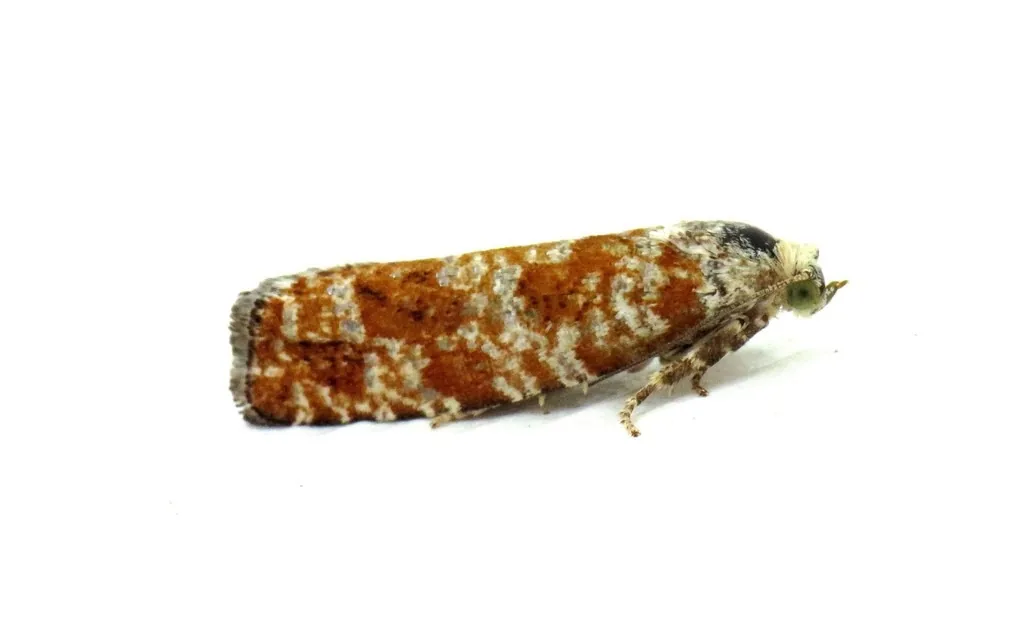
- The moth is small and mottled rusty brown, with grayish patches on the forewings and a wingspan of about 14 to 23 mm.[1][2]
- The pupa is spindle-shaped, dark brown and 10 to 13 mm long, and is found inside the blister from mid-May.[1]
Look-alikes
| Look-alike | How to tell them apart |
|---|---|
| Pinyon pitch nodule moth | A subspecies, Petrova albicapitana arizonensis, is the pinyon pitch nodule moth of the Southwest. It was epidemic on pinyon in Utah in 1964 and 1965, cutting the nut crop and ruining trees for Christmas trees.[3] |
| Zimmerman pine moth | Zimmerman pine moth (Dioryctria zimmermani) caterpillars also feed under pitch masses on pine trunks and limbs, but in the northern states they work in the cambium and outer wood under the bark of larger limbs and trunks rather than making a nodule on a young shoot.[2] |
Where it lives
It occurs wherever jack pine grows naturally, in Canada from Nova Scotia to interior British Columbia and probably into the southern Northwest Territories, and in the United States south to Montana and the Lake States.[1][2]
Biology and life cycle
Hosts are pines: jack pine, lodgepole pine and Scots pine. Lodgepole pine planted outside its natural range may be more susceptible than jack or Scots pine.[1][2][3]
Moths fly in June and July. In July the female lays cream to yellow eggs, about 0.5 mm long, singly near terminal buds at the base of needle sheaths. They hatch after several weeks.[1]
The young caterpillar chews a small circular cavity in the bark near the tip of a current-year shoot and covers it with a resin bubble, where it spends its first winter. In spring it enlarges the cavity and blister, then in early summer moves down the branch to the main stem, usually at a branch whorl, and makes a second, brown blister up to 2 cm long for its second summer.[1]
After a second winter the caterpillar feeds briefly and pupates inside the blister, beginning after mid-May. The life cycle takes two years in the Prairie Provinces, Manitoba and Saskatchewan, but two unsynchronized populations mean moths are present every year.[1][2][3]
Several parasitic insects attack it but usually kill less than 10 percent of larvae and pupae. Chickadees and other birds take larvae, pupae and moths, and hail, wind and cool rainy weather also work against it.[1]
Damage and signs
- Pines 0.5 to 5 m tall (about 1.5 to 16 feet) take most of the injury; the USDA manual says trees 1 to 5 feet tall are most heavily infested, smaller ones are not attacked, and taller trees are rarely injured although signs appear on trees up to 30 feet.[1][2]
- First-year feeding on a shoot does little harm, though it sometimes girdles or breaks the shoot. The second-year caterpillar feeds deeper into bark and wood at the stem, and can weaken or kill the terminal leader. Partly girdled stems are prone to break in high wind and wet snow for up to five years afterward.[1][2]
- Broken leaders leave weakened, crooked or multiple stems and sometimes reduce height growth. Stem deformities are usually worst on jack pine. In the upper third of the crown, up to a third of the shoots may be killed in a single year, and in 8- to 12-year-old lodgepole pine stands 60 to 70 percent of trees may be attacked in the same year.[1][2]
- Damage can be severe in jack, Scots and lodgepole pine plantations. Plantations of a single pine species, seed orchards and shelterbelts tend to support high populations, while mixed plantings with non-host trees and dense, closed-crown stands discourage it.[2][1]
Health risk
The forest sources treat it only as a pest of pine stems and report no risk to people.[1][2][3]
Control
Prevention
Check pines brought in from an infested area for blisters with larvae before planting. Mixing pines with non-host trees keeps populations low; single-species plantings, seed orchards and shelterbelts favor the moth. Areas planted within a one- or two-year period suffer much less than areas planted in small blocks over several years.[1][2]
Traps and physical control
On ornamentals and other high-value trees, remove each blister by hand along with the single caterpillar under it. Natural Resources Canada calls this effective, and economical while trees are small.[1]
Biological control
Pheromone-baited traps can monitor flight periods and abundance, and in small isolated infestations, such as a seed orchard or plantation, trapping males can disrupt mating. Some jack pines show natural resistance, so resistant trees might be selected for planting.[1]
Common questions
- What is the lump of pitch at the base of a branch on my young pine?
- A nodule of resin mixed with silk and frass at a branch whorl on a small jack, lodgepole or Scots pine is the work of the northern pitch twig moth. One caterpillar lives in a cavity in the bark under each blister for about two years.[1][2]
- Will it kill the tree?
- It usually does not kill the tree. The second-year caterpillar can girdle and kill the leader or weaken it so it snaps in wind or wet snow, leaving a crooked or forked stem.[1][2]
- How do I get rid of it on a few landscape pines?
- Pick off each blister with the caterpillar inside. For a few small trees that is the control Natural Resources Canada recommends.[1]
Sources
- Natural Resources Canada, Canadian Forest Service, “Northern pitch twig moth (Petrova albicapitana), Trees, insects and diseases of Canada's forests.” tidcf.nrcan.gc.ca/en/insects/factsheet/11152 (accessed 2026-11-10)
- USDA Forest Service, “Eastern Forest Insects, Miscellaneous Publication 1175 (W. L. Baker, 1972; scanned copy).” archive.org/details/easternforestins1175bake (accessed 2026-11-10)
- USDA Forest Service, “Western Forest Insects, Miscellaneous Publication 1339 (R. L. Furniss and V. M. Carolin, November 1977; scanned copy).” archive.org/details/CAT78702369 (accessed 2026-11-10)
- iNaturalist, “Retinia albicapitana taxon page (order and family).” www.inaturalist.org/taxa/50275 (accessed 2026-11-10)