On this page
How to identify it
- A nodule of resin and frass on the upper surface of a current-year twig, averaging 7/8 inch long (1/2 to 1 1/4 inches), dark red-orange on pitch pine and a lighter orange on Scotch pine; winter weathering bleaches the color. Brown, dislodged needles help flag infested twigs.[1][2]
- The caterpillar tunnels into the pith of the twig, 3 or 4 inches downward, and overwinters there with its head toward the lower end of the tunnel; at emergence the pupa pushes halfway out of the nodule and the empty pupal skin is left behind.[1][2]
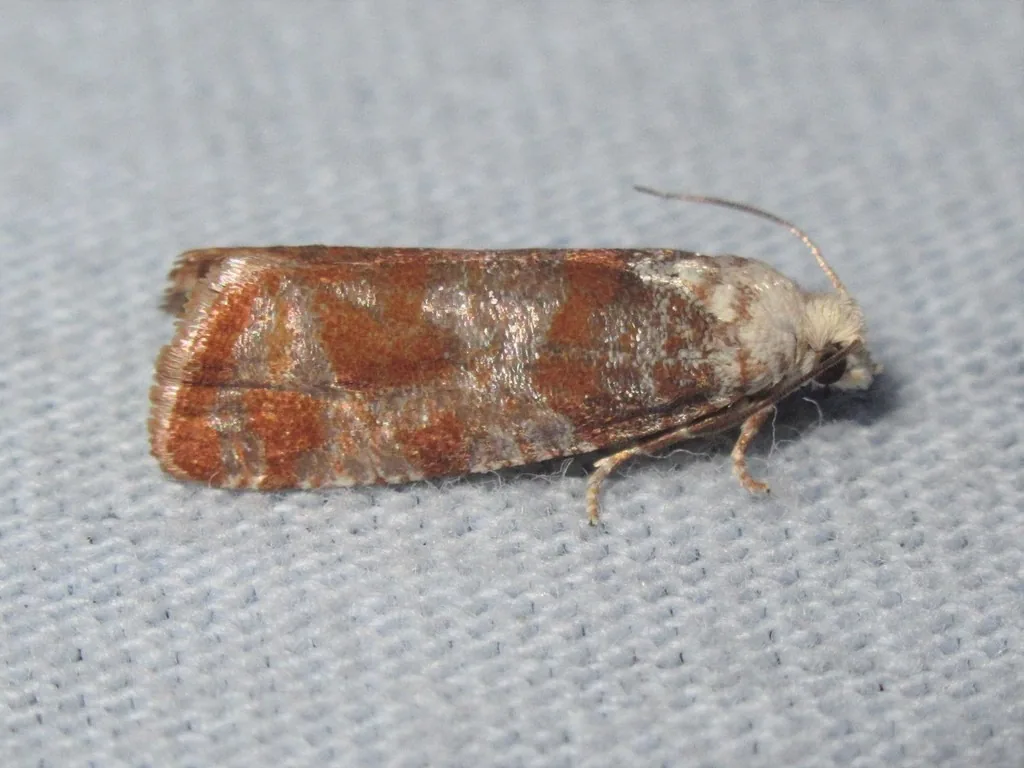
- The adult is reddish-brown mottled with gray, with a wingspread of 14 to 20 mm.[2]
Look-alikes
| Look-alike | How to tell them apart |
|---|---|
| Northern pitch twig moth | A close relative in the same genus that UMass says is easily confused with this species, but it is known from lodgepole and jack pines, while the pitch twig moth works pitch and Scotch pine twigs of the current year.[1] |
| Zimmerman pine moth | A larger gray moth (wingspread 25 to 37 mm) whose larvae feed under the bark of pine limbs and trunks in the North and lay eggs on resin masses and bark crevices; the pitch twig moth confines itself to small nodules on current-year twigs.[2][1] |
Where it lives
Maine to North Carolina and west into the Central States, on the hard pines; pitch pine is the preferred host in the Midwest and in Massachusetts, with Scotch pine also attacked, red pine only occasionally and lightly when growing near infested pitch pine, and rare single records from other pines. A 1943 study put the flight period on Nantucket and Martha's Vineyard at about June 19 to July 22.[2][1]
Biology and life cycle
Moths fly in May and June, laying tiny, circular yellow eggs on the twigs. In Ohio, caterpillars were present by June and fed at the bases of the needles for one to two weeks before boring into the twig.[1][2]
After about a month in the twig the caterpillar moves into the pith and tunnels downward; resin leaking from the feeding sites mixes with frass and silk to form the nodule, which the caterpillar enlarges with its mouthparts. There may be at least five instars.[1][2]
Partly grown caterpillars overwinter head-down in the pith tunnel under the pitch mass, resume feeding by early April in Ohio, cut an exit tunnel and pupate inside the nodule for four to five weeks from the end of April; adults appear by May.[1][2]
There is one generation a year. UMass notes a history of confusion over a possible second generation, which may occur in the unstudied southern part of the range.[1][2]
Damage and signs
- Infested twigs may be partly or completely girdled and are more prone to breakage; damaged twigs break off and deform the tree. Twigs that survive often take three to four years to resume normal growth. Twigs under 1/8 inch in diameter are not attacked.[1][2]
- Host trees are typically not killed, but at high populations the loss of current-season twigs can be economically important, and nursery stock has historically been affected. In forests nodules are rarely found below 4 feet, while on ornamental trees they occur at any height.[1]
Health risk
Neither source mentions any effect on people; this is a pest of pine twigs.[1][2]
Control
Prevention
Keep pines vigorous and plant them on suitable sites: vigorously growing twigs are less susceptible and can survive up to three caterpillars. Watch for young larvae at the needle bases by mid-June and for nodules on the current season's twigs afterward.[1]
Traps and physical control
Prune out and destroy infested twigs showing pitch nodules in the terminals.[1]
Biological control
The braconid wasp Agathis pini has been a major control factor; it was a significant mortality factor in forest stands in the Ohio study but was absent from ornamental sites. Hyssopus thymus kills up to 7 percent of caterpillars by late summer, and Calliephialtes comstockii and Glypta varipes are also recorded parasitoids.[1][2]
Pesticides
UMass lists acephate, bifenthrin (against larvae), chlorantraniliprole, cyantraniliprole, emamectin benzoate and permethrin as active ingredients labeled in Massachusetts; apply after bloom to protect pollinators.[1]
Common questions
- What is the orange blob on the tip of my pitch pine twig?
- A pitch twig moth nodule: resin that leaked from the caterpillar's feeding, mixed with frass, on the upper side of a current-year twig, usually about 7/8 inch long.[1]
- Will it kill the tree?
- Typically not. The twig may girdle and break off, deforming the tree, but the sources describe the trees themselves as not killed.[1][2]
- How is it different from the northern pitch twig moth?
- The two are easily confused, but the northern pitch twig moth is known from lodgepole and jack pines, while this species attacks the current year's twigs of pitch and Scotch pine.[1]
Sources
- UMass Extension Landscape, Nursery and Urban Forestry Program, University of Massachusetts Amherst, “Petrova (formerly Retinia) comstockiana, Pitch Twig Moth, Insect & Mite Guide (Professional Guide for IPM in Trees and Shrubs).” www.umass.edu/agriculture-food-environment/landscape/publications-resources/insect-mite-guide/petrova-formerly-retinia-comstockiana (accessed 2026-11-10)
- USDA Forest Service, “Eastern Forest Insects, Miscellaneous Publication 1175 (W. L. Baker, 1972; scanned copy).” archive.org/details/easternforestins1175bake (accessed 2026-11-10)
- iNaturalist, “Retinia comstockiana taxon page (order and family).” www.inaturalist.org/taxa/50274 (accessed 2026-11-10)