On this page
How to identify it
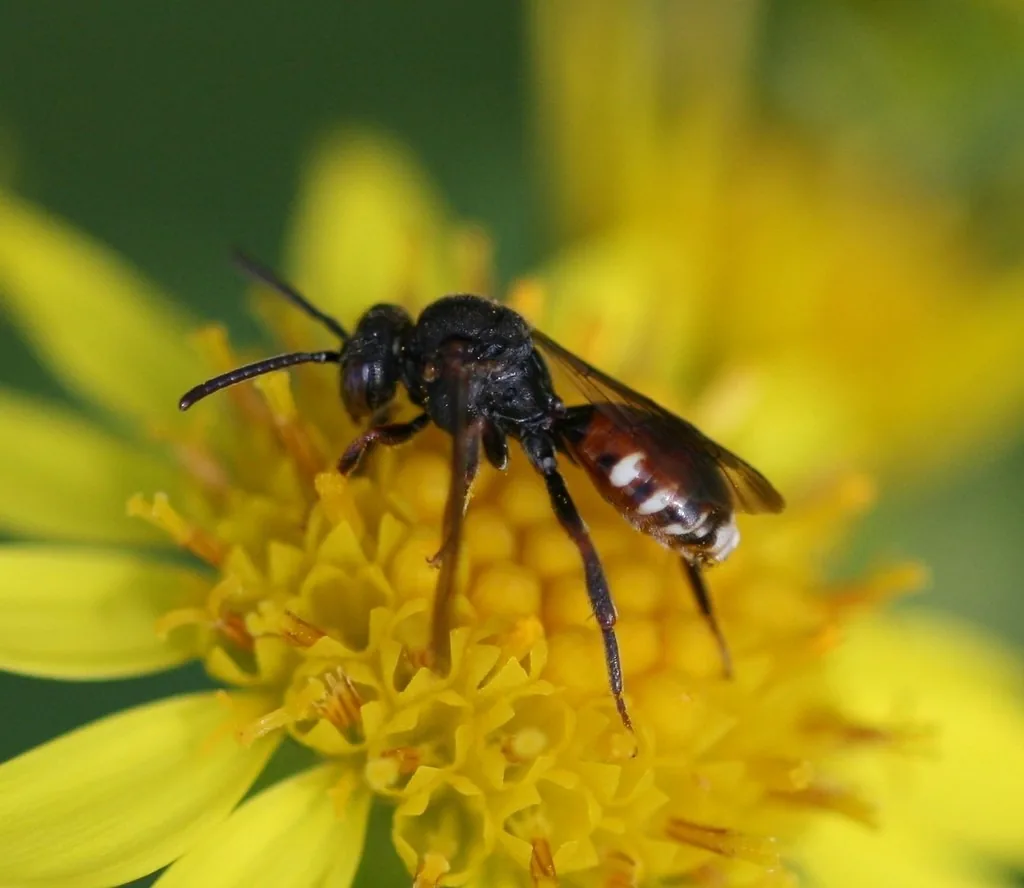
- Small to medium bees, about one-quarter to one-half inch long, slender and wasp-like.[2][1]
- Usually red or yellow, sometimes with whitish markings.[1]
- The body is nearly hairless, and the hind legs and abdomen lack the pollen-carrying hairs (scopa) of pollen-collecting bees, so a nomad bee is never dusted with pollen.[1][2]
- Watch for them flying low over bare ground in spring, or hovering near the nest entrances of other bees.[1][2]
- They do visit flowers, apple blossoms among them, but only to drink nectar.[1][5][6]
Look-alikes
| Look-alike | How to tell them apart |
|---|---|
| Mining bees (hosts) | Andrena mining bees have pale hairs on the thorax and a hairy face, carry pollen home, and dig their own ground nests, which show as small holes in cone-shaped piles of soil, often in large groups on loose, sunny ground. Nomad bees are nearly hairless, carry no pollen and dig no nests.[2][5][1] |
| Yellow-faced bees | Also small, slender, nearly hairless and wasp-like, but black with small bright yellow markings on the face, thorax and legs. They nest in existing tunnels in wood, stems or twigs and feed their own young with pollen carried in the crop.[7][1] |
| Longhorn-cuckoo and cellophane-cuckoo bees | Triepeolus and Epeolus are other cuckoo bees in the same family. Bee Basics shows a Triepeolus waiting at the unguarded nest of a Melissodes digger bee, while many Nomada target mining bees.[3][1] |
| Small wasps | Nomad bees look wasp-like, but they drink nectar at flowers and lay their eggs in bee nests instead of hunting prey.[1][2] |
Where it lives
Nomada is the largest genus of cuckoo bees, with nearly 800 species on every continent except Antarctica; a 2022 genetic study traced its origin to the northern continents about 65 million years ago. In the U.S. it is among the common native bees of Utah, and Missouri's conservation department lists its apid bees, the family that includes nomad bees, statewide. GBIF's public U.S. records since 1990 for the genus (about 25,700) come from 47 states on the map, most from Maryland, Oregon and Washington.[8][2][3][11]
Biology and life cycle
The Nomadinae, the subfamily that includes Nomada, is made up entirely of parasitic bees. Because they do not provision their own young, nomad bees have lost the adaptations that carry pollen.[1]
Many parasitize nests of bees in the family Andrenidae (mining bees). In early spring the females fly low over bare ground searching for host nests; once a female locates one, she waits nearby for a chance to sneak in and lay an egg while the host is away.[1][2]
Sources describe what happens next in different ways. Missouri says the egg is laid on the wall of a host cell and the cuckoo larva hatches first and eats the pollen and nectar meant for the host's larva; Bee Basics says the cuckoo larva kills and eats the host larva as well as the food; and Penn State says the female cuckoo eats the host's egg before laying her own.[3][1][5]
Host ranges differ by scale. Missouri says each kind of cuckoo bee is usually limited to certain host bees, and a classic study of European pairs found that many Nomada species attack a single Andrena species, with male Nomada carrying the same scent compounds as the female host bees. Across the whole genus, though, a 2022 study counts at least ten host genera from five bee families.[3][10][9]
In Utah they are active from April to August, with peak activity in April and May. In the Northeast, Penn State says cuckoo bees appear a few weeks after the mining and cellophane bees they parasitize emerge.[2][5]
Damage and signs
Health risk
None of the sources report nomad bees stinging people. As in all bees, only females have a stinger, and Penn State notes that solitary spring bees will not try to sting unless they are handled or stepped on.[1][5][2][3]
Control
Prevention
No control is needed or appropriate. Nomad bees are native cuckoo bees of other native bees, visit flowers only for nectar, and build no nests of their own.[1][3][6]
Common questions
- Is this red wasp-like insect hovering over my lawn a wasp?
- In spring, a slender red or yellow, nearly hairless insect flying low over bare ground is likely a nomad bee searching for mining bee nests to parasitize. It is a bee, not a wasp.[1][2][5]
- Why doesn't it collect pollen?
- Nomad bees lay their eggs in other bees' nests, where their young eat the host's stored food, so they have lost the pollen-carrying hairs that other bees use.[1][2]
- Will nomad bees wipe out the mining bees in my yard?
- The sources describe them as natural cleptoparasites of particular host bees and a normal part of a native bee community, and none recommends any action.[3][1]
- Do nomad bees sting?
- None of the sources report stings to people. Only female bees have a stinger, and solitary bees generally sting only if handled or stepped on.[1][5]
Sources
- USDA Forest Service and Pollinator Partnership, “Bee Basics: An Introduction to Our Native Bees (Beatriz Moisset and Stephen Buchmann).” www.fs.usda.gov/wildflowers/pollinators/documents/BeeBasics.pdf (accessed 2026-11-11)
- Utah State University Extension, “Beginner's Guide to Common Native Bees (May 2021).” extension.usu.edu/planthealth/research/beginners-guide-to-common-native-bees.php (accessed 2026-11-11)
- Missouri Department of Conservation, “Apid Bees (Field Guide).” mdc.mo.gov/discover-nature/field-guide/apid-bees (accessed 2026-11-11)
- iNaturalist, “Nomada taxon page (order and family).” www.inaturalist.org/taxa/53648 (accessed 2026-11-11)
- Penn State Extension, “Spring Bees: Who Are They and Where Do They Live?.” extension.psu.edu/spring-bees-who-are-they-and-where-do-they-live (accessed 2026-11-11)
- Penn State Extension, “Bees in Pennsylvania: Diversity, Ecology, and Importance.” extension.psu.edu/bees-in-pennsylvania-diversity-ecology-and-importance (accessed 2026-11-11)
- Washington State University Extension, “Colletidae: Polyester and Yellow-Faced Bees (Hortsense).” hortsense.cahnrs.wsu.edu/fact-sheet/colletidae-polyester-and-yellow-faced-bees/ (accessed 2026-11-11)
- Molecular Phylogenetics and Evolution, via PubMed, “Phylogenomics and historical biogeography of the cleptoparasitic bee genus Nomada (Odanaka et al. 2022).” pubmed.ncbi.nlm.nih.gov/35341964/ (accessed 2026-11-11). Cited from the PubMed abstract.
- Scientific Reports, via PubMed, “Harrison's rule corroborated for the body size of cleptoparasitic cuckoo bees (Nomadinae) and their hosts (Lim et al. 2022).” pubmed.ncbi.nlm.nih.gov/35768474/ (accessed 2026-11-11). Cited from the PubMed abstract.
- Science, via PubMed, “Cleptoparasitism and odor mimetism in bees: do Nomada males imitate the odor of Andrena females? (Tengo and Bergstrom 1977).” pubmed.ncbi.nlm.nih.gov/17778551/ (accessed 2026-11-11). Cited from the PubMed abstract.
- Global Biodiversity Information Facility (GBIF), “Nomada: occurrence records in the U.S., 1990-2026 (GBIF occurrence search).” api.gbif.org/v1/occurrence/search?taxonKey=1343230&country=US&hasGeospatialIssue=false&occurrenceStatus=PRESENT&year=1990%2C2026&facet=stateProvince&facetLimit=400&limit=0 (accessed 2026-11-11). State counts are records reported (iNaturalist research-grade, museum specimens, surveys), not abundance.