On this page
How to identify it
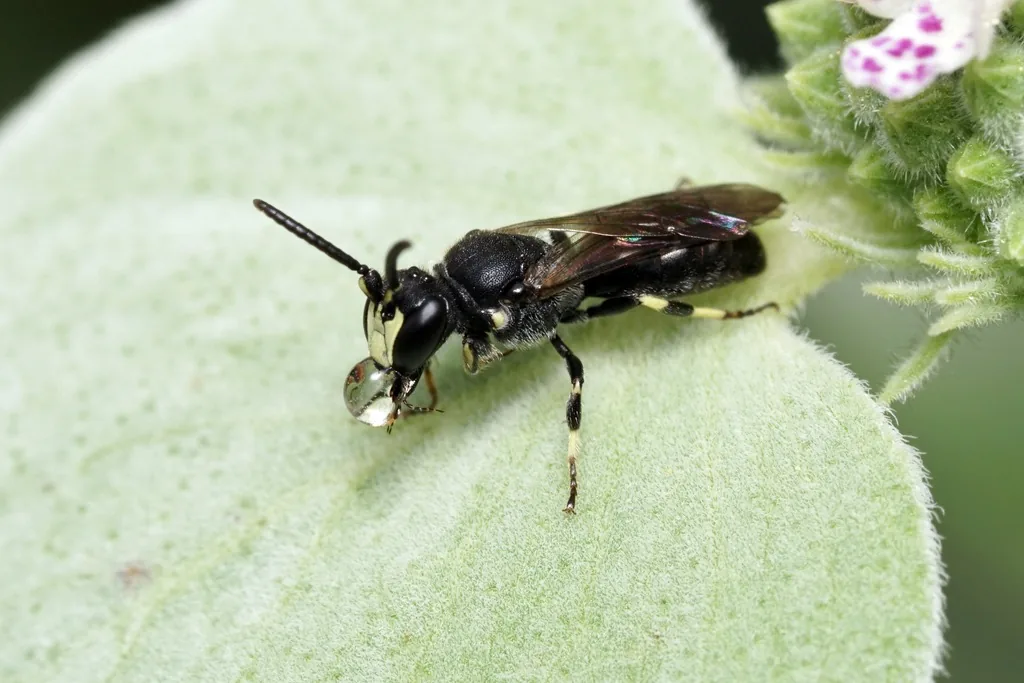
- Small (0.2 to 0.3 inch), slender and hairless, so they resemble wasps more than bees.[1][2]
- Black with small, bright yellow marks on the face, thorax and legs; the yellow face marks give the group its name, and the Forest Service calls them yellow-masked bees.[1][2]
- No pollen-collecting hairs or baskets on the legs, so a foraging female never looks dusted with pollen the way most bees do; she carries pollen inside her crop.[1][2]
- You'll see them at flowers and around hollow or pithy stems, twigs and old tunnels in wood where they nest.[1][2][3]
Look-alikes
| Look-alike | How to tell them apart |
|---|---|
| Cellophane (polyester) bees | Colletes are in the same family but are larger (0.3 to 0.6 inch) and hairy, with pale abdominal stripes and a heart-shaped face; they are often seen with loads of pollen on the hind legs and nest in soil, sometimes in big aggregations.[1] |
| Small carpenter bees | Ceratina are also small, dark stem nesters, no more than 3/8 inch, but they are black with metallic blue or blue-green highlights (some also have pale face marks), and the female bores her own tunnel down into the pith of a broken stem rather than using an existing hole.[4][2] |
| Small wasps | Yellow-faced bees look like wasps because they lack the dense hair of most bees, but the females feed their young on pollen and nectar carried in the crop.[1][2] |
Where it lives
Colletidae, the family that includes yellow-faced bees, is one of five common bee families found across North America from Canada and Alaska to Florida and Mexico, and Hawaii has its own endemic Hylaeus species. GBIF holds about 50,000 US records of Hylaeus since 1990 from 46 states, counting the District of Columbia, most from Utah, California and Colorado.[2][6][7]
Biology and life cycle
Yellow-faced bees are solitary. Each female builds and stocks her own nest, usually in an existing tunnel in wood, a hollow or pithy stem or a twig, though many nests may be clustered close together.[1][2]
The female lines the nest with a silk-like, cellophane-like secretion from glands in her body that waterproofs the cells; this lining is why members of the family are sometimes called cellophane bees.[1][2]
Lacking pollen baskets, the female stores nectar and pollen in her crop and regurgitates the mixture into each cell, which gets all the food one larva needs.[1][2]
The Colletidae are a small family of solitary bees considered more primitive than the other bee families, with a two-lobed tongue tip as their one shared feature. Penn State counts 24 species of cellophane and masked bees in Pennsylvania.[2][1][3]
In Hawaii, a DNA study of pollen from the crops of endemic Hylaeus bees in two national parks found that every identified sample contained native plant pollen; at high elevations on Haleakala, Hawaiian silversword made up 86 percent of samples even though more than 12 plant species were flowering.[6]
Damage and signs
Health risk
The sources describe yellow-faced bees as tiny solitary pollinators that resemble wasps; none of them report stings to people.[1][2][3]
Control
Prevention
No control is needed. To keep yellow-faced bees and other native bees around, plant native flowers, avoid regular use of broad-spectrum insecticides and limit the area given over to lawn.[1][2][3]
Leave nesting sites: hollow stems, and standing dead trees, which the Forest Service says are important nesting habitat for 30 percent of native bees; a stump or standing log is a fallback if a dead tree has to go.[2][3]
Endangered yellow-faced bees
The U.S. Fish and Wildlife Service lists seven Hylaeus species as endangered, all with a listing date of October 31, 2016, and three of them carry the common name Hawaiian yellow-faced bee. It lists another 33 Hylaeus species as species of concern.[5]
Hawaii's endemic Hylaeus collect pollen almost entirely from native plants, as the national park pollen study showed.[6]
Where sources disagree
Where they nest: WSU says yellow-faced bees usually nest in existing tunnels in wood, stems or twigs, and the Forest Service says the family nests in pithy stems. Penn State lists masked bees among the groups with many ground-nesting species in Pennsylvania, while noting they may use hollow twigs, stems or cavities in wood.[1][2][3]
Common questions
- Is this little black and yellow insect a wasp or a bee?
- If it is slender, nearly hairless and black with small bright yellow marks on the face, it is likely a yellow-faced bee. It looks like a wasp because it lacks the dense hair of most bees, but it feeds its young pollen and nectar carried in the crop rather than on the legs.[1][2]
- Why doesn't it have pollen on its legs like other bees?
- Yellow-faced bees have no pollen-collecting structures. The female swallows pollen and nectar, carries them in her crop and regurgitates the mixture for the larvae.[1][2][6]
- Where do yellow-faced bees nest?
- Mostly in existing tunnels in wood, hollow or pithy stems and twigs, each cell lined with a waterproof cellophane-like secretion; Penn State notes some masked bees nest in the ground.[1][2][3]
- Are yellow-faced bees endangered?
- Seven Hylaeus species are federally listed as endangered, three of them named Hawaiian yellow-faced bees, and 33 more are listed as species of concern.[5]
Sources
- Washington State University Extension, “Colletidae: Polyester and Yellow-Faced Bees (Hortsense pollinator fact sheet, reviewed April 2026).” hortsense.cahnrs.wsu.edu/fact-sheet/colletidae-polyester-and-yellow-faced-bees/ (accessed 2026-11-11)
- USDA Forest Service and Pollinator Partnership, “Bee Basics: An Introduction to Our Native Bees (Beatriz Moisset and Stephen Buchmann).” www.fs.usda.gov/wildflowers/pollinators/documents/BeeBasics.pdf (accessed 2026-11-11)
- Penn State Extension, “Bees in Pennsylvania: Diversity, Ecology, and Importance.” extension.psu.edu/bees-in-pennsylvania-diversity-ecology-and-importance (accessed 2026-11-11)
- NC State Extension, “Small Carpenter Bees (PDIC Factsheet).” content.ces.ncsu.edu/small-carpenter-bees (accessed 2026-11-11)
- U.S. Fish and Wildlife Service, Environmental Conservation Online System (ECOS), “ECOS species report: Hylaeus (common name, scientific name, ESA listing status, listing date).” ecos.fws.gov/ecp/pullreports/catalog/species/report/species/export?format=json&columns=%2Fspecies%40cn%2Csn%2Cstatus%2Clisting_date&filter=%2Fspecies%40sn%20like%20%27Hylaeus%25%27 (accessed 2026-11-11)
- Molecular Ecology, via PubMed, “Pollen foraging behaviour of solitary Hawaiian bees revealed through molecular pollen analysis (Wilson et al. 2010).” pubmed.ncbi.nlm.nih.gov/20958818/ (accessed 2026-11-11). Cited from the PubMed abstract.
- Global Biodiversity Information Facility (GBIF), “Hylaeus: US occurrence records since 1990 by state (GBIF occurrence search API).” api.gbif.org/v1/occurrence/search?taxonKey=1349360&country=US&hasGeospatialIssue=false&occurrenceStatus=PRESENT&year=1990%2C2026&facet=stateProvince&facetLimit=400&limit=0 (accessed 2026-11-11). State counts are records reported (iNaturalist research-grade, museum specimens, surveys), not abundance.
- iNaturalist, “Hylaeus taxon page (order and family).” www.inaturalist.org/taxa/127812 (accessed 2026-11-11)