On this page
How to identify it
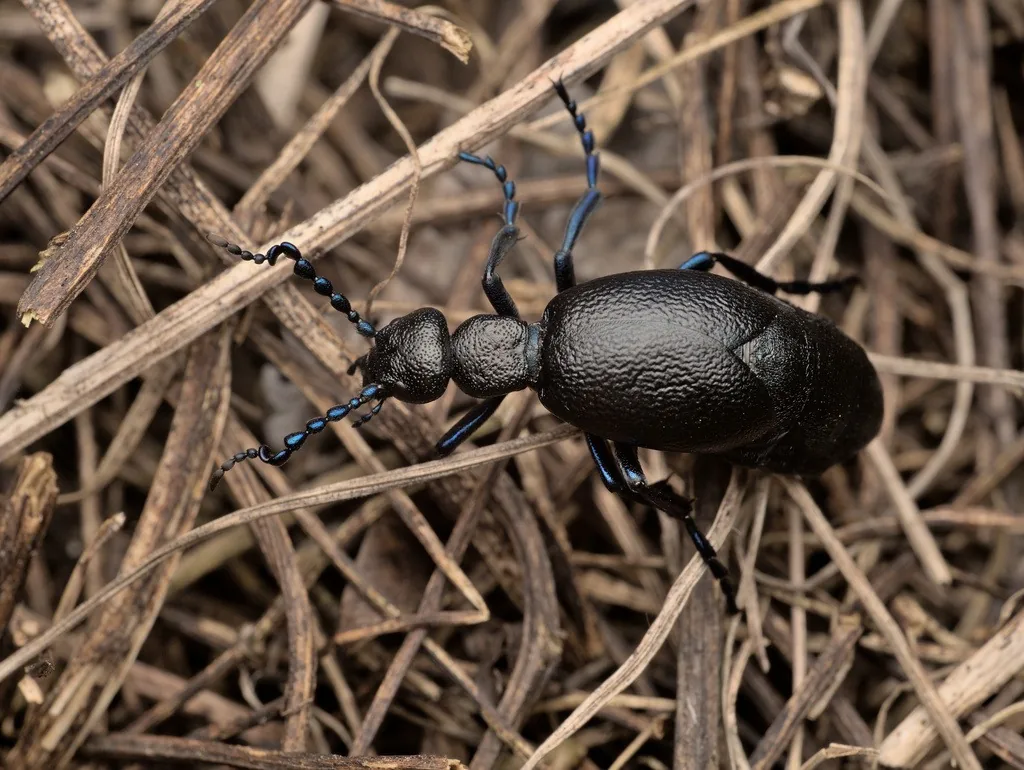
- Black and chubby, with very short, overlapping wing covers and no hind wings.[1]
- The wing covers are extremely short and scale-like, unlike the narrow, elongated wing covers of blister beetles such as Epicauta.[3]
- Like other blister beetles, the section just behind the head is narrower than the head, and the antennae are thread-like or beaded.[3][2]
- Males have odd kinks in their antennae, which they use to hold the female during courtship.[1]
- North America has more than 20 Meloe species, and they all look much alike.[1]
Look-alikes
| Look-alike | How to tell them apart |
|---|---|
| Other blister beetles (Epicauta and relatives) | Epicauta species have narrow, elongated wing covers whose rounded tips meet at the end of the abdomen. Most blister beetles contain cantharidin.[3][2] |
Where it lives
More than 20 species occur in North America.[1]
Biology and life cycle
As in most blister beetles, eggs are laid on flowers or other places bees visit. They hatch into tiny, active larvae with legs that grab onto a visiting bee and ride it back to its nest.[2]
In the nest the larva molts into a plump, slow grub that eats the bee's stored honey and pollen and its eggs or young, then pupates and becomes an adult beetle.[2]
In California, larvae of Meloe franciscanus cluster together and give off a scent that mimics the sex pheromone of a female solitary bee. Male bees that come to the cluster pick up larvae, which move onto female bees during mating and are carried to the nests.[4]
Populations of that species are matched to their local host bees, both in the chemistry of the scent and in how high the larval clusters perch, which matches the height where local male bees patrol.[5]
Damage and signs
Health risk
Crushing or squeezing an oil beetle releases oil containing cantharidin, which can raise blisters on skin. Cantharidin is toxic to livestock, and horses are the most sensitive; horses have died after eating hay containing dead blister beetles.[1][3][2]
Control
Prevention
Don't pick up or crush the beetles with bare hands. Their fluids come out when they are crushed or handled roughly.[3][1]
Horse and livestock owners should know that storing hay does not break down cantharidin from beetles caught in it.[3]
Common questions
- Why is it called an oil beetle?
- Because it oozes a yellowish oil from its joints when squeezed or upset. The oil contains cantharidin.[1]
- Can an oil beetle hurt me?
- Its oil can. The beetle releases it when squeezed or handled roughly, and the cantharidin in it can blister the skin of many people.[1][3]
- Is an oil beetle a kind of blister beetle?
- Yes. Oil beetles are the blister beetles in the genus Meloe, part of the blister beetle family Meloidae.[1]
Sources
- Missouri Department of Conservation, “Oil Beetles (Field Guide).” mdc.mo.gov/discover-nature/field-guide/oil-beetles (accessed 2026-11-10)
- Missouri Department of Conservation, “Blister Beetles (Meloids) (Field Guide).” mdc.mo.gov/discover-nature/field-guide/blister-beetles-meloids (accessed 2026-11-10)
- New Mexico State University Cooperative Extension Service, “Blister Beetles in Alfalfa (Circular 536).” pubs.nmsu.edu/_circulars/CR536/index.html (accessed 2026-11-10)
- Proceedings of the National Academy of Sciences, “Phoretic nest parasites use sexual deception to obtain transport to their host's nest (PNAS 103:14039-44, 2006).” pubmed.ncbi.nlm.nih.gov/16966608/ (accessed 2026-11-10)
- Proceedings of the National Academy of Sciences, “Deceptive signals and behaviors of a cleptoparasitic beetle show local adaptation to different host bee species (PNAS 115:9756-60, 2018).” pubmed.ncbi.nlm.nih.gov/30201716/ (accessed 2026-11-10)
- iNaturalist, “Meloe taxon page (order and family).” www.inaturalist.org/taxa/68006 (accessed 2026-11-10)