On this page
How to identify it
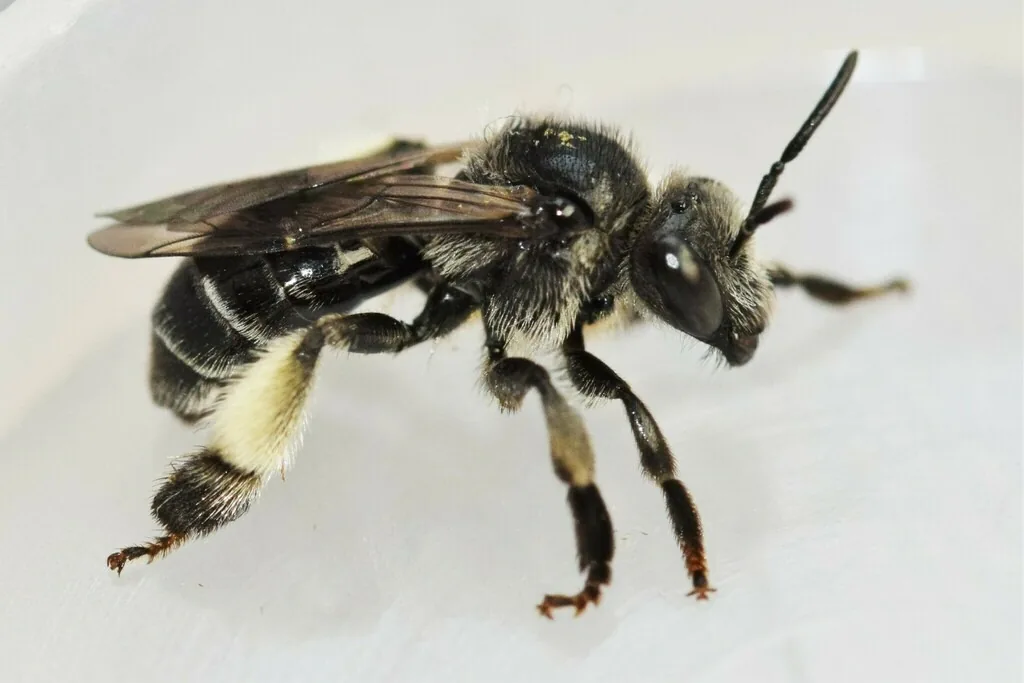
- Small bees, females about 7 to 8 mm and males about the same, with a black body and sparse pale hairs on the head and thorax.[1][2]
- The legs are dark and noticeably wide, and the pollen-carrying hairs (scopa) on the hind legs are entirely white. In Macropis nuda the tarsi are dark; in M. patellata the first tarsal segments are white.[1][2]
- Males have a yellow to cream colored face plate (clypeus).[1]
- The surest clue is the flower: these bees collect oil and pollen only from Lysimachia, so look for them on fringed loosestrife, prairie loosestrife and other native yellow loosestrifes, although they may visit dogbane, water hemlock or dwarf dandelion for nectar.[1][3]
Look-alikes
| Look-alike | How to tell them apart |
|---|---|
| Other Macropis species | The species are separated by small details such as whether the hind tarsi are dark (M. nuda) or the basitarsi white (M. patellata).[1][2] |
| Macropis cuckoo bee (Epeoloides pilosulus) | A cleptoparasite that enters Macropis nests and lays its eggs in the cells the host has provisioned; it is one of the rarest bees in North America and was only recently recorded in Minnesota.[4][1] |
| Eastern cranberry bee and other Melitta | Melitta bees are in the same family and are also ground-nesting specialists, but the eastern cranberry bee forages on cranberry (Vaccinium) rather than loosestrife.[3] |
| Sweat bees | Many small dark bees visit flowers; Macropis is told by the broad dark legs with entirely white scopa and by its strict attachment to Lysimachia flowers.[1][2] |
Where it lives
The genus is Holarctic and occurs in the eastern and central United States and southern Canada. Macropis nuda ranges through the northern United States into Canada and across much of Minnesota; M. patellata is distributed through the eastern United States.[3][1][2]
Biology and life cycle
Macropis bees are apparently all oligolectic: the females collect pollen and floral oil from their host plant, Lysimachia, and the oil goes into feeding the young. Minnesota records tie M. nuda to fringed loosestrife (L. ciliata) and prairie loosestrife (L. quadriflora).[3][1]
They nest in the ground. Adults are in flight from June to August in Minnesota, with M. nuda noted in late summer.[1][2][3]
Cuckoo bees, also called kleptoparasites, enter the nests of oil-collecting bees and lay their eggs in the provisioned cells. The Macropis cuckoo bee, Epeoloides pilosulus, is one of the rarest bees in North America; only two Canadian specimens were reported between the 1960s and a 2018 Alberta record that greatly extended its western range.[1][4]
Both bees are uncommon: Minnesota ranks M. nuda S2 and M. patellata S1, the latter known in the state only from a few historical records in Houston and Ramsey counties.[1][2][4]
Damage and signs
Health risk
None of the sources mentions stings or any effect on people; these are small solitary ground-nesting bees seen on loosestrife flowers.[1][2]
Control
Prevention
No control is needed. If you have native loosestrife in a wet meadow, pond edge or rain garden, leave the plants and the bare ground nearby alone during the June to August flight period; the bees depend entirely on those flowers, and both Minnesota species carry state rarity ranks.[1][2][3]
Common questions
- Why are these bees only on my loosestrife?
- Macropis bees are oligolectic, meaning they collect pollen, and in this case floral oil, from a single plant group. Lysimachia flowers produce floral oil, and the females gather it along with pollen to feed their young; they visit other flowers only for nectar.[3][1]
- Do they sting?
- Neither the Minnesota DNR nor the research papers mention stings; these are small solitary bees that nest in the ground and spend their time on loosestrife flowers.[1][2]
- What is the Macropis cuckoo bee?
- Epeoloides pilosulus is a cleptoparasite that lays its eggs in Macropis nest cells. It is one of the rarest bees in North America and was documented in Minnesota only recently.[4][1]
Sources
- Minnesota Department of Natural Resources, “Macropis nuda (Dark-legged Yellow Loosestrife Bee), Minnesota's specialist bees.” www.dnr.state.mn.us/pollinators/macropis-nuda-dark-legged-yellow-loosestrife-bee.html (accessed 2026-11-10)
- Minnesota Department of Natural Resources, “Macropis patellata (Patellar Oil-collecting Bee), Minnesota's specialist bees.” www.dnr.state.mn.us/pollinators/macropis-patellata-patellar-oil-collecting-bee.html (accessed 2026-11-10)
- Ottawa Field-Naturalists' Club (The Canadian Field-Naturalist), “Payette A. First record of the bee Melitta americana (Smith) (Hymenoptera: Melittidae) for Quebec and Canada. The Canadian Field-Naturalist 127(1):60-63 (2013).” doi.org/10.22621/cfn.v127i1.1409 (accessed 2026-11-10)
- Biodiversity Data Journal (Pensoft), abstract via PubMed, “Sheffield CS and Heron J. A new western Canadian record of Epeoloides pilosulus (Cresson), with discussion of ecological associations, distribution and conservation status in Canada. Biodiversity Data Journal 6:e22837 (2018).” pubmed.ncbi.nlm.nih.gov/29686501/ (accessed 2026-11-10)
- iNaturalist, “Macropis taxon page (order and family).” www.inaturalist.org/taxa/180732 (accessed 2026-11-10)