On this page
How to identify it
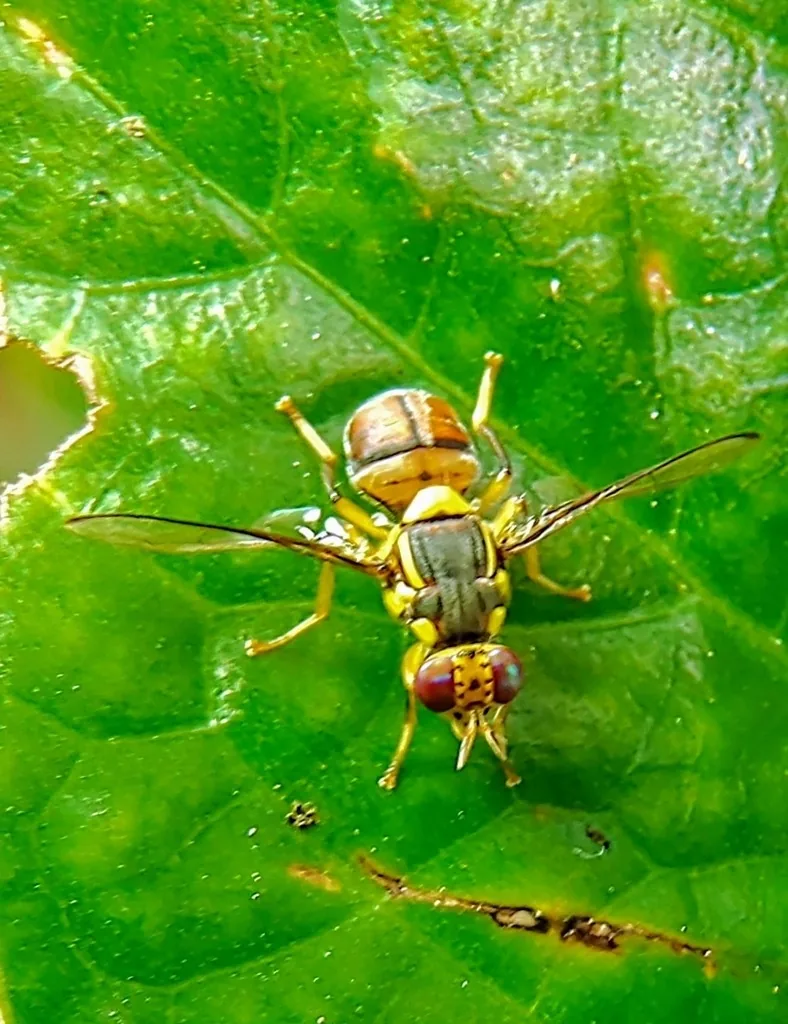
- The adult is noticeably larger than a house fly, with a body about 1/3 inch (8 mm) long and mostly clear wings.[1]
- Its color varies a lot, but the thorax has prominent yellow and dark brown to black markings. The abdomen usually has two black crosswise stripes and a black stripe running down the middle, which can form a T, though the pattern varies.[1]
- The female's egg-laying tube (ovipositor) is very slender and sharply pointed.[1]
- The full-grown maggot is creamy white, about 10 mm long, with the typical fruit fly maggot shape. Its tan to dark brown pupal case, about 5 mm long, is formed in the soil.[1]
Look-alikes
| Look-alike | How to tell them apart |
|---|---|
| Mediterranean fruit fly (medfly) | The maggots of the two species are very similar and are separated by fine details of the mouthparts and breathing openings, so suspect larvae need an expert's identification.[1] |
| House fly | The oriental fruit fly is noticeably larger than a house fly and has bold yellow and dark markings on the thorax.[1] |
Where it lives
Established in many parts of Asia and on Pacific islands. In the United States it is present on all major Hawaiian islands after it was accidentally introduced in 1944 or 1945. It is not established in California or Florida, but flies have been trapped in both states many times, and past infestations there have been eradicated.[1]
Biology and life cycle
Under summer conditions it takes about 16 days to develop from egg to adult. The mature maggot leaves the fruit, drops to the ground and pupates in the soil. Adults need about 9 more days to become sexually mature, and cool weather slows every stage.[1]
Under ideal conditions a female can lay more than 3,000 eggs in her lifetime; in the field, 1,200 to 1,500 is usual. Ripe fruit seems to be preferred, but unripe fruit is also attacked.[1]
It has been recorded from more than 150 kinds of fruit and vegetables, including apricot, avocado, banana, citrus, fig, guava, loquat, mango, papaya, passion fruit, peach, pear, persimmon and tomato. Avocado, mango and papaya are attacked most often.[1]
Adults shelter (roost) on plants, including plants along the borders of crops such as papaya. In a Hawaii test, plants they preferred included castor bean, panax, tiger's claw, ti plant, Brazilian pepper tree, guava and several kinds of citrus.[2]
Four pest flies that were once treated as separate species, B. dorsalis, B. papayae, B. philippinensis and B. invadens, are now recognized as a single species, B. dorsalis.[4]
Damage and signs
- Fruit is injured by egg-laying punctures and by the maggots feeding inside. After it reached Hawaii it soon did more damage than the Mediterranean fruit fly or the melon fly, until introduced parasites brought it partly under control.[1]
- Where it is established it can take over: on Tahiti, after it arrived in 1996, it displaced two other fruit fly species to become the most abundant fruit fly in coastal areas.[3]
Health risk
The sources describe it only as a pest of fruit and vegetables and mention no harm to people.[1]
Control
Traps and physical control
Traps baited with a lure plus a toxicant are used to monitor and control the flies. Many countries run continuous trapping programs with methyl eugenol, a lure that attracts males.[1][5]
Biological control
Introduced parasites partly controlled it in Hawaii. A parasitic wasp, Fopius arisanus, was taken from Hawaii to French Polynesia, where it became established and oriental fruit flies emerging from guava fell by about three quarters.[1][3]
Pesticides
Japan eliminated it from its islands by 1985 after an 18-year program that combined methyl eugenol baits laced with insecticide and releases of sterile males. In Hawaii, protein bait sprays are traditionally applied to the crop, and spraying the plants where adults rest along crop borders may also help.[1][2]
When to call a professional
Outside Hawaii, finds are handled by government programs. USDA-APHIS and state agencies have action plans that start when fruit flies are trapped, and in Florida the state Division of Plant Industry works with APHIS in regulating what commercial growers and homeowners may do.[1]
Common questions
- Is the oriental fruit fly in California?
- It is not established there, but it has been found repeatedly. Four major infestations were eradicated between 1960 and 1997, and later finds led to new quarantines and eradication programs.[1]
- What fruits does it attack?
- More than 150 kinds of fruit and vegetables have been recorded, with avocado, mango and papaya attacked most often. Citrus, peach, pear, guava, fig and tomato are also on the list.[1]
Sources
- University of Florida/IFAS Extension (Featured Creatures), “Oriental Fruit Fly, Bactrocera dorsalis (Hendel), EENY-083 (H. V. Weems, J. B. Heppner, J. L. Nation and T. R. Fasulo; revised March 2012; archival copy).” journals.flvc.org/edis/article/view/119599 (accessed 2026-11-09)
- Journal of Insect Science (via NCBI PubMed), “Assessment of attractiveness of plants as roosting sites for the melon fly, Bactrocera cucurbitae, and oriental fruit fly, Bactrocera dorsalis (Journal of Insect Science, 2007; abstract).” pubmed.ncbi.nlm.nih.gov/20334596/ (accessed 2026-11-09)
- Journal of Economic Entomology (via NCBI PubMed), “Impact of introduction of Bactrocera dorsalis and classical biological control releases of Fopius arisanus on economically important fruit flies in French Polynesia (Journal of Economic Entomology, 2007; abstract).” pubmed.ncbi.nlm.nih.gov/17598524/ (accessed 2026-11-09)
- ZooKeys (via NCBI PubMed), “Historical perspective on the synonymization of the four major pest species belonging to the Bactrocera dorsalis species complex (ZooKeys, 2015; abstract).” pubmed.ncbi.nlm.nih.gov/26798266/ (accessed 2026-11-09)
- Environmental Entomology (via NCBI PubMed), “Field longevity of methyl eugenol and cue-lure plugs and associated insecticidal strips: captures of Bactrocera dorsalis and Zeugodacus cucurbitae in Hawaii (Environmental Entomology, 2024; abstract).” pubmed.ncbi.nlm.nih.gov/38956829/ (accessed 2026-11-09)
- iNaturalist, “Bactrocera dorsalis taxon page (order and family).” www.inaturalist.org/taxa/358125 (accessed 2026-11-09)