On this page
How to identify it
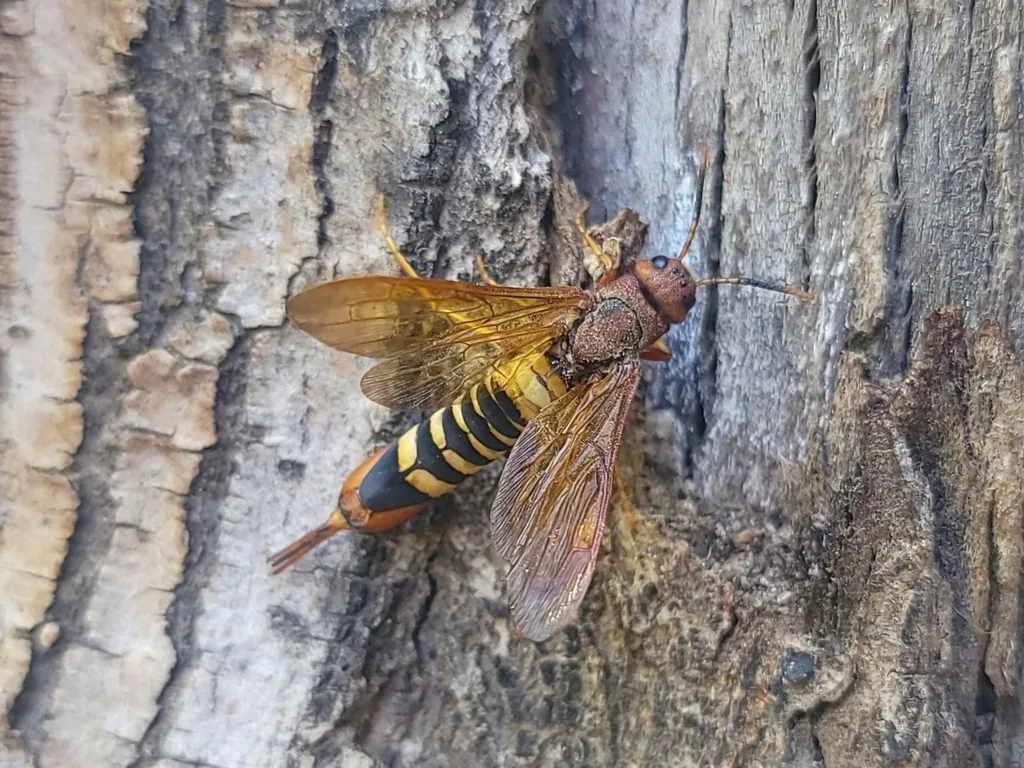
- Adults are 1 to 2 inches long with thick, cylindrical bodies, reddish brown to black with yellow and black bands on the abdomen, and dark wings.[2][1][3]
- Females carry a stout spine at the rear, an ovipositor about 1/2 inch long, used to drill eggs into wood. It looks like a stinger, but the pigeon tremex can't sting. A short horn sits above it, which is where the name horntail comes from.[1][3][2]
- Females are much larger than males. Dead females are sometimes found stuck to a trunk with the ovipositor still embedded.[3]
- The larvae are cream-colored, cylindrical grubs up to 2 inches long with a horn at the rear, living in round tunnels in the wood.[1][3][2]
Look-alikes
| Look-alike | How to tell them apart |
|---|---|
| Giant ichneumon wasps | Often seen on the same dying trees, these are its most common natural enemy: very elongated wasps with long tail-like ovipositors, more than 5 inches long overall, that lay their eggs into the wood onto pigeon tremex larvae.[3] |
| Conifer horntails | Other horntails in Colorado develop in conifers, usually in forests; the pigeon tremex attacks hardwoods.[3] |
Where it lives
NC State notes it was once a fairly common pest in the northeastern United States and is more of a curiosity in North Carolina; Colorado State and Utah State cover it on landscape hardwoods in Colorado and Utah.[2][3][1]
Biology and life cycle
It attacks only stressed, declining or very recently dead hardwoods: elms and sugar maple are preferred, along with ash, cottonwood, oak, hickory, sycamore, beech, apple and pear.[2][1][3]
Adults are active from summer into early October. A female drills about 1/2 inch into the wood and lays two to seven eggs along with a white rot fungus, which softens the wood and which the larvae need to develop.[1][3]
Larvae feed in the wood until the next summer, spending the winter deep in the heartwood, then pupate just below the bark. There is typically one generation a year.[1]
Its population can build locally as host trees age or become diseased.[3]
Damage and signs
Health risk
Despite the stinger-like ovipositor, it is a non-stinging wasp; the sources describe no risk to people.[3][1][2]
Control
Prevention
Keep trees healthy and avoid wounding the bark. Finding pigeon tremex means the tree or limb is already in serious decline or recently dead.[2][1][3]
Biological control
Giant ichneumon wasps are its most common natural enemy, laying their eggs on pigeon tremex larvae inside the wood.[3]
Pesticides
Spraying isn't recommended: no insecticide is available that kills the larvae deep in the wood, and the wasp attacks trees that are dying or dead anyway.[1][2]
Common questions
- Can a pigeon tremex sting me?
- No. The long spine at the rear is an egg-laying tool for drilling into wood, and the pigeon tremex is a non-stinging wasp.[3][1]
- Does a pigeon tremex mean my tree is dying?
- It means that tree or limb is already in serious decline or very recently dead; the wasp doesn't attack healthy wood.[3][1]
- Should I spray the tree?
- No. No insecticide is effective against larvae deep in the wood, and treatment is not recommended.[2][1]
Sources
- Utah State University Extension, Integrated Pest Management, “Pigeon Tremex (Ornamental Pest Guide).” extension.usu.edu/planthealth/ipm/ornamental-pest-guide/arthopods/wood-borers/pigeon-tremex (accessed 2026-11-08)
- NC State Extension, “Pigeon Tremex (J. Baker; published November 2013, reviewed May 2024).” content.ces.ncsu.edu/pigeon-tremex (accessed 2026-11-08)
- Colorado State University Extension, “Pigeon Tremex Horntail and the Giant Ichneumon Wasp, Fact Sheet 5.604.” extension.colostate.edu/resource/pigeon-tremex-horntail-and-the-giant-ichneumon-wasp (accessed 2026-11-08)
- iNaturalist, “Tremex columba taxon page (order and family).” www.inaturalist.org/taxa/63275 (accessed 2026-11-08)