On this page
How to identify it
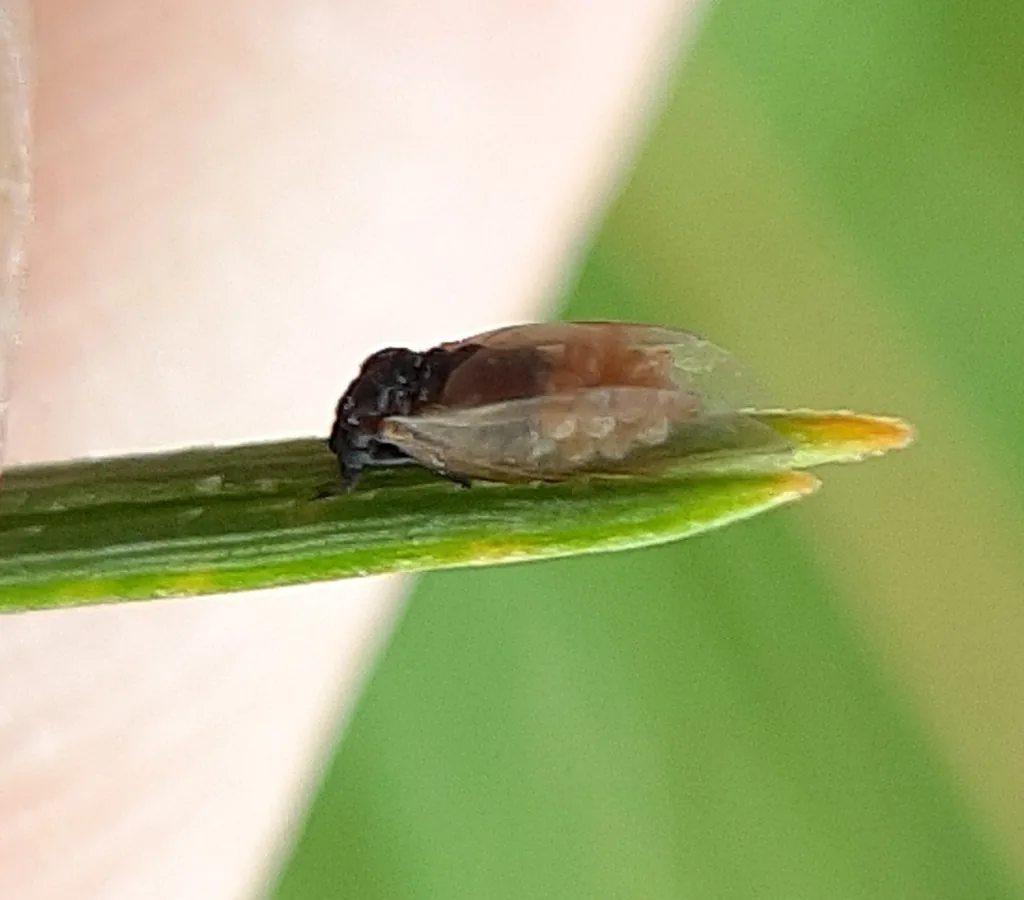
- On white pine, the diagnostic sign is a row of dead winged females on the needles, all with their heads toward the base of the needle. These migrants are black and about 2.5 mm long; they settle on the previous year's needles in June, lay eggs, die in place and stay attached well into winter.[2]
- The feeding form on pine shoots is so small that groups look like pepper spots on the light green twigs. Each is oval, keeled and dark purplish brown with a fringe of wax plates around the body and along the keel; UNH describes the adults as scale-like with a fringe of white hairs.[2][3]
- Infested white pine shoots stunt, yellow and brown from the needle tips down and then droop and die, either in late summer the same year or, more often, the following spring. On red and black spruce the insect causes compact, cone-like galls on the new shoots in May.[2][1][3]
- Because the life cycle takes two years, with the pine generation arriving from spruce in odd-numbered years in the Maritimes, heavily infested white pines brown every other year.[1][2]
Look-alikes
| Look-alike | How to tell them apart |
|---|---|
| Pine bark adelgid | A related adelgid of white pine. The pine leaf adelgid attacks the current year's shoots as pepper-spot nymphs and leaves dead black winged females lined up on last year's needles, and it needs red or black spruce as its other host.[2][1] |
| Eastern spruce gall adelgid | Also makes galls on spruce shoots. The pine leaf adelgid's galls form on red and black spruce in May, and the insects that leave them in mid-June fly to white pine rather than staying on spruce.[1][2] |
| Cooley spruce gall adelgid | Another gall-making adelgid of spruce shoots. The pine leaf adelgid alternates between red or black spruce and eastern white pine, and its galls are the only damage it does to spruce.[1][2] |
| White pine aphid | Dark brown, shiny aphids that cluster around a white pine branch or leader. Pine leaf adelgid nymphs on pine are pepper-spot sized, purplish brown with wax fringes, and arrive from spruce galls.[3][2] |
Where it lives
Canada and the northeastern United States, including Maine, New Hampshire, Vermont and New York. It is considered a very important pest of white pine growing next to red and black spruce in the Maritime Provinces.[1]
Biology and life cycle
Red and black spruce are the primary hosts and eastern white pine is the alternate host. The cycle involves five distinct forms and takes two years, with winged forms alternating between spruce and pine.[2][1]
Two forms on spruce produce cone-like galls as the new shoots develop in May. Winged migrants leave the galls about mid-June, fly to white pine, settle on the previous year's needles, lay eggs and die. The eggs hatch and two kinds of wingless offspring crawl to the developing pine shoots in early July, pierce them and feed.[2][1]
The adelgids overwinter on the pine and feed again in spring. In the second season winged forms develop and fly back to spruce, where two successive wingless generations follow; the second overwinters and produces the galls the next spring. Every other year a few remain on pine, but most return to spruce.[2][1]
In the Maritimes the move from spruce to pine usually happens in odd-numbered years, so the pine damage runs on a two-year rhythm.[1]
Damage and signs
- Severe outbreaks can kill up to 100 percent of the new shoots on eastern white pines of any size or age, and heavy feeding in two or three successive years can kill trees, especially understory or less vigorous ones. Moderate infestations may cause the shoots to die the following spring.[2][1]
- Damage to spruce is limited to the cone-like galls on new shoots, which are unsightly but cause little injury and matter only on ornamentals.[2][1]
- On white pine the shoot tips droop, yellow and die in the same season under heavy infestation; more often the injured shoots turn brown and die the next spring, and growth is reduced.[2][3]
Health risk
None of the sources mention any effect on people or pets; the insect feeds only on pine and spruce.[1][2]
Control
Prevention
Control is not normally recommended on spruce, where the galls are a cosmetic problem. Avoid overspraying pines for aphids, since that kills the natural predators that help hold adelgid numbers down.[2][3]
Pesticides
On ornamental white pine the least toxic option is horticultural oil. Maine lists imidacloprid, bifenthrin, permethrin and deltamethrin products among the conventional insecticides that can be used; UNH's Christmas tree manual says occasional outbreaks may call for a spray of the pine foliage in late June, repeated ten days later. Follow current labels and state registrations.[2][3]
Common questions
- Why do my white pine tips die every other year?
- The pine leaf adelgid's two-year cycle brings a wave of migrants from spruce galls to white pine in alternate years. Their offspring kill the current shoots, so heavily infested pines brown every other year.[2][1]
- What are the black specks in a row on my pine needles?
- Those are the dead winged migrant females, about 2.5 mm long, lined up with their heads toward the needle base. They settled in June, laid eggs and died in place, and the row is the species' diagnostic mark.[2]
- Should I treat the galls on my spruce?
- No. Galls on red and black spruce cause little injury, and control on spruce is not normally recommended. Treatment, if any, goes on nearby ornamental white pine, where oil is the least toxic choice.[2][1]
Sources
- Natural Resources Canada, Canadian Forest Service, “Pine leaf adelgid, Trees, insects, mites, and diseases of Canada's forests.” tidcf.nrcan.gc.ca/en/insects/factsheet/5328 (accessed 2026-11-10)
- Maine Forest Service, Maine Department of Agriculture, Conservation and Forestry, “Pine Leaf Adelgid (Forest Health and Monitoring, July 2016).” www.maine.gov/dacf/mfs/forest_health/insects/pine_leaf_adelgid.htm (accessed 2026-11-10)
- University of New Hampshire Cooperative Extension, “Christmas Tree Pest Manual, Pesticide Safety Education Program (S.R. Swier and P. Auger), pine leaf adelgid entry.” extension.unh.edu/sites/default/files/migrated_unmanaged_files/Resource000221_Rep240.pdf (accessed 2026-11-10)
- iNaturalist, “Pineus pinifoliae taxon page (order and family).” www.inaturalist.org/taxa/454598 (accessed 2026-11-10)