On this page
How to identify it
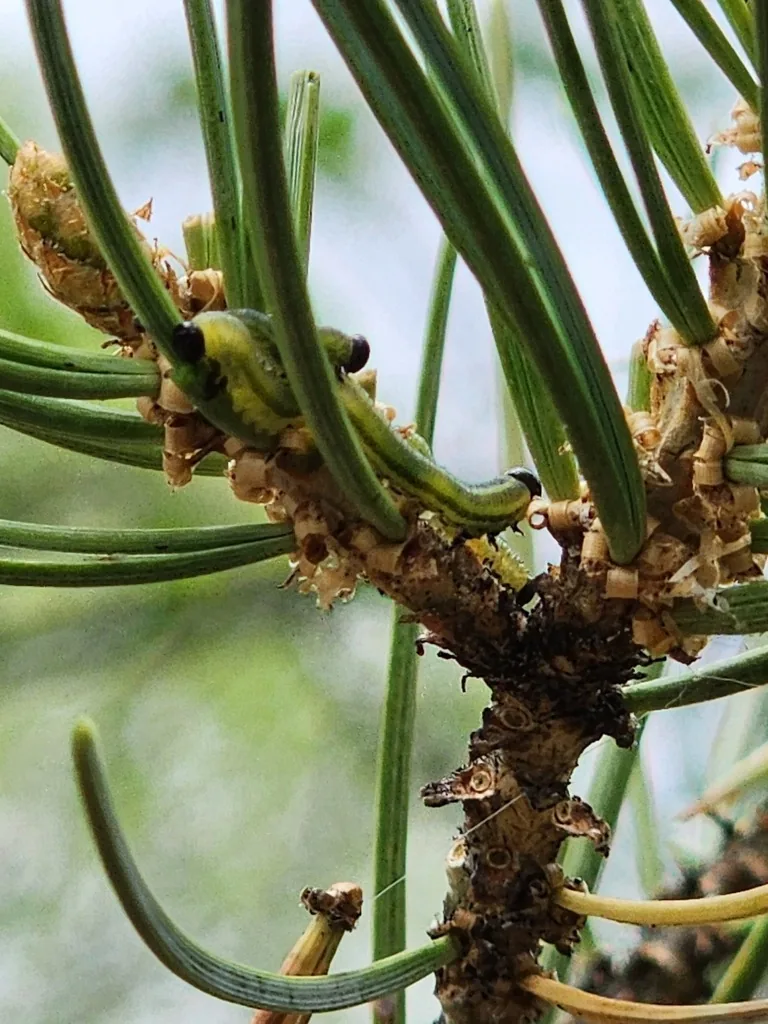
- Young larvae are pale green with a dark green stripe along each upper side and a narrow off-white stripe down the middle of the back, under a jet-black head; they have eight pairs of prolegs. Fifth- and sixth-instar larvae switch to tan head capsules and a pinkish-gray body with dark stripes, reach about three quarters of an inch, and turn dark brown just before molting.[1]
- Groups of three or more larvae line up side by side along a needle with their heads toward the tip and keep that orientation while they eat, working from the tip toward the base. Young larvae skeletonize the needle, leaving a central rib and yellow-brown shriveled remains that break off in wind and rain; older larvae eat the whole needle down to the base.[1]
- In spring, a noticeable swelling forms on the needle around each overwintered egg before it hatches. Large colonies drop a rain of frass pellets under the tree.[1]
- Adults fly in October and early November: the female is 6 to 8 mm, golden brown with dark, saw-edged antennae; the male 5 to 7 mm, greenish black with feathery antennae. Cocoons are tough, papery capsules about 8 mm long, white when new and darkening to golden brown with sand grains stuck to them; cocoons two or more years old are dark brown.[1]
Look-alikes
| Look-alike | How to tell them apart |
|---|---|
| Pinyon needle scale | Another insect of pinyon pines. The pinyon sawfly is a caterpillar-like larva with eight pairs of prolegs that chews the needles in groups from early April to mid-June.[1] |
| Pine sawflies | The pinyon sawfly is the Neodiprion of pinyon pines; its only known hosts are single-leaf pinyon and two-needle pinyon, its larvae align head-to-tip along the needles, and the older larvae have tan heads and pinkish-gray bodies.[1] |
| Red pine sawfly | Another Neodiprion species. The pinyon sawfly is known only from pinyon pines, in Nevada, Utah, Arizona and the Colorado-New Mexico border country, and its mature larvae have tan rather than black heads.[1][2] |
Where it lives
Collected from single-leaf pinyon at Caliente and Pioche in eastern Nevada, where it is the principal host, and from two-needle pinyon at the Colorado-New Mexico line and in Zion National Park, Utah. A population on Pinus edulis near Sunset Crater in northern Arizona was monitored for twelve years and rarely occurred above 1,900 meters elevation.[1][2]
Biology and life cycle
The only known hosts are single-leaf pinyon and two-needle pinyon. Trees of all ages, sizes and crown classes are attacked, with the heaviest feeding on trees 10 feet tall or less.[1]
There is one generation a year. Eggs are laid in October and early November: the female saws slits and gouges egg pockets in the current year's needles, one egg per slit and one to five per needle, averaging two, with a few in year-old needles. The eggs overwinter inside the needles and hatch in early April.[1]
Larvae feed through spring and drop to the ground in mid-June to spin cocoons under the duff, up to 2 inches deep in sandy soil. They pupate in fall and the adults emerge in October and early November.[1]
The larvae tolerate only a narrow band of temperatures. Near Sunset Crater, Arizona, the population declined in years when April minimum temperatures were unusually low or unusually high, larvae moved to trees above 1,900 meters could not sustain a population, and cold delayed and disrupted the life cycle; limited temperature tolerance was judged the likeliest cause of the population's decline from 1994 to 2006.[2]
Late spring storms followed by freezing temperatures, and parasitism, appear to regulate populations. In Nevada, 11 species of parasitic wasps and six parasitic flies were reared from cocoons; a small pteromalid wasp, Dibrachys, can kill over 90 percent of the larvae when conditions favor it, and rodents dig up some cocoons.[1]
Damage and signs
- Light infestations show first in the exposed upper third of the crown. After moderate to heavy defoliation the stand looks parched, and because larvae prefer older foliage, late spring feeding can leave only the current season's needles so crowns look tufted or thin.[1]
- Trees completely defoliated for two or more years put on stunted new growth, and complete defoliation of smaller trees for three years can kill them. The 1959 outbreak near Pioche, Nevada defoliated 7,000 to 9,000 acres by 10 to 100 percent and killed some trees under 4 feet; the 1965 outbreak covered more than 100,000 acres near Pioche and Caliente and left many small trees unfit for sale as Christmas trees.[1]
- Pinyon is valued for Christmas trees, pine nuts, fuel, scenery and watershed cover, so defoliation matters in those uses. In remote country the damage may not be noticed for a year or more.[1]
Health risk
Control
Prevention
No practical method of direct control is known. Outbreaks collapse on their own when late spring storms and freezes or heavy parasitism catch the larvae, as happened in 1960 after the first recorded outbreak.[1]
Biological control
Parasitic wasps and flies, above all a small pteromalid that can kill more than 90 percent of larvae in a good year, and cocoon-digging rodents are the main checks on the sawfly.[1]
Common questions
- Why are the sawfly larvae on my pinyon all lined up the same way?
- Pinyon sawfly larvae feed in groups of three or more aligned side by side along a needle with their heads pointed at the tip, and they keep that orientation as they eat from tip to base. It is a reliable field mark for this species.[1]
- Can I spray my pinyons for it?
- The Forest Service leaflet reports no practical direct control. Outbreaks are usually ended by spring cold snaps and by parasitic wasps and flies, and the insect's own narrow temperature tolerance limits where it can persist.[1][2]
- Will the sawfly kill my trees?
- Usually not after a single year. Stunted growth follows two or more years of complete defoliation, and small trees stripped three years running can die; larger trees fared better in the Nevada outbreaks.[1]
Sources
- USDA Forest Service, “Pinyon Sawfly, Neodiprion edulicolus Ross, Forest Pest Leaflet 117 (M.D. McGregor and L.O. Sandin, December 1969).” www.fs.usda.gov/foresthealth/docs/fidls/FIDL-117-PinyonSawfly.pdf (accessed 2026-11-10)
- Environmental Entomology (Entomological Society of America), “Consequences of narrow temperature tolerance for a pinyon pine sawfly, Neodiprion edulicolus (O.D. Sholes, Environmental Entomology 40:777-781, 2011) (abstract).” doi.org/10.1603/EN10318 (accessed 2026-11-10)
- iNaturalist, “Neodiprion edulicolus taxon page (order and family).” www.inaturalist.org/taxa/320672 (accessed 2026-11-10)