On this page
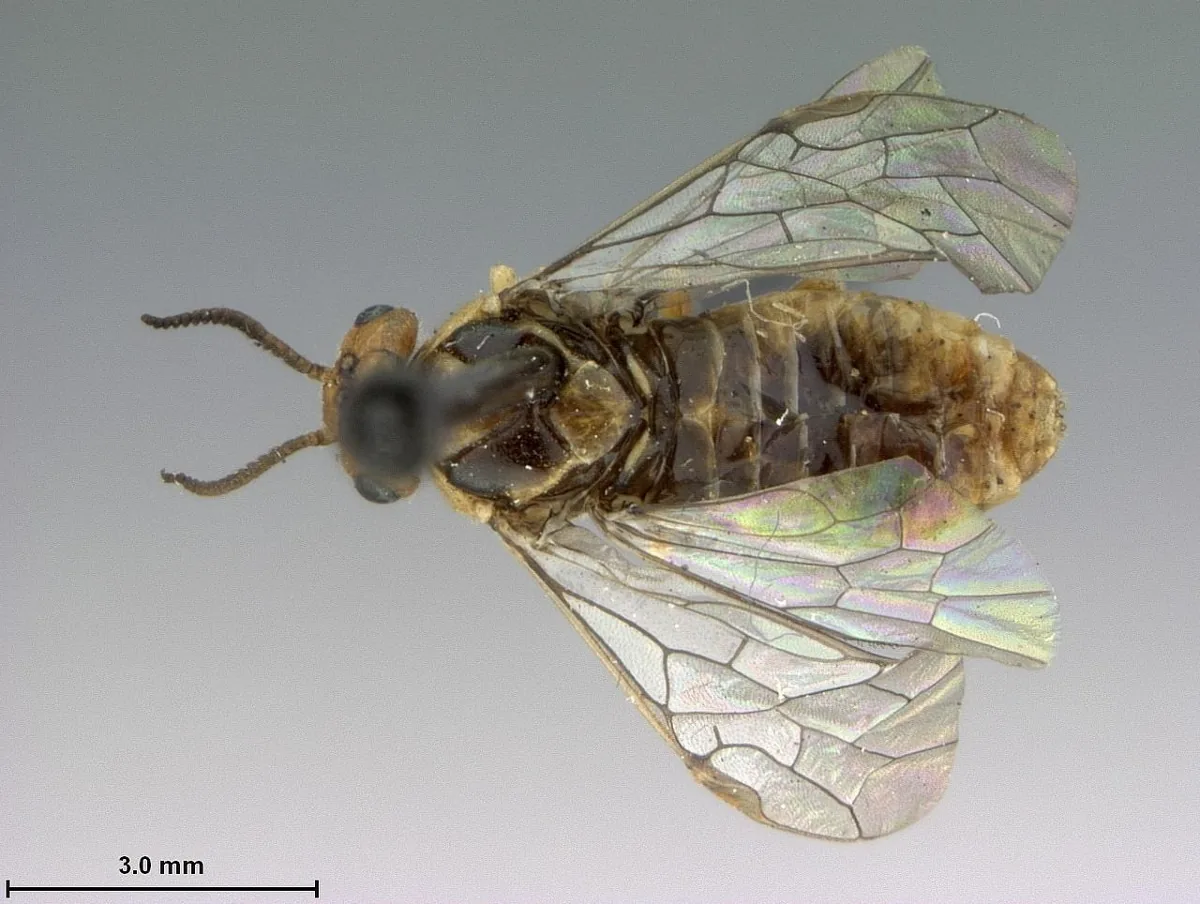
How to identify it
- Mature larvae are up to 21 mm (about 0.8 inch) long with a uniformly brown to black head. The body is green to yellowish green with a yellowish-green stripe down the middle of the back, a broad green stripe on each upper side, and paler green-gray stripes lower on the sides. The Forest Service describes mature larvae of the western subspecies as green to olive green with a darker green band along the side and a shiny black head capsule.[1][2]
- Larvae feed in colonies on one-year-old and older needles, moving from shoot to shoot as the old needles run out. Young larvae eat only the outer needle tissue and leave the midrib; older larvae eat the whole needle, and frass pellets collect under heavily fed trees.[1][2]
- Disturbed larvae rear their heads back and forth in unison and bring up a droplet of pine resin to dab on a predator or parasite.[2]
- Eggs are laid in fall in slits cut along the needle margins and can show as swellings on the needle edge. Up to 10 are laid per needle on short-needled jack or lodgepole pine and more on long-needled red or ponderosa pine; western females averaged about 9.5 eggs per needle on lodgepole and about 19 on ponderosa pine.[1][2]
Look-alikes
| Look-alike | How to tell them apart |
|---|---|
| Redheaded pine sawfly | A related Neodiprion sawfly of pines. The red pine sawfly's larvae have a uniformly brown to black head (not red) and a yellowish-green stripe down the back between broad green stripes, and they feed on one-year-old and older needles from May into early July.[1][2] |
| Pine sawflies | Several Neodiprion species feed in colonies on hard pines. The red pine sawfly overwinters as an egg in the needle, hatches in May or June, finishes feeding by early July and spends the rest of the summer dormant in a cocoon in the soil, with adults flying in September and October.[1][2] |
| White pine sawfly | The red pine sawfly is a hard-pine species, found on two- and three-needle hard pines such as red, jack, pitch, lodgepole and ponderosa pine.[1] |
Where it lives
The eastern subspecies occurs in Canada from northeastern British Columbia east to Nova Scotia and Prince Edward Island, and in the United States from Wisconsin to southern Illinois and east to the Atlantic states as far south as Pennsylvania. The western subspecies occurs in the Rockies of western Alberta and central British Columbia south through high-elevation forests to Montana and Idaho, in cool Pacific coastal forests from Oregon north through British Columbia, and recently for the first time in southeast Alaska; the Forest Service records it from Idaho, Montana, Oregon and adjoining Alberta.[1][2]
Biology and life cycle
Hosts are hard (two- and three-needle) pines. In the east these are red pine, jack pine, pitch pine and, to a lesser extent, shortleaf pine and introduced Scots pine; in the west, lodgepole and ponderosa pine in the interior and shore pine on the coast.[1][2]
There is one generation a year. The insect overwinters as an egg. Larvae hatch in May (early to mid-June in the western subspecies) and feed in colonies on old needles; females pass through five instars and males four. Unfertilized eggs become males.[1][2]
Feeding ends in early July. Mature larvae drop to the litter and upper soil, spin cocoons and stay dormant as prepupae through the summer, pupating in early September. Adults emerge mainly in September and October to mate and lay eggs. A variable share of prepupae remain dormant for two or more years.[1][2]
Several natural enemies attack the larvae and cocoons, including virus diseases, parasitic wasps and flies, and mice, voles and invertebrates that eat cocoons. Rain and cold weather while larvae are feeding can also collapse an outbreak.[1][2]
Damage and signs
- Larvae consume the old needles and spare the current year's growth unless populations are very high, so a heavily fed pine keeps only a tuft of new needles at the end of each shoot.[1]
- Damaging outbreaks occur mostly in plantations and on pole-sized trees, with mature trees attacked mainly in isolated or ornamental settings. Tree death is uncommon unless an outbreak lasts more than two years; outbreaks typically run two to four years and are more frequent on poor sites, open-grown stands and even-aged plantations.[1][2]
- The eastern subspecies seldom causes significant defoliation. The western subspecies occasionally damages interior and coastal forests in British Columbia and has recently caused significant defoliation in southeast Alaska. Trees weakened by sawfly defoliation are sometimes finished by bark beetles.[1][2]
Health risk
Neither source mentions any effect on people or pets; the larvae's only defense is a droplet of regurgitated pine resin.[2][1]
Control
Prevention
Outbreaks on ornamental trees and in plantations are unsightly and slow growth while they last, but affected trees usually recover, and natural enemies and weather end most outbreaks within a few years.[1][2]
Traps and physical control
The larvae feed in conspicuous colonies and can be handpicked off smaller, high-value trees, or light infestations on ornamental pines can be removed by clipping the infested branches and destroying the larvae.[1][2]
Pesticides
Bacillus thuringiensis (Bt), widely used on caterpillars, is not effective against sawflies. The Forest Service says several chemical insecticides applied from the ground or air are effective; Natural Resources Canada advises checking current registrations, treating only when numbers warrant it and against the approved life stage, and consulting a tree-care professional.[2][1]
Common questions
- My pine has only new needles left at the branch tips. Which sawfly is it?
- That pattern, old needles gone and current growth intact, fits the red pine sawfly on hard pines. Look for colonies of green, striped larvae with brown to black heads from May to early July, or egg swellings along needle edges in fall.[1][2]
- Can I spray Bt?
- No. Bt works on moth and butterfly caterpillars, not sawfly larvae. Handpick colonies or clip out infested branches on small trees.[2][1]
- Is the lodgepole pine sawfly the same insect?
- The western form, Neodiprion nanulus contortae, is a subspecies of the red pine sawfly that feeds on lodgepole and ponderosa pine; it looks and lives much like the eastern form on red and jack pine.[1][2]
Sources
- Natural Resources Canada, Canadian Forest Service, “Red pine sawfly (V.G. Nealis, 2024), Trees, insects, mites, and diseases of Canada's forests.” tidcf.nrcan.gc.ca/en/insects/factsheet/6575 (accessed 2026-11-10)
- USDA Forest Service, “Diprionid Sawflies on Lodgepole and Ponderosa Pines, Forest Insect and Disease Leaflet 179 (Ciesla and Smith, January 2011).” www.fs.usda.gov/foresthealth/docs/fidls/FIDL-179-DiprionidSawflies.pdf (accessed 2026-11-10)
- iNaturalist, “Neodiprion nanulus taxon page (order and family).” www.inaturalist.org/taxa/1030839 (accessed 2026-11-10)