On this page
How to identify it
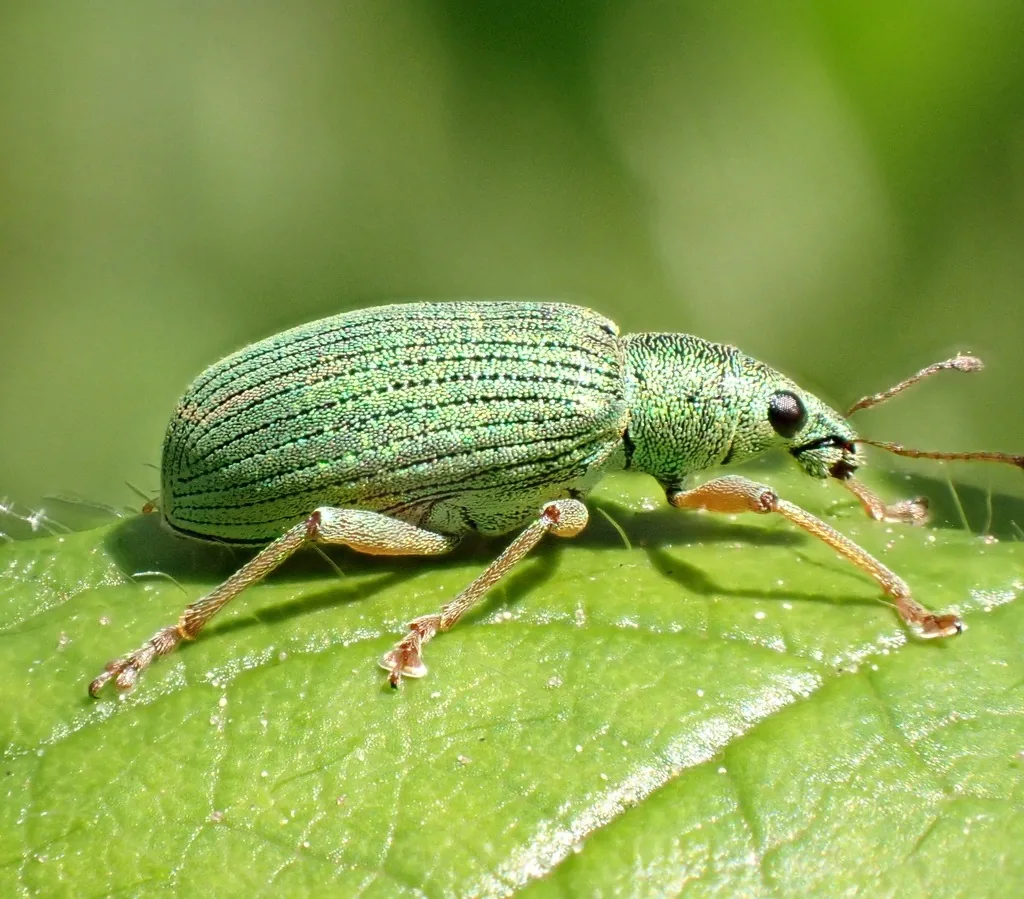
- Adults are slender, about 1/4 inch long, with a short blunt snout and a dark body covered in bright green, iridescent scales; where scales rub off they look green with black patches.[1][2][3]
- UMass notes two introduced species in the Northeast: P. formosus, 0.2 to 0.27 inch long, and the smaller P. impressifrons, 0.15 to 0.22 inch.[1]
Where it lives
Both species came from Europe in the early 1900s and occur in the northeastern United States; P. impressifrons is common in forested northeastern and north-central Minnesota.[1][2]
Biology and life cycle
There is one generation a year: adults emerge from the soil in late May or June and feed until August.[1][2][3]
Females lay groups of tiny white eggs on the soil or in bark crevices; the larvae feed on roots, overwinter there and pupate in spring.[1][2]
Damage and signs
Health risk
Harmless to people and property, though weevils that wander indoors from June through August are a nuisance.[2][4]
Control
Keep them out
Caulk cracks and keep screens and doors snug to keep weevils out of the house.[2]
Traps and physical control
Vacuum or sweep up weevils found indoors; they are temporary and go away on their own.[2]
Pesticides
Pesticides are generally not needed, and products sold to the public are not very effective against weevils.[2]
Common questions
Sources
- UMass Extension Landscape, Nursery and Urban Forestry Program (Landscape Insect & Mite Guide), “Polydrusus spp. (Polydrusus Weevil).” www.umass.edu/agriculture-food-environment/landscape/publications-resources/insect-mite-guide/polydrusus-spp (accessed 2026-10-16)
- University of Minnesota Extension, “Home-invading weevils (Nuisance Insects).” extension.umn.edu/nuisance-insects/home-invading-weevils (accessed 2026-10-16)
- University of Minnesota Extension (What insect is this?), “Polydrusus weevil (garden pests).” apps.extension.umn.edu/garden/diagnose/insect/garden/beetles/medium/polydweevil.html (accessed 2026-10-16)
- University of Minnesota Extension (What insect is this?), “Polydrusus weevil (insects found indoors).” apps.extension.umn.edu/garden/diagnose/insect/indoor/beetles/medium/polydrususweevil.html (accessed 2026-10-16)
- iNaturalist, “Polydrusus formosus taxon page (order and family).” www.inaturalist.org/taxa/494559 (accessed 2026-10-06)