On this page
How to identify it
- The full-grown caterpillar is about 1-5/8 inches long, with highly variable, mottled markings: black-brown stripes along the sides and a brownish pink stripe down the back carrying four or five diamond-shaped spots.[1]
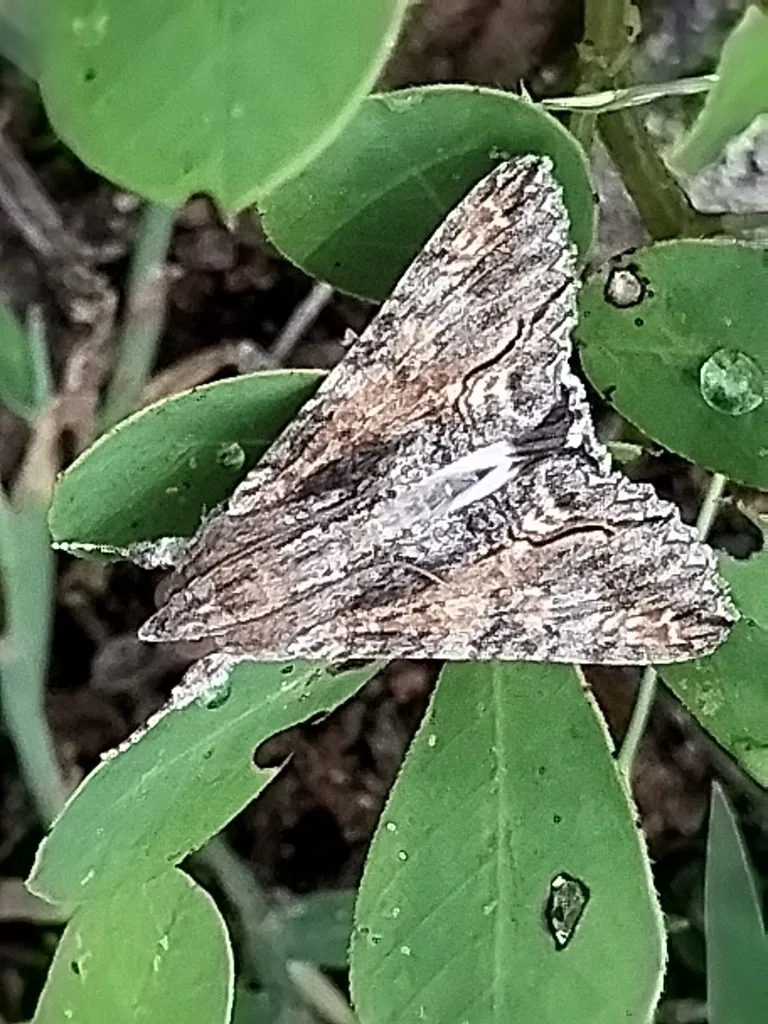
- The moth's forewings are dingy brown-gray with darker brown shading and dark brown zigzag marks near the tips, typical of a cutworm moth. The hindwings set it apart: mostly white with a brown blotch toward the edge. The wingspread is about 1-1/2 inches.[1]
- A telltale sign is a stream of caterpillars climbing the trunk just after sunset, or masses of them going down the trunk in the morning and resting on it or around its base during the day.[1][4]
Look-alikes
| Look-alike | How to tell them apart |
|---|---|
| Other cutworms | Most cutworms feed on vegetables and other low-growing plants. This one climbs and defoliates tall trees, mainly royal poinciana.[1] |
Where it lives
Reported from Arizona, California, Florida and Texas, and from Mexico, the Caribbean and Central America south to Brazil. In Florida it seems to be found about as widely as royal poinciana trees are planted, from St. Petersburg south to Key West.[1][4]
Biology and life cycle
The caterpillars feed at night. Early in the morning they go back down the trunk to hide in the soil or debris around the base; they will also hide in cracked seed pods in the tree, in a box at the foot of the tree, or under bands on the trunk, so they seem to be avoiding light.[3][1]
They pupate in plant debris or piles of droppings near the soil surface, without a cocoon.[1]
In Florida the moths have been collected in most months except February and April, and outbreaks have come at different times of year. Several generations probably develop between spring and fall, and long gaps, 10 years or more, can pass between outbreaks.[1][4]
Hosts are legumes such as royal poinciana, Poeppigia procera and Parkinsonia species, including Jerusalem thorn. The caterpillar has been released in northern Australia to help control Jerusalem thorn, an invasive weed there.[1]
Paper wasps hunt the caterpillars on the trunk, catching those that are not well hidden.[1]
Damage and signs
- Outbreaks can strip large trees: in Naples, Florida, in 2006, at least four royal poincianas 30 to 40 feet tall were half to completely defoliated by October 10.[1]
- Defoliation can upset the tree's leaf cycle. Key West trees stripped in July 1943 put out no new growth until the following June, though healthy trees there normally leaf out in March or April, and some trees were killed.[2][1]
- Trees stripped in late summer may put out new leaves in late fall, and the caterpillars have been found feeding on those leaves in January.[3]
Health risk
The sources describe it only as a defoliator of royal poinciana and related trees and mention no harm to people.[1]
Control
Traps and physical control
Take advantage of the daily climb. Wrap a burlap or cloth band around the trunk; caterpillars hide under it during the day and can be removed by changing the band regularly. Sticky bands have also caught caterpillars under both their upper and lower edges.[1][3]
Biological control
Paper wasps are natural predators and pick off caterpillars that are not well hidden on the trunk.[1]
Pesticides
There is no need to spray the upper canopy. Because the caterpillars climb up and down the trunk every night, a contact insecticide could be applied just to the base of the tree.[1]
Common questions
- Why can't I see the caterpillars eating my poinciana during the day?
- They feed at night and come down the trunk early in the morning to hide in debris at the base of the tree or in cracked seed pods, then climb back up after sunset.[3][1]
- Will a defoliated royal poinciana recover?
- Repeated defoliation year after year is likely to injure the trees. Stripped trees in Key West were slow to leaf out again, and some defoliated trees died the following year.[2][1]
Sources
- Florida State Horticultural Society (Proceedings), “Caterpillar outbreaks: defoliation by the royal poinciana caterpillar (Melipotis acontioides) and the snowbush caterpillar (Melanchroia chephise) in Naples, Florida (D. L. Caldwell; Proc. Fla. State Hort. Soc. 120:360-362, 2007).” journals.flvc.org/fshs/article/view/86254 (accessed 2026-11-09)
- Florida Entomological Society (Florida Entomologist), “The damage of Melipotis acontioides to the royal poinciana (J. R. Watson; Florida Entomologist 27(3), 1944).” journals.flvc.org/flaent/article/view/55313 (accessed 2026-11-09)
- Florida Entomological Society (Florida Entomologist), “The damage of Melipotis acontioides to the royal poinciana, continued (J. R. Watson; Florida Entomologist 27(4), 1944).” journals.flvc.org/flaent/article/view/55317 (accessed 2026-11-09)
- Florida Entomological Society (Florida Entomologist), “The damage of Melipotis acontioides to the royal poinciana, continued (J. R. Watson; Florida Entomologist 28(1), 1945).” journals.flvc.org/flaent/article/view/55323 (accessed 2026-11-09)
- iNaturalist, “Melipotis acontioides taxon page (order and family).” www.inaturalist.org/taxa/224853 (accessed 2026-11-09)