On this page
How to identify it
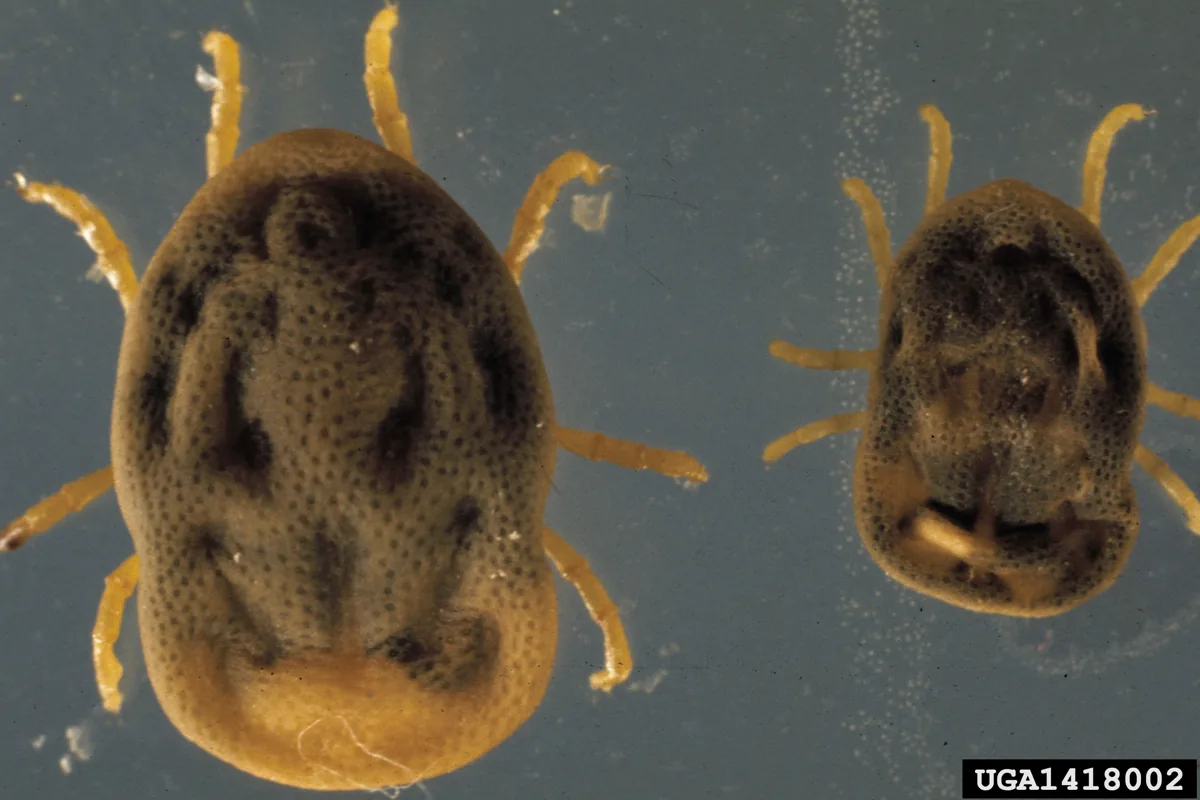
- What you usually find are the nymphs, deep in the ear: gray to light brown and, once fed, 7 to 10 mm long and covered with short yellowish spines that give the tick its name.[2][3]
- Adults live off the host. They are blue-gray with yellow legs and mouthparts, about 4 to 8 mm long, and lack working mouthparts for feeding.[3][2]
- The larvae are tiny, 2 to 3 mm, and climb vegetation to wait for a host.[3][2]
Look-alikes
| Look-alike | How to tell them apart |
|---|---|
| Gulf Coast tick | Gulf Coast ticks also feed mainly on the head and ears of cattle, but they are hard ticks whose adults feed; spinose ear ticks are soft ticks found as spiny nymphs deep in the ear canal, and their adults don't feed.[1][2] |
| Other soft ticks | Most soft tick females take repeated small blood meals between batches of eggs; the spinose ear tick female doesn't feed at all and lays her eggs without a blood meal.[1] |
Where it lives
It occurs in western North America, from British Columbia through the United States into Mexico, and also in Central and South America, Africa and India. A 1953 report called it a common parasite of cattle in the southern United States and less plentiful farther north.[1][2][3][4]
Biology and life cycle
It is a one-host tick: only the larvae and nymphs feed, all on the same animal.[3][2]
Larvae crawl into the outer ear canal, attach and feed, then molt into nymphs, which may stay from about five weeks to seven months before they finish feeding. Animals carry them to new places during that time.[2][3]
Full-fed nymphs drop off and molt on the ground. The adults live on what is left of the nymphal blood meal, mate within a few days, and each female lays up to 500 eggs over 2 to 4 weeks.[2][3]
Larvae hatch in about 3 to 8 weeks and can survive 2 to 4 months before finding a host. The whole cycle can take as little as five months.[3][2]
Hosts include cattle, horses, mules, sheep, goats, dogs, cats, wild canids, rabbits and hares, elk, deer and mountain sheep and goats, and people are occasionally infested.[2][3][4]
Immature ticks can be found year-round, but infestations are usually heaviest in late winter and spring.[2]
Damage and signs
- Heavy infestations can block the ear canal. Infested cattle are restless and turn their heads, and the ear can fill with a waxy discharge and become badly inflamed.[2][3]
- Wounds, tick droppings and shed skins invite bacterial infections, and severely infested ears can attract flies that lay eggs and cause maggot infestations. Heavy infections can ulcerate the ear, perforate the eardrum and occasionally cause meningitis.[2][3]
- In horses, ear ticks can cause sweating, pawing and muscle tremors that may be mistaken for colic.[3]
Health risk
People are occasionally infested, but the spinose ear tick is not known to transmit any disease agents and is not associated with tick paralysis.[2][3]
Control
Pesticides
Treatment usually means applying an acaricide directly into the ear.[3]
When to call a professional
If cattle are restless and keep turning their heads, or a horse shows colic-like signs such as sweating and pawing, have a veterinarian look deep in the ears. Diagnosis is made by finding and identifying the ticks there.[2][3]
Common questions
- My horse is pawing, sweating and twitching. Could it be ear ticks?
- It can be. Spinose ear ticks can cause sweating, pawing and muscle tremors that may be mistaken for colic, so ask your veterinarian to check deep in the ears.[3]
- Why don't I ever find adult ear ticks on my cattle?
- Adults never feed. The nymphs drop off the animal to molt on the ground, and the adults mate and lay eggs off the host.[2][3]
- Can spinose ear ticks get into people's ears?
- Occasionally. People are among the recorded hosts, though the tick isn't known to transmit any disease agents.[2][3]
Sources
- Texas A&M AgriLife Extension Service, Livestock Veterinary Entomology, “Ticks (Livestock Veterinary Entomology).” livestockvetento.tamu.edu/insectspests/ticks/ (accessed 2026-11-08)
- Texas A&M AgriLife Extension Service and AgriLife Research, “Spinose ear tick (The Tick App).” tickapp.tamu.edu/?p=579 (accessed 2026-11-08)
- University of Saskatchewan, Western College of Veterinary Medicine, “Otobius megnini (Learn About Parasites).” wcvm.usask.ca/learnaboutparasites/parasites/otobius-megnini.php (accessed 2026-11-08)
- Entomological Society of British Columbia, “Records of the tick Otobius megnini (Duges) from British Columbia (J. D. Gregson, Proceedings of the Entomological Society of British Columbia 49, 1953).” journal.entsocbc.ca/index.php/journal/article/download/2389/2453/5109 (accessed 2026-11-08)
- iNaturalist, “Otobius megnini taxon page (order and family).” www.inaturalist.org/taxa/263531 (accessed 2026-11-08)