On this page
How to identify it
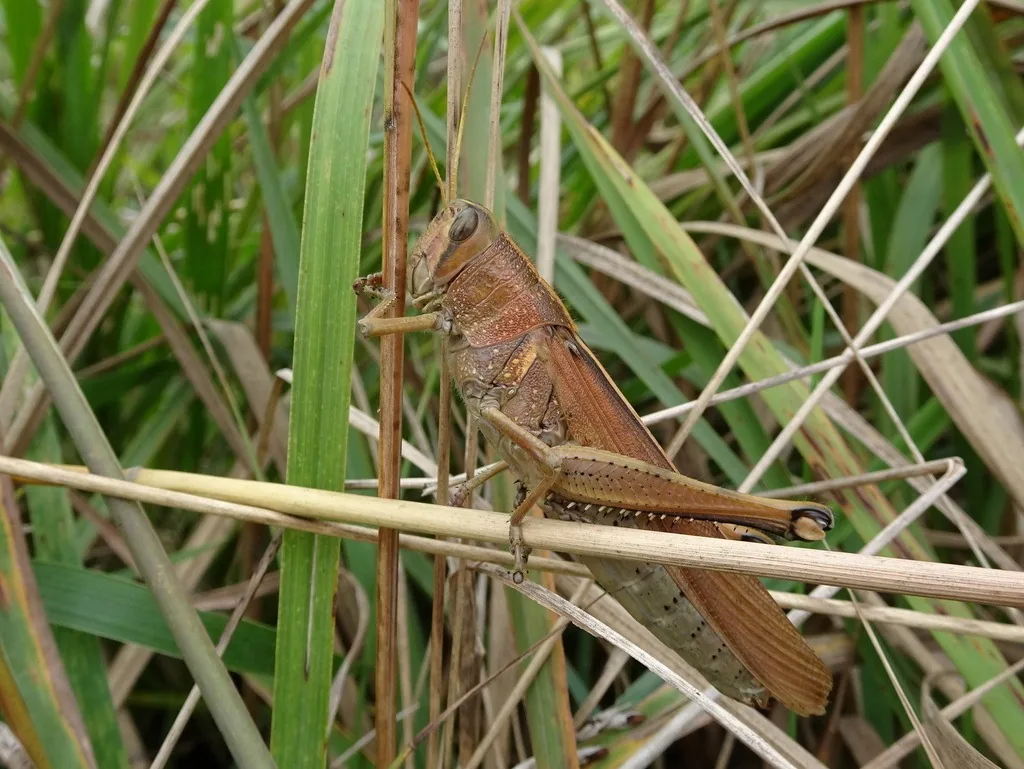
- Its color varies by region, from shades of yellow, brown or green; Nebraska specimens are light purplish brown with darker purplish areas.[1][2]
- A pale or yellowish stripe usually runs from the top of the head down the back.[1][2]
- The thorax has pits and yellowish dots, but there are no yellow spots on the side of the body in front of the hind legs; rows of black dots line the rear edges of the abdominal segments.[1]
- The knee joint has a pale spot bordered with black along its front and top edge, and the hind tibiae are black to reddish.[1][2]
- Males have swollen femurs on the front and middle legs, a little like muscular biceps.[1]
- It is large: males 27 to 37 mm and females 33 to 51 mm long in Nebraska.[2]
Look-alikes
| Look-alike | How to tell them apart |
|---|---|
| Obscure bird grasshopper | The obscure bird grasshopper has an olive-green body and a bright yellow or green spot on each side of the thorax; the spotted bird grasshopper lacks yellow spots on the side of the body in front of the hind legs.[1] |
| American grasshopper (American bird grasshopper) | The American bird grasshopper has spotted wings, a white spot on the side of each knee and a dark spot on each side of the pronotum split in two by a narrow pale stripe.[1] |
Where it lives
It is very widespread in the United States, with several regional forms and color patterns; in Nebraska it occurs nearly statewide but becomes rare in the westernmost counties.[1][2]
Biology and life cycle
It lives in grasslands, especially tallgrass and mixed-grass prairie, and in the Nebraska Sandhills it is commonly found among leadplant.[2]
It eats a variety of grasses and forbs but prefers legumes; recorded hosts include leadplant, wild licorice, milkvetches and peavine.[2]
Nymphs appear in spring, and adults are most common from late July to September in Nebraska.[2]
Like other bird grasshoppers, it has large wings; adults may fly long distances when alarmed, and many bird grasshoppers glide up into trees to escape.[2][1]
Bird grasshopper females push the tips of their long abdomens into the soil to lay clusters of eggs, and grasshoppers usually live just one season, dying with the hard freezes of late fall.[1]
Birds, mammals, fish, snakes, lizards and toads eat grasshoppers, as do spiders, mantids, assassin bugs and robber flies.[1]
Damage and signs
Health risk
It is a plant-feeding grasshopper; MDC and the Nebraska guide describe no risk to people.[1][2]
Control
Traps and physical control
If grasshoppers are chewing garden plants, UC IPM's general advice is to handpick them while numbers are low and to shield plants with cones, screened boxes or covers, using metal window screening because hungry grasshoppers chew through cloth and plastic.[3]
Common questions
- How can I tell a male spotted bird grasshopper?
- Males have noticeably swollen femurs on their front and middle legs, which look a little like muscular biceps.[1]
- What does the spotted bird grasshopper eat?
- Grasses and forbs, with a preference for legumes such as leadplant, wild licorice, milkvetches and peavine.[2]
- Can spotted bird grasshoppers damage trees and shrubs?
- Occasionally. The Nebraska guide notes it may sometimes become numerous enough to damage forage legumes and cultivated trees and shrubs.[2]
Sources
- Missouri Department of Conservation, “Bird Grasshoppers (Field Guide group page).” mdc.mo.gov/discover-nature/field-guide/bird-grasshoppers (accessed 2026-11-08)
- University of Nebraska-Lincoln Extension, “The Grasshoppers (Orthoptera: Acrididae and Romaleidae) of Nebraska, EB3 (M. L. Brust, W. W. Hoback and R. J. Wright).” extensionpubs.unl.edu/publication/eb3/2009/pdf/view/eb3-2009.pdf (accessed 2026-11-08)
- University of California Statewide IPM Program, “Grasshoppers (Home and Landscape).” ipm.ucanr.edu/home-and-landscape/grasshoppers/ (accessed 2026-11-08)
- iNaturalist, “Schistocerca lineata taxon page (order and family).” www.inaturalist.org/taxa/199581 (accessed 2026-11-08)