On this page
How to identify it
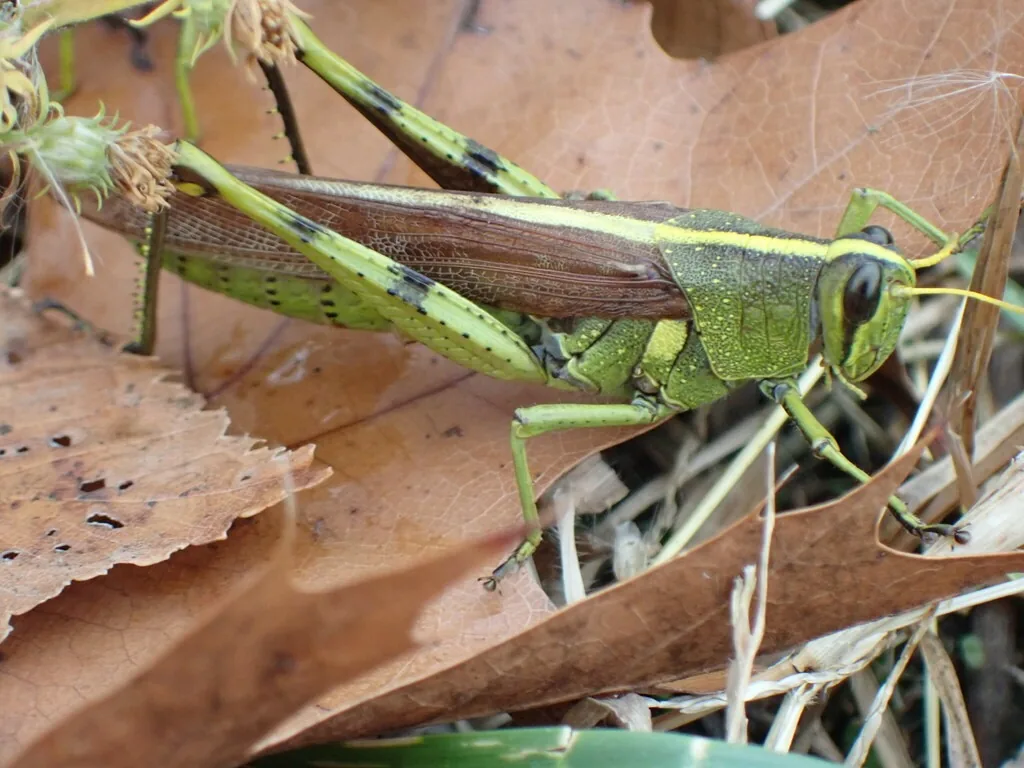
- The body is olive green, and the forewings are darker green, grayish or reddish brown; Nebraska specimens are described as dark purplish brown and green.[1][2]
- A yellow to greenish stripe runs from the top of the head down the back.[1][2]
- There is a bright yellow or green spot on each side of the thorax just behind the pronotum, and a bright yellow, green or white spot on the otherwise dark knee joint.[1]
- The upper surface of the femur has two dark bars, and the hind tibiae are black to green.[1][2]
- Bird grasshoppers are some of Missouri's largest short-horned grasshoppers: obscure bird grasshopper females can reach 2 1/2 to 2 3/4 inches, and Nebraska specimens measured 47 to 58 mm for females and 29 to 41 mm for males.[1][2]
Look-alikes
| Look-alike | How to tell them apart |
|---|---|
| Spotted bird grasshopper | The spotted bird grasshopper lacks the yellow spots on the side of the body in front of the hind legs, has rows of black dots along the abdomen, and its males have swollen front and middle femurs. Missouri treats it as its own species (Schistocerca lineata); Colorado State treats it as a subspecies, S. alutacea lineata, and describes it as a very long grasshopper, about 2 inches, and a strong flier that is never very abundant.[1][4] |
| American grasshopper (American bird grasshopper) | The American bird grasshopper has a large creamy stripe down the back, spotted wings, a white spot on the side of each knee, and a dark spot on each side of the pronotum split by a narrow pale stripe.[1] |
Where it lives
Missouri lists about 6 bird grasshopper species, calls the obscure bird grasshopper a common one and finds bird grasshoppers statewide. In Nebraska it appears limited to the southern half of the state, mainly in the east. GBIF's public U.S. records since 1990 (about 14,600) come from 19 states on the map, most from Texas, Florida and Oklahoma.[1][2][7]
Biology and life cycle
It lives in moist grassy areas and among young trees; around Lincoln, Nebraska, it is commonly found on young elms. Bird grasshoppers in general favor open grassy places such as prairies, pastures, old fields, roadsides and gardens, along with open woods and wood edges.[2][1]
Its diet is poorly known. It likely feeds on a variety of forbs, shrubs and trees, has been seen eating stinging nettle in Nebraska, and bird grasshoppers as a group are generalists that chew the foliage of many plants.[2][1]
Nymphs appear in spring, and adults are most common from late July to September in Nebraska. Young bird grasshoppers don't have full wings yet and can be colored quite differently from adults.[2][1]
Females push the tips of their long abdomens into the soil to lay egg clusters. Like most grasshoppers, adults live a single season and die with the hard freezes of late fall.[1]
Bird grasshoppers carry a small spine on the underside between the front legs, so they are sometimes called spur-throated grasshoppers, but they belong to their own subfamily rather than the true spur-throated grasshoppers.[1]
The genus has about 10 to 13 species north of Mexico and about 50 worldwide, and all but the desert locust live in the Americas. A 2006 DNA study concluded that the New World species descend from a single flight across the Atlantic from Africa, followed by many new species.[1][5]
Most species in the genus are sedentary grasshoppers that do not swarm. Even so, two non-swarming relatives reared in crowded cages in a 2013 study became more active, darker patterned and more attracted to each other, much like crowded locusts.[6]
Damage and signs
Health risk
It is a plant-feeding grasshopper; MDC and the Nebraska guide describe no risk to people.[1][2]
Control
Prevention
No control is usually needed: the Nebraska guide gives it no economic importance, and birds, mammals, toads, spiders, mantids, assassin bugs and robber flies all eat grasshoppers.[2][1]
Common questions
- What is the huge olive-green grasshopper with a yellow stripe on its back?
- It may be an obscure bird grasshopper: females can be 2 1/2 inches or longer, olive green with darker forewings, a yellow stripe down the back and a bright spot on each side of the thorax.[1][2]
- Why did the grasshopper fly up into a tree?
- Bird grasshoppers have large wings, and many can fly gracefully, almost floating, away from danger and up into trees. The obscure bird grasshopper is also found among young trees, such as elms.[1][2]
- Are obscure bird grasshoppers garden pests?
- Not usually. The Nebraska guide gives them no economic importance, and MDC notes grasshoppers are rarely as damaging to gardens as many other insect pests.[2][1]
- Is the obscure bird grasshopper a locust?
- Not a swarming one. It belongs to the same genus as the desert locust, but most species in the genus are sedentary and don't swarm. North America's swarming Rocky Mountain locust, which was not a bird grasshopper, went extinct in 1902.[1][6]
Sources
- Missouri Department of Conservation, “Bird Grasshoppers (Field Guide group page).” mdc.mo.gov/discover-nature/field-guide/bird-grasshoppers (accessed 2026-11-11)
- University of Nebraska-Lincoln Extension, “The Grasshoppers (Orthoptera: Acrididae and Romaleidae) of Nebraska, EB3 (M. L. Brust, W. W. Hoback and R. J. Wright).” extensionpubs.unl.edu/publication/eb3/2009/pdf/view/eb3-2009.pdf (accessed 2026-11-11)
- iNaturalist, “Schistocerca obscura taxon page (order and family).” www.inaturalist.org/taxa/67327 (accessed 2026-11-11)
- Colorado State University Extension, “Grasshopper Control in Gardens and Small Acreages (Fact Sheet 5.536).” extension.colostate.edu/resource/grasshopper-control-in-gardens-and-small-acreages/ (accessed 2026-11-11)
- Proceedings of the Royal Society B, via PubMed, “Ancient trans-Atlantic flight explains locust biogeography: molecular phylogenetics of Schistocerca (Lovejoy et al. 2006).” pubmed.ncbi.nlm.nih.gov/16618668/ (accessed 2026-11-11). Cited from the PubMed abstract.
- Journal of Insect Physiology, via PubMed, “Non-swarming grasshoppers exhibit density-dependent phenotypic plasticity reminiscent of swarming locusts (Gotham and Song 2013).” pubmed.ncbi.nlm.nih.gov/24035748/ (accessed 2026-11-11). Cited from the PubMed abstract.
- Global Biodiversity Information Facility (GBIF), “Schistocerca obscura: occurrence records in the U.S., 1990-2026 (GBIF occurrence search).” api.gbif.org/v1/occurrence/search?taxonKey=1707333&country=US&hasGeospatialIssue=false&occurrenceStatus=PRESENT&year=1990%2C2026&facet=stateProvince&facetLimit=400&limit=0 (accessed 2026-11-11). State counts are records reported (iNaturalist research-grade, museum specimens, surveys), not abundance.