On this page
How to identify it
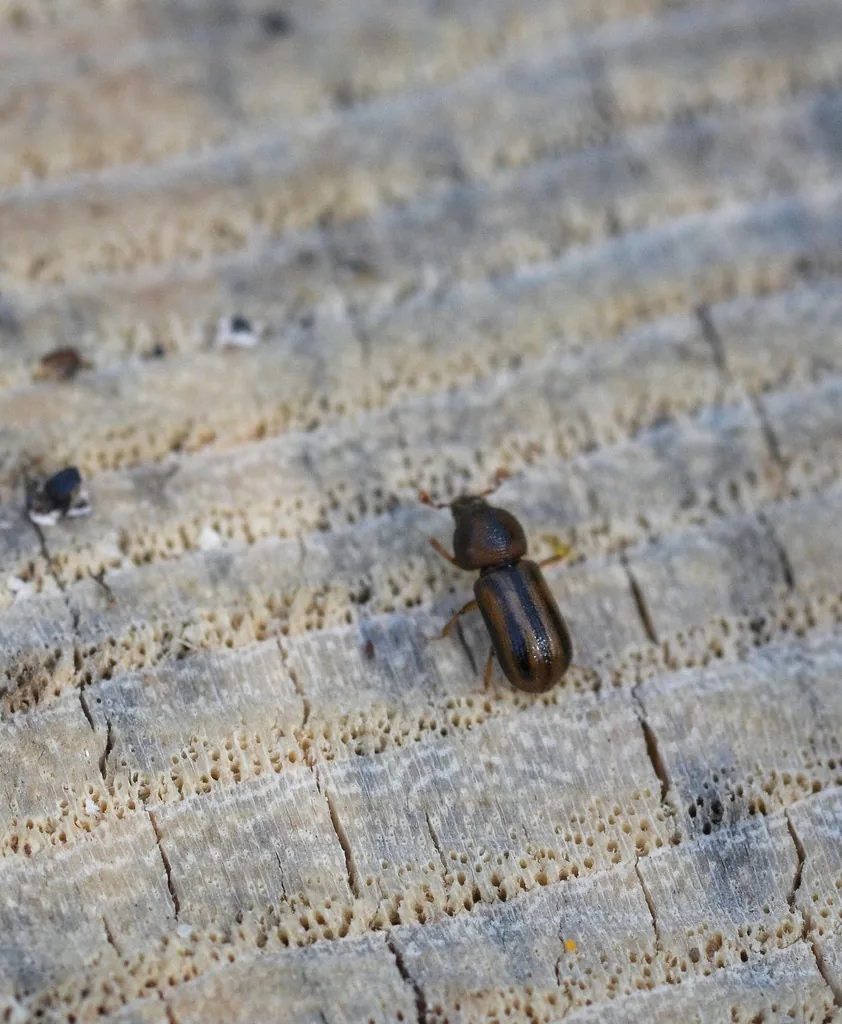
- Adults are small and cylindrical, brown to black with two lighter lengthwise stripes on each wing cover, averaging about 3.5 mm long and 1.5 mm wide (the Idaho guide gives 3.0 to 3.5 mm). The front of the head is convex in females and deeply concave in males.[1][3]
- The telling sign is the dust, not the beetle: ambrosia beetles penetrate the sapwood and throw out whitish sawdust, while bark beetles stay in the bark and produce brown boring dust. Look for small piles of white dust on the log, stump or dead tree, in bark crevices, on the ground, or floating in the water around boomed logs.[1][2]
- Entrance holes are very small and perfectly round, and a dark fungal stain shows up around them within a few days of attack. In sawn products the galleries appear as dark-stained pinholes with branching pupal niches on plywood veneer and on the tangential face of lumber. Trypodendron entrance holes are wider than the 1.3 mm holes of Gnathotrichus ambrosia beetles.[2][3]
- Under the bark, the gallery runs radially into the sapwood and then branches, following an annual growth ring in a horizontal plane, with larvae developing in short cradles aligned above and below the parent tunnels.[3][1]
Look-alikes
| Look-alike | How to tell them apart |
|---|---|
| Gnathotrichus ambrosia beetles | The other common western ambrosia beetles; they are dark reddish-brown without stripes, slightly longer and more slender, make smaller entrance holes, overwinter inside the log and will attack timber felled at any season, including debarked logs.[1] |
| Granulate ambrosia beetle (Xylosandrus crassiusculus) | An introduced ambrosia beetle of eastern hardwoods and nursery stock; the striped ambrosia beetle is a native western conifer species of logs and stumps.[1] |
| Pine bark beetles | Bark beetles tunnel in the bark and inner bark and produce brown boring dust; ambrosia beetles go into the sapwood and produce white sawdust and stain.[2] |
Where it lives
Holarctic. In North America the beetle is recorded from British Columbia, Manitoba, New Brunswick, Newfoundland and Labrador, Ontario and Quebec, and in the United States from Alaska and much of the West and North, with the heaviest infestations in coastal British Columbia and southeast Alaska and damaging populations in coastal Washington, Oregon and northern California. In Idaho it is known from counties across the state.[2][1][3]
Biology and life cycle
The genus overwinters as adults in forest litter and bark crevices near the brood tree, unlike Gnathotrichus, whose stages stay in the log. Flight starts when daytime temperatures exceed 60 to 65 degrees F for several hours (Natural Resources Canada gives 16 degrees C): it can begin in March or April, with the main flight from late April through May, and in British Columbia studies it ran through August with peaks in April-May and July-August, the later attacks mostly by re-emerged parents.[1][2][3]
Females start the boring in this species and produce an aggregation pheromone, identified as (+)-lineatin, that rapidly brings in many more beetles; the olfactory neurons tuned to lineatin are the most abundant class on the antennae. Beetles find suitable hosts by the volatiles of decaying conifers, including alpha-pinene and the ethanol produced anaerobically in stressed wood, and use non-host hardwood odors to rule out unsuitable material.[4][1]
Mating happens on the bark near the entrance hole, and the pair extends the gallery and keeps it clear of dust. Eggs are laid in niches along the brood galleries, and the larvae feed on the fungus the parents carried in, enlarging the niche into a pupal cradle. Development to young adults takes 6 to 10 weeks after the eggs are laid, and the new adults leave the log in June or July for their overwintering sites. There is one generation a year, though parent beetles may fly to a second host in mid to late summer.[1][3]
The beetles eat fungus, not wood. The mutualist is named as Phialophoropsis ferruginea in recent work and as Monilia ferruginea by Natural Resources Canada, and the larvae cannot develop without it; its growth in the wood makes the black and gray stain around the tunnels. The beetle's genome is small, 74 to 84 million bases, with contracted gene families for digesting plant cell walls, detoxification and immunity, which fits a diet of fungus rather than plant tissue.[4][2][1]
Damage and signs
- Attacks are concentrated in the sapwood, the knot-free outer wood that would otherwise yield clear lumber and veneer-grade plywood, so even light infestation downgrades high-value products. The Forest Service gives worked examples: a 33-foot Douglas-fir log 17 inches in basal diameter with galleries 3 cm into the sapwood suffers degrade on 28 percent of its volume, while a similar western hemlock log with galleries 8 cm deep may have degrade on 64 percent of the lumber volume. Mills also lose yield to heavier slabbing of infested logs, and some importing countries reject wood showing any insect damage or require costly treatment.[1]
- Susceptibility depends on when the wood was cut. Freshly cut and recently killed trees are rarely colonized, but logs cut between August and January are very susceptible the following spring; the beetle does not colonize a log for more than one year, and debarked logs are not attacked at any age. It prefers material felled the previous fall or winter, and in the Northwest the preferred hosts are Douglas-fir, hemlock and spruce down to about 15 cm in diameter.[1][2]
- Hosts include virtually all merchantable conifers: the beetle infests stumps, felled trees, and the bases of standing trees killed by other agents. In British Columbia, where at least five ambrosia beetle species attack commercial timber, this is the most abundant and damaging one.[3][2]
Health risk
A pest of logs and lumber with no reported effect on people; the sources describe degrade of wood products only.[1]
Control
Prevention
At sort yards and mills: keep high-value logs turning over quickly, avoid storing fall- and winter-cut logs, store logs in ponds or on watermist decks, keep green lumber away from log storage, debris and tree lines, locate sort yards away from forested areas, and remove nearby breeding and overwintering sites. Pond storage reduces infestation but exposed log surfaces are still attacked, so misting the pond surface during the flight season adds protection.[1]
Leaving limbs and foliage on downed trees can help: the transpirational drying that follows lowers wood moisture, and the ambrosia fungi need moist wood, so in some cases this reduces susceptibility to colonization.[1]
Sanitation
The key is moving logs out fast. Remove all logs from the forest as soon as possible after felling, and above all do not leave fall- and winter-felled timber in the woods through the spring beetle flight. Damage reports cluster around storm events and poor markets, when access is delayed or log inventory turns over slowly.[1]
Traps and physical control
Funnel traps baited with the synthetic aggregation pheromone monitor populations and reduce beetle numbers around mills and sort yards; trapping programs are widely used in British Columbia, Oregon and Washington. The Forest Service advises using them alongside the storage and turnover practices rather than on their own.[1]
Common questions
- Are these pinholes a sign my standing trees are infested?
- Not usually. Ambrosia beetles do not normally attack living trees; they colonize felled, dying or recently killed conifers, stumps and the bases of trees killed by something else.[2][3]
- Which logs are at risk?
- Conifer logs cut between August and January and still in the woods or the yard during the spring flight. Freshly cut and recently killed trees are rarely colonized, a log is only colonized for one year, and debarked logs are not attacked at all.[1]
- What causes the black stain around the holes?
- The fungus the beetles carry in and farm as food. Its growth in the wood produces the black and gray stain, which appears within a few days of attack and is as much of the lumber degrade as the holes themselves.[1][2]
Sources
- USDA Forest Service, Pacific Northwest Research Station, “Forest Insect & Disease Leaflet 170: Ambrosia Beetles of Western Conifers (Daterman and Overhulser).” www.fs.usda.gov/foresthealth/docs/fidls/FIDL-170-AmbrosiaBeetles.pdf (accessed 2026-11-10)
- Natural Resources Canada, Canadian Forest Service, “Striped ambrosia beetle (Trypodendron lineatum), Insects and Diseases of Canada's Forests factsheet 3005.” tidcf.nrcan.gc.ca/en/insects/factsheet/3005 (accessed 2026-11-10)
- University of Idaho, Idaho Forest, Wildlife and Range Experiment Station, “Furniss and Johnson. Field Guide to the Bark Beetles of Idaho and Adjacent Regions, Station Bulletin 74 (2002).” objects.lib.uidaho.edu/fwres/fwres201.pdf (accessed 2026-11-10)
- BMC Genomics (BioMed Central), open access via PubMed Central, “Comparative genomics reveal signatures of ecological specialization in the striped ambrosia beetle Trypodendron lineatum. BMC Genomics 27 (2026), PMC13270666.” pmc.ncbi.nlm.nih.gov/articles/PMC13270666/ (accessed 2026-11-10)
- iNaturalist, “Trypodendron lineatum taxon page (order and family).” www.inaturalist.org/taxa/452380 (accessed 2026-11-10)