On this page
How to identify it
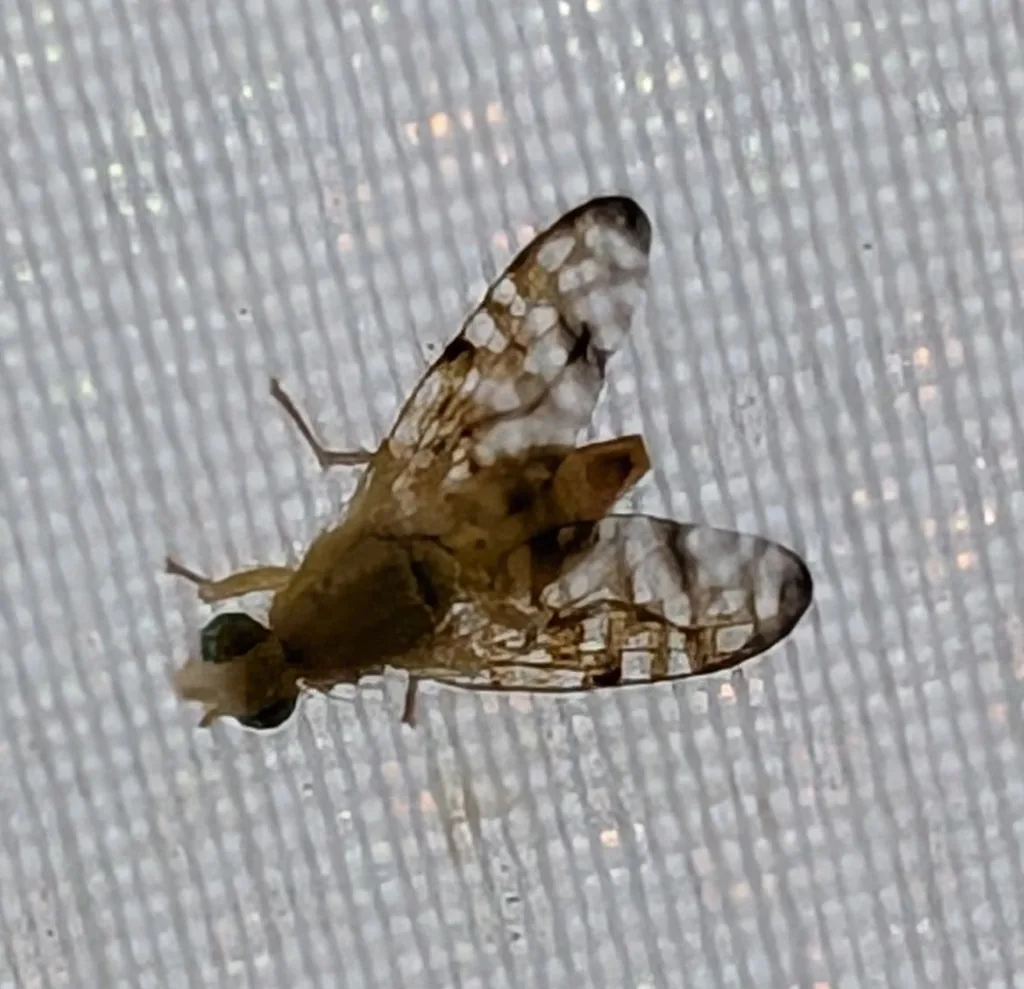
- The adult is a fly about 5/16 inch long by the South Dakota measurement (about 0.5 inch by the Pacific Northwest handbook's), with a wingspan of about 3/4 inch, a bright yellow body, bright metallic green eyes and wings with a mottled yellow-brown pattern.[1][2]
- The larvae are yellowish-white maggots about 5/16 inch long when mature and are found inside the sunflower head.[1]
- Exit holes in the receptacle of the sunflower head in August and early September show where mature larvae have left to pupate.[1]
Look-alikes
| Look-alike | How to tell them apart |
|---|---|
| Sunflower maggot (Strauzia longipennis) | Another sunflower fruit fly, whose larvae tunnel in the pith of the stalk rather than feeding in the head; it is also treated as a pest that rarely needs control.[1] |
| Sunflower midge | A very small midge whose larval feeding leaves heads undeveloped, gnarled or twisted, usually near field margins; the receptacle maggot is a larger yellow fly whose larvae feed in the receptacle without distorting the head.[1] |
| Banded sunflower moth and sunflower moth | Moth caterpillars that feed on pollen, florets and developing seeds in the head; the sunflower moth's larvae spin silk that gives the head a trashy look, whereas the receptacle maggot is a legless maggot that leaves only exit holes in the receptacle.[1] |
Where it lives
Described as a minor sunflower pest in South Dakota and listed as a sunflower insect by the Pacific Northwest handbook.[1][2]
Biology and life cycle
The pupa overwinters in the soil. Adult flies emerge in June and early July and lay their eggs on the bracts of the sunflower head.[1]
The larvae move into the head, feed on the receptacle, and then drop to the soil to pupate; most have dropped by late August and early September.[1]
Damage and signs
Health risk
Neither source mentions any effect on people; the fly is a sunflower insect only.[1][2]
Control
Prevention
No scouting method has been developed; in general, watch for the adults in June and early July and for exit holes in the receptacle through August and early September. Crop rotation generally keeps receptacle maggot populations in check.[1]
Pesticides
Chemical management is not considered necessary because the damage has not been linked to yield loss; the Pacific Northwest handbook lists pyrethroid products for commercial fields but says treatment is generally not considered necessary.[1][2]
Common questions
- What is the bright yellow fly with green eyes on my sunflowers?
- A yellow fly about 5/16 inch long with metallic green eyes and brown-mottled wings, seen in June and early July, is the sunflower receptacle maggot fly; its larvae feed in the base of the head.[1]
- Do I need to spray for sunflower receptacle maggot?
- No. Its feeding has not been shown to reduce yield, so neither South Dakota State nor the Pacific Northwest handbook considers treatment necessary; rotating the crop is enough.[1][2]
- What are the holes in the back of my sunflower heads?
- Exit holes in the receptacle in August and early September are where mature receptacle maggots left the head to pupate in the soil.[1]
Sources
- South Dakota State University Extension, “Chapter 11: Sunflower Insect Pests, P-00205-11 (A. Varenhorst, P. Rozeboom and P. Wagner, July 2021).” extension.sdstate.edu/sites/default/files/2021-08/P-00205-11.pdf (accessed 2026-11-10)
- Pacific Northwest Pest Management Handbooks (Oregon State University, Washington State University and University of Idaho), “Sunflower-Sunflower maggot (Gymnocarena diffusa), Pacific Northwest Insect Management Handbook.” pnwhandbooks.org/insect/agronomic/sunflower/sunflower-sunflower-maggot (accessed 2026-11-10)
- iNaturalist, “Gymnocarena diffusa taxon page (order and family).” www.inaturalist.org/taxa/522230 (accessed 2026-11-10)