On this page
How to identify it
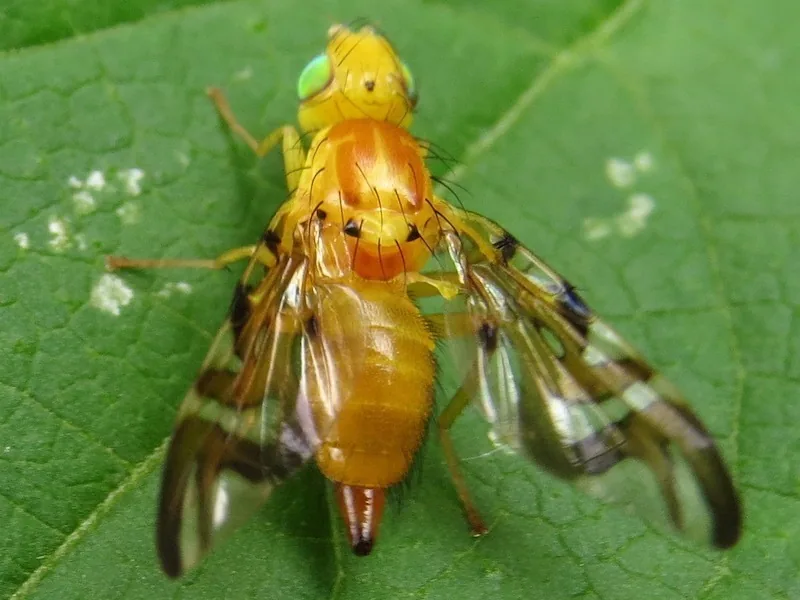
- The adult fly has a yellow head and legs and a light orange body. Its eyes are iridescent and range from green to orange.[1]
- The wings are clear with dark yellow to black bands; near the tip the bands form a reversed letter F. Manitoba Agriculture describes the same mark as a fairly distinct F-shaped pattern of broad dark bands near the wing tips, which separates this fly from the two other sunflower maggots, whose wings are mottled or lace-like.[1][2]
- SDSU Extension puts the adult at about 1/4 to 5/16 inch long; Manitoba Agriculture gives a body of about 6 mm (1/4 inch) and a wing spread of about 13 mm (1/2 inch). The larvae are creamy white, headless and legless, taper slightly at both ends and reach about 7 mm (0.28 inch).[1][2]
- The larvae are white to cream maggots with no visible head or legs, about 1/4 to 1/3 inch long when full grown, found tunneling in the white pith inside the stalk.[1]
Where it lives
SDSU Extension describes it as widespread and present in most sunflower fields, and Manitoba Agriculture covers it as one of three sunflower maggots found in Manitoba's sunflower crop.[1][2]
Biology and life cycle
There is one generation a year. Adults emerge from the end of May to mid-June and can be seen visiting sunflowers until the end of July.[1]
Females lay eggs near the growing point of the stalk. The larvae burrow into the stalk and tunnel through the pith.[1]
In August the larvae leave the stalks and move into the soil nearby. They spend the winter there as larvae and pupate the following spring.[1]
Damage and signs
- The tunnels are in the pith, which helps hold the stalk up but does not carry water or nutrients, so the feeding has little or no effect on how the plant develops and has not been linked to yield loss. Manitoba Agriculture adds that infestation levels have occasionally reached nearly 100 percent, and that in fields next to a grassed waterway or other water source, 8 to 10 larvae per stalk can occur and stalk breakage of up to 30 percent of plants has been recorded.[1][2]
- When there are 8 to 10 larvae in a plant, some stalks may break. In some fields every plant may be infested, but usually with only a few larvae each. The tunnels may also give plant diseases a way in.[1]
Health risk
Neither source mentions any harm to people; both treat it only as a stalk-boring insect of sunflower.[1][2]
Control
Prevention
No management is recommended. SDSU Extension says management strategies have not been developed for this insect because the feeding has little to no impact on the plant, and Manitoba Agriculture says insecticide use has not been warranted for sunflower maggots.[1][2]
Checking a field
Because it is not tied to economic losses, no scouting protocol has been developed. Infestations are more common near road ditches and grassy waterways. If you see lodged or broken stalks, split them and look for maggots in the pith.[1]
Common questions
- What is the orange fly with striped wings on my sunflowers?
- A small orange fly with iridescent green-to-orange eyes and dark bands across clear wings that form a reversed F near the tips is likely the sunflower maggot fly; the two other sunflower maggots have mottled or lace-like wings.[1][2]
- Are the maggots in my sunflower stalks hurting the plant?
- Usually not much. Sunflower maggot larvae feed in the pith, not on the heads or seeds, and their tunneling has not been linked to yield loss, though heavy infestations of 8 to 10 larvae per plant can cause some stalk breakage.[1]
Sources
- South Dakota State University Extension, “Chapter 11: Sunflower Insect Pests, P-00205-11 (A. Varenhorst, P. Rozeboom and P. Wagner, July 2021).” extension.sdstate.edu/sites/default/files/2021-08/P-00205-11.pdf (accessed 2026-11-09)
- Manitoba Agriculture (Government of Manitoba), “Sunflower Maggots (Insects, Crops).” gov.mb.ca/agriculture/crops/insects/sunflower-maggots.html (accessed 2026-11-10)
- iNaturalist, “Strauzia longipennis taxon page (order and family).” www.inaturalist.org/taxa/322166 (accessed 2026-11-09)