On this page
How to identify it
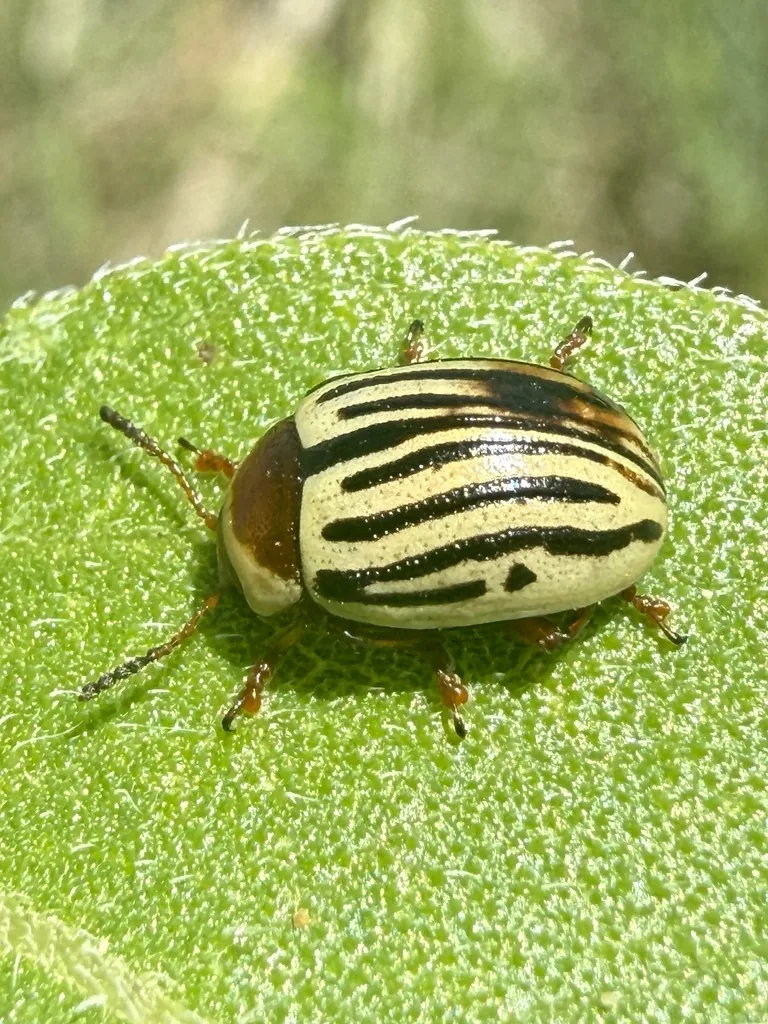
- Adults are leaf beetles about 1/4 to 3/8 inch long by Kansas State's measure (up to 1/2 inch in the PNW handbook), with a reddish-brown head and cream-colored wing covers.[1][2]
- Each wing cover carries three dark stripes running its length, plus a shorter stripe on the side that stops at mid-wing in a dot, like an exclamation point. The pale thorax has a reddish-brown patch at its base.[2][1]
- Larvae are slow-moving, yellowish green and humpbacked, with a swollen abdomen and a light brown head, reaching about a third of an inch.[1][2]
- Eggs are oval and pale yellow, laid in loose groups on the plants.[1]
Look-alikes
| Look-alike | How to tell them apart |
|---|---|
| Colorado potato beetle | Adult sunflower beetles resemble the Colorado potato beetle. Look for the sunflower beetle's own marks: three dark stripes down each wing cover with a short side stripe ending in an exclamation-point dot, a reddish-brown head, and a pale thorax with a reddish-brown patch at the base.[2][1] |
Where it lives
Kansas State calls it one of the most damaging defoliators of cultivated sunflower in North America. Damaging populations are rare in Kansas and more common farther north, and the Pacific Northwest handbook lists it among sunflower pests there.[1][2]
Biology and life cycle
It is closely tied to sunflowers. In Kansas, local populations live on wild sunflowers (Helianthus species) when cultivated sunflowers are absent.[1]
There is one generation a year. Adults spend the winter in the soil and come out in late spring. Each female lays 100 to 2,000 eggs over 40 to 60 days, and the eggs hatch in about a week.[1]
Larvae feed for up to six weeks, depending on temperature, then pupate in the soil. About two weeks later new adults come up, feed on the foliage for a short time, and go back into the soil for the winter; they mate the following spring.[1]
Damage and signs
- Adults feed soon after they emerge from the soil. Damage to the seed leaves is usually slight, but the first true leaves can be badly damaged or eaten entirely.[2]
- Adult feeding leaves small shot holes, while the larvae do more damage, chewing larger windows and holes in the leaves. When beetles are numerous, fields can be severely defoliated.[1][2]
Health risk
It feeds only on sunflower plants. Kansas State and the PNW handbook describe it as a crop pest and mention no risk to people or animals.[1][2]
Control
Prevention
Later-planted fields are usually hit less, so delayed planting is one option where the beetle has a history of damage. Tillage is not a control: North Dakota studies suggest it has little effect on the survival of the overwintering adults.[1]
Kansas State uses a degree-day model to time scouting: adults begin emerging at about 416 degree-days and are half emerged at about 710, counting from March 1 with soil temperature at 2 inches and a 32 degree F base. Sample in an X pattern across the field, checking 20 plants at each of at least 5 spots.[1]
Biological control
Weather and natural enemies kill many beetles. Hot, dry weather dries out eggs, heavy rain knocks larvae off the plants, and predatory bugs, ground beetles, birds and parasitic tachinid flies take a share. In many regions this may be enough to keep the beetle below damaging levels in most years.[1]
Pesticides
Kansas State thresholds: 1 to 2 adult beetles per plant at the seedling stage; on larger plants, 10 to 15 larvae per plant on the upper leaves, or 25 percent defoliation while most larvae are still feeding. Insecticides listed in the PNW handbook for sunflower fields include carbaryl, esfenvalerate, and lambda-cyhalothrin combined with chlorantraniliprole.[1][2]
Early studies suggest seed treatments can control adults early in the season and so reduce egg laying and larvae, but Kansas State says more data are needed to confirm they are reliable.[1]
Common questions
- What is the striped beetle eating my sunflower leaves?
- A cream-colored beetle with dark stripes down its back, and a short side stripe ending in a dot like an exclamation point, matches the sunflower beetle. Its humpbacked, yellowish-green larvae feed on the same leaves.[2][1]
- Is it a Colorado potato beetle on my sunflowers?
- The two look alike. The sunflower beetle is closely tied to sunflowers, and it has an exclamation-point dot at the end of the short side stripe on each wing cover.[2][1]
- When do sunflower beetles feed?
- Adults feed on young plants soon after they come out of the soil in late spring, and the first true leaves can be badly damaged. Larvae then feed for up to six weeks. Kansas State's threshold at the seedling stage is 1 to 2 adults per plant.[2][1]
Sources
- Kansas State University Department of Entomology, “Sunflower Beetle (J. P. Michaud, Facts and Information on Sunflower Pests).” entomology.k-state.edu/extension/crop-protection/sunflowers/sunflower-beetle.html (accessed 2026-11-08)
- Pacific Northwest Pest Management Handbooks (Oregon State, Washington State and University of Idaho Extension), “Sunflower-Sunflower beetle (Pacific Northwest Insect Management Handbook).” pnwhandbooks.org/node/6539 (accessed 2026-11-08)
- iNaturalist, “Calligrapha exclamationis taxon page (order and family).” www.inaturalist.org/taxa/1511599 (accessed 2026-11-08)