On this page
How to identify it
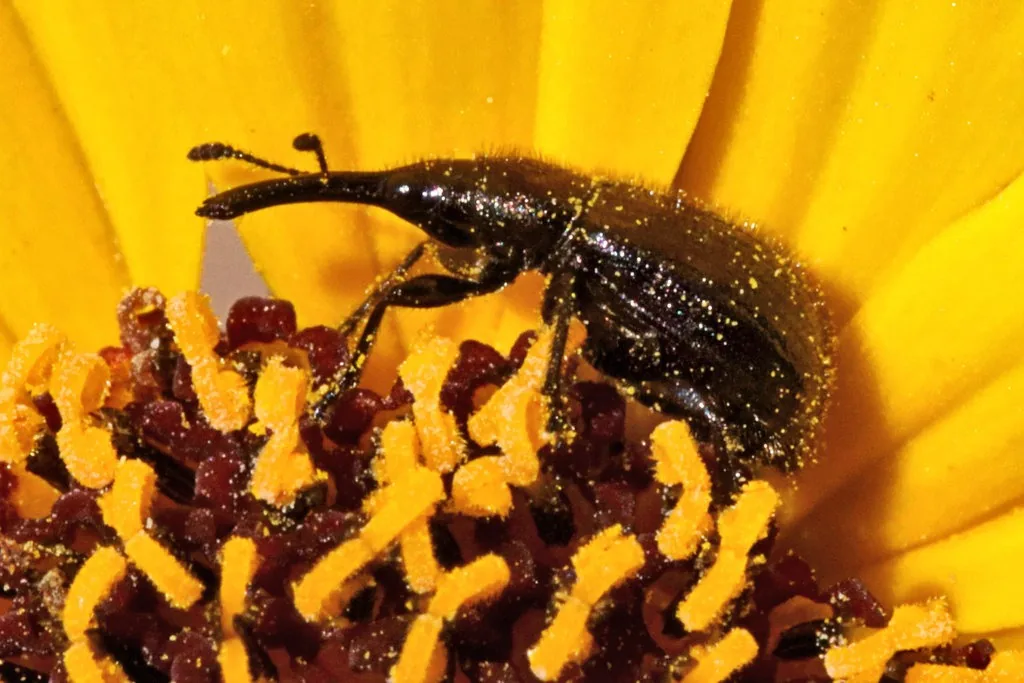
- The adult is a shiny black, slightly hairy weevil about 1/3 inch long, with a long, curved snout and fairly soft wing covers.[1][2]
- The damage is the easiest way to recognize it: flower heads, and sometimes leaves, hang partly severed from the plant. Open a clipped head and you will often find pairs of adult weevils covered in pollen.[1][2]
- Larvae are about 1/4 inch long, C-shaped and yellow or cream colored with a brown head. They are found developing in fallen sunflower heads.[2]
Where it lives
Colorado State describes it as widespread in eastern Colorado, Kansas State reports it in Kansas sunflower fields, and Colorado State cites losses of up to 25% recorded in individual fields in North Dakota. It is associated with native sunflowers, especially the common sunflower.[2][1]
Biology and life cycle
There is one generation a year. Adults emerge in early summer and are on sunflowers by July, as the plants approach bloom, feeding on pollen.[1][2]
Only females are thought to do the clipping. Before laying eggs, a female punctures and girdles the stalk below a developing flower so the head droops; if buds are not yet available, weevils sometimes cut leaf stalks instead. Kansas State suggests the clipping may make the head less suitable for other flower-feeding insects that would compete with the larvae.[1][2]
Eggs are laid in the hanging head. Kansas State says they are thought to hatch only after the head falls to the ground. The larvae feed on the decaying head, along with flowers and pollen, through four stages.[1][2]
Mature larvae leave the head and burrow into the soil to spend the winter; Colorado State puts this in October. They pupate the following year and emerge as adults in early summer.[1][2]
Besides sunflowers, it occasionally attacks other related plants.[2]
Damage and signs
- Adults girdle the flower stalks and leaf petioles, leaving flower heads partly severed and hanging.[1][2]
- In home gardens the damage is generally aesthetic. In fields it usually affects only a small share of plants in border rows or along field margins, with about 1 to 3% of heads clipped, although losses up to 25% have been recorded in individual North Dakota fields and the weevil has been abundant enough in some years in Kansas to cause appreciable yield losses.[2][1]
Health risk
Kansas State and Colorado State describe it only as a pest of sunflowers and mention no risk to people or animals.[1][2]
Control
Prevention
Scout fields for clipped, hanging heads, starting with the border rows where damage is usually concentrated. No specific economic thresholds have been developed, and treatment is not needed when adults are only seen occasionally.[2][1]
In home gardens, the damage is generally aesthetic and typically needs no management. Colorado State notes the weevil can be difficult to manage in small gardens.[2]
Pesticides
Treatment is rarely warranted. Kansas State suggests considering it when 10% or more of the heads are clipped and adult weevils are still active in the field. Sprays aimed at sunflower moth usually give some control; if you do treat for headclipping weevils, direct the spray at the backs of the flower heads rather than the faces.[1][2]
Common questions
- Why are my sunflower heads hanging from the stalk?
- The sunflower headclipping weevil is one likely cause. Adults girdle the stalk just under the flower head, leaving it partly severed and hanging. Open a hanging head and look for small black weevils covered in pollen.[1][2]
- Should I spray my garden sunflowers for headclipping weevils?
- Usually not. In home gardens the injury is generally aesthetic and typically needs no management. In fields, Kansas State suggests treatment only when 10% or more of heads are clipped and adults are still active, with the spray aimed at the backs of the heads.[2][1]
- Why does the weevil cut off the flower heads?
- Only females are thought to do it, and they lay their eggs in the clipped head, where the larvae develop. Kansas State suggests clipping may make the head less suitable for other insects that would compete with the larvae.[1]
Sources
- Kansas State University Department of Entomology, “Sunflower Headclipping Weevil (Sunflower Insects).” entomology.k-state.edu/extension/crop-protection/sunflowers/sunflower-headclipping-weevil.html (accessed 2026-11-08)
- Colorado State University Agricultural Biology, “Sunflower headclipping weevil.” agsci.colostate.edu/agbio/ipm-pests/sunflower-headclipping-weevil/ (accessed 2026-11-08)
- iNaturalist, “Haplorhynchites aeneus taxon page (order and family).” www.inaturalist.org/taxa/455137 (accessed 2026-11-08)