On this page
How to identify it
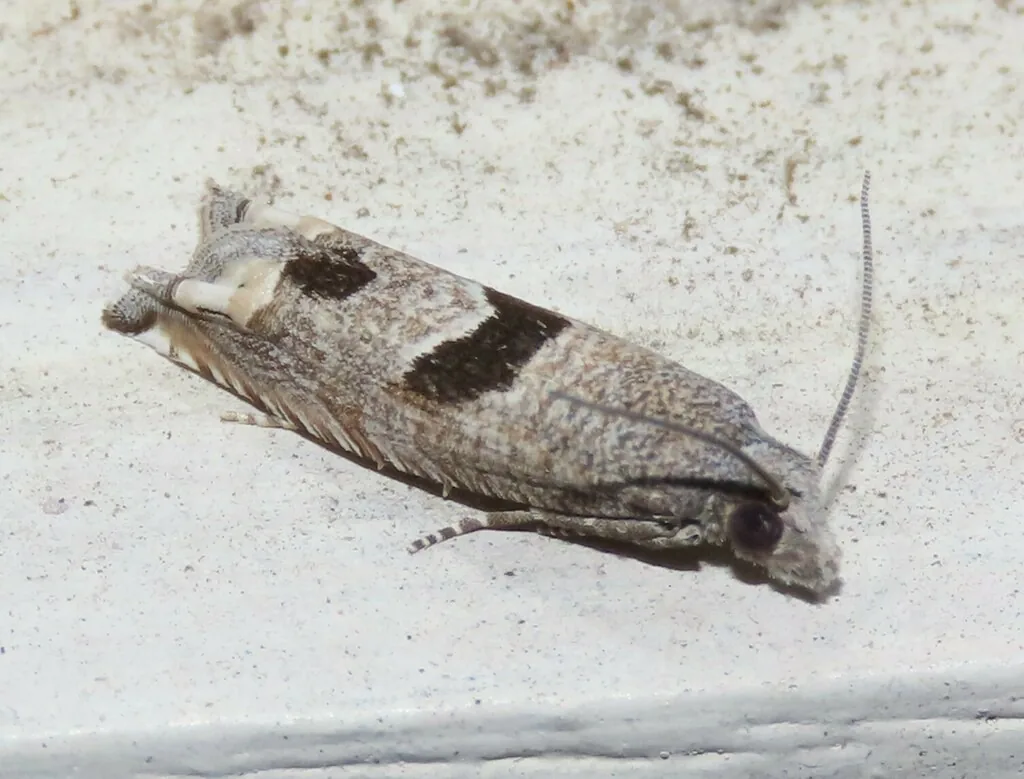
- The adult is a small gray to gray-brown moth with two dark bands across each forewing, one across the middle and one near the tip. Its wingspan is about 16 to 18 millimeters (roughly 2/3 inch), and it holds its wings folded over the body at rest.[1][2]
- The larva has a smooth, cream-colored body and a dark head, and is about 1/4 to 1/2 inch (8 to 11 millimeters) long when full grown.[1][2]
- The usual sign is a hole in the stalk or the back of the head with black frass (insect droppings) piled at the opening.[1][2]
Look-alikes
| Look-alike | How to tell them apart |
|---|---|
| Banded sunflower moth | Manitoba Agriculture warns not to confuse the adults with the banded sunflower moth, another small moth found on sunflowers that looks similar in some ways.[1] |
Where it lives
It feeds on wild and cultivated sunflowers and on common ragweed. The cited sources report it in sunflower fields in South Dakota, North Dakota and Manitoba.[1][2][3]
Biology and life cycle
It spends the winter as a larva in sunflower residue at the base of the plants and pupates in spring. In Manitoba, adults appear from the last week of May to mid-June and live for about 11 days.[1]
Females lay eggs in leaf axils or on the growing tips of young sunflowers, or on the back of the head of older plants. The eggs take about a week to develop, and the larvae go through five stages of about four to six days each.[1]
The hatched larvae tunnel into the plant and keep the burrow open, pushing frass out to the entrance. They pupate inside the plant right at the entrance hole so the adult can get out easily.[1][2]
There are up to two generations a year. In Manitoba the second-generation adults fly in July and August.[1][2]
Damage and signs
- Most feeding happens in the stalk, but larvae also tunnel into the developing head. Stem feeding occasionally leads to stalk breakage, though that damage is not usually economic.[2][1]
- The damage that matters comes when larvae bore into unopened buds and disrupt head development, which leaves deformed heads. Early in the season, flower buds are the moth's preferred egg-laying site.[1][2]
- Usually only a small share of plants in a field is affected. SDSU Extension calls it a minor pest in South Dakota and says its injury has not yet been tied to economic loss, while Manitoba Agriculture notes that populations occasionally reach economic levels.[2][1]
Health risk
These sources treat it only as a pest of sunflowers and do not mention any harm to people.[1][2]
Control
Prevention
Planting later helps. In a North Dakota study over nine site-years, sunflowers planted in early to mid-June had a smaller share of heads damaged by sunflower bud moth than those planted in mid- to late May, and yield losses were lower when populations were high.[3][1]
Biological control
Three species of parasitic wasps were found attacking sunflower bud moth in the Red River Valley.[1]
Pesticides
Insecticides are not recommended. The larvae feed inside the plant, which limits how well sprays work, and Manitoba Agriculture notes that no insecticides are registered there for this pest.[2][1]
Scouting
Adults can be seen resting on plants during the day. Frass around holes in the stalk or the back of the head means larvae are already inside; split the plant near a hole to find them. Numbers can be higher along field margins than in the middle of a field.[1]
No economic thresholds have been developed for this insect.[1]
Common questions
- What are the holes with black frass in my sunflower stalks?
- Holes in the stalk or the back of the head with black frass piled at the opening are a sign of sunflower bud moth larvae tunneling inside the plant.[1][2]
- Should I spray for sunflower bud moth?
- SDSU Extension does not recommend insecticides for this pest, because the larvae feed inside the plant and only a small share of plants is usually affected.[2]
Sources
- Manitoba Agriculture, Government of Manitoba, “Sunflower Bud Moth (J. Gavloski, revised January 2025).” www.gov.mb.ca/agriculture/crops/insects/pubs/sunflower-bud-moth-revised-january2025.pdf (accessed 2026-11-09)
- South Dakota State University Extension, “Chapter 11: Sunflower Insect Pests, P-00205-11 (A. Varenhorst, P. Rozeboom and P. Wagner, July 2021).” extension.sdstate.edu/sites/default/files/2021-08/P-00205-11.pdf (accessed 2026-11-09)
- Journal of Economic Entomology (via NCBI PubMed), “Impact of planting dates on a seed maggot, Neotephritis finalis (Diptera: Tephritidae), and sunflower bud moth (Lepidoptera: Tortricidae) damage in cultivated sunflower (J. J. Knodel et al.; Journal of Economic Entomology 104(4): 1236-1244, 2011; abstract).” pubmed.ncbi.nlm.nih.gov/21882688/ (accessed 2026-11-09)
- iNaturalist, “Suleima helianthana taxon page (order and family).” www.inaturalist.org/taxa/417012 (accessed 2026-11-09)