On this page
How to identify it
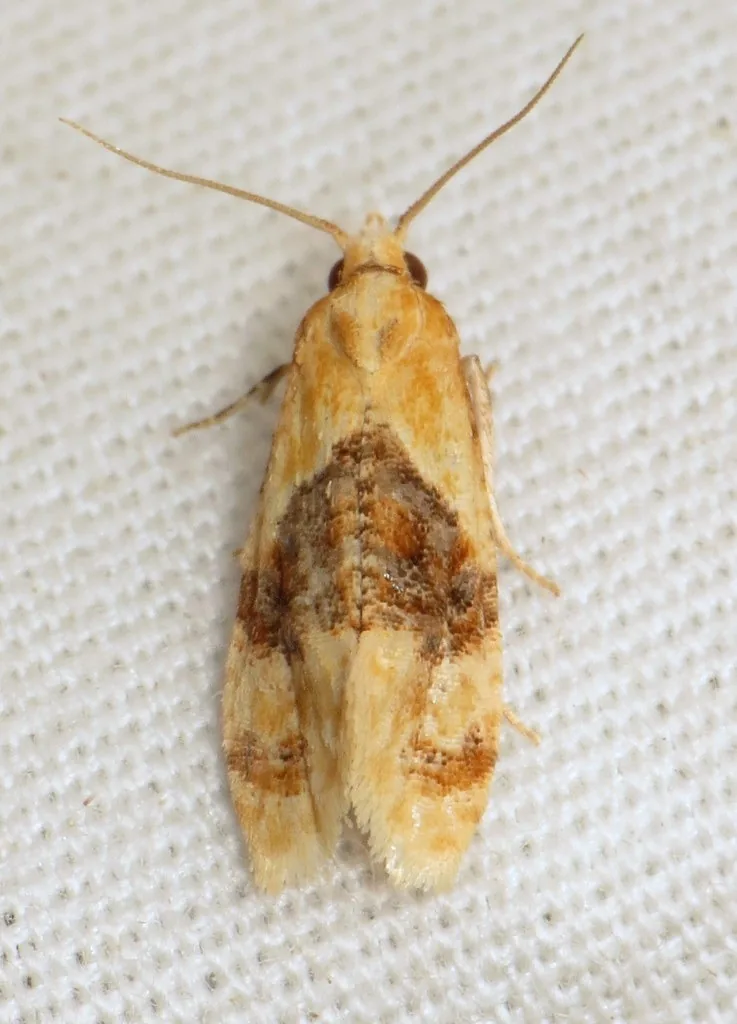
- The adult is a small moth with yellowish-tan forewings crossed by a dark band, and a wingspan of about 1/2 inch.[1][2]
- Larvae change color as they grow through five stages: off-white at first, then pinkish to red, and blue-green in the later stages. Young larvae have a dark brown to black head, older ones a light brown head.[2][1]
- Small patches of silken webbing on the face of sunflower heads are a sign of banded sunflower moth larvae.[2][1]
Look-alikes
| Look-alike | How to tell them apart |
|---|---|
| Sunflower moth | Sunflower moth caterpillars are black with light stripes running the length of the body and a distinctive orange head, becoming light brown with white stripes as they mature. The adults are mottled gray, with a wingspan of 1/2 to 1 inch, and hold their wings tight to the body at rest.[2] |
Where it lives
It is an important economic pest of sunflower in the Upper Great Plains of North America, where it causes significant yield losses, and SDSU Extension calls it a common sunflower seed pest. The Pacific Northwest insect management handbook also lists it as a pest of sunflower.[4][5][2][1]
Biology and life cycle
Adults emerge from their overwintering sites in mid-July and lay eggs on the outside of the bracts of sunflower heads through mid-August. The eggs hatch in five to eight days.[2]
Heads are open to infestation only while they are flowering. Larvae feed in the florets until the third larval stage, then tunnel into the seeds; a larva usually enters near the top of a seed and leaves by the same hole after eating the contents.[1]
Larvae are in the heads from mid-July to mid-September. When fully grown they drop to the soil to spend the winter.[2]
Researchers are testing sunflower lines for resistance. In multi-year field tests, several lines rated as resistant had fewer larvae per head and less seed damage than a susceptible line; one of them received more eggs than the susceptible line in two of three years but still had fewer larvae in all three.[5]
In a 2019 revision of the New World moths in its group, an entomologist at the National Museum of Natural History placed the species, long known as Cochylis hospes, in the genus Cochylichroa.[3][1]
Damage and signs
- Only the larvae cause damage. Young larvae feed on the bracts and then the open florets, which reduces the number of seeds in the head. Older larvae tunnel through the base of the florets into the seeds and eat the entire kernel; each larva destroys about five to seven seeds.[2][1]
- Losses come from fewer seeds and from lower seed weight and quality, and they can be significant.[4]
Health risk
These extension and research sources deal with it only as a sunflower seed pest and do not mention any harm to people.[1][2][4]
Control
Prevention
Research in North Dakota suggests that delaying sunflower planting until late May or early June may reduce infestations.[1]
Traps and physical control
In Manitoba, deep plowing of sunflower stubble in the fall reduced moth emergence the next season by about 80 percent.[1]
Biological control
Parasitic wasps attack the eggs and larvae, and general predators in sunflower fields eat both.[1]
Pesticides
SDSU Extension recommends treating the heads when either the egg or the adult threshold is reached. The moths gather around field margins just before the plants flower, and treating the margins then can significantly reduce adults while limiting cost and the impact on pollinators; spraying in the early morning or late afternoon also helps protect pollinators.[2][1]
The Pacific Northwest handbook lists Bacillus thuringiensis (some formulations are OMRI-listed for organic use), beta-cyfluthrin, chlorantraniliprole, cyantraniliprole, deltamethrin, esfenvalerate, gamma-cyhalothrin and lambda-cyhalothrin for banded sunflower moth in sunflower.[1]
Scouting and thresholds
Scout for eggs and adults mainly at the R2 to R3 growth stages. For eggs, check eight random sites of five plants each and count the eggs on six outer bracts of the bud on each plant, using a magnifying lens. Treatment is recommended above two to three eggs per six bracts, or when you find one adult per 100 plants.[2]
Sampling for adult moths can be difficult and inaccurate, while eggs can be counted accurately in the field with a headband magnifier. Researchers at North Dakota State University took egg samples from the center of 400-meter spans along every side of a field and used them to map how far an economically damaging population extends into the field interior.[4]
From mid-July through mid-September, look for small patches of silken webbing on the face of the heads, a sign of larvae.[2]
Common questions
- What is the webbing on the face of my sunflower heads?
- Small patches of silken webbing on the face of sunflower heads indicate that banded sunflower moth larvae are present. The larvae feed in the florets and then tunnel into the seeds.[2][1]
- When are sunflowers at risk from banded sunflower moth?
- Heads can be infested only while they are flowering. Moths lay eggs on the bracts from mid-July through mid-August, and larvae feed in the heads until mid-September.[1][2]
- Is it still called Cochylis hospes?
- Extension guides still use Cochylis hospes, but a 2019 revision moved the species to the genus Cochylichroa, and iNaturalist now lists it as Cochylichroa hospes.[1][2][3][6]
Sources
- Pacific Northwest Pest Management Handbooks (Oregon State, Washington State and University of Idaho Extension), “Sunflower: Banded sunflower moth (Pacific Northwest Insect Management Handbook).” pnwhandbooks.org/insect/agronomic/sunflower/sunflower-banded-sunflower-moth (accessed 2026-11-09)
- South Dakota State University Extension, “Chapter 11: Sunflower Insect Pests, P-00205-11 (A. Varenhorst, P. Rozeboom and P. Wagner, July 2021).” extension.sdstate.edu/sites/default/files/2021-08/P-00205-11.pdf (accessed 2026-11-09)
- Zootaxa (via NCBI PubMed), “New genera, new species, and new combinations in New World Cochylina (Lepidoptera: Tortricidae: Tortricinae) (J. W. Brown; Zootaxa 4671(2), 2019; abstract).” pubmed.ncbi.nlm.nih.gov/31716053/ (accessed 2026-11-09)
- Journal of Economic Entomology (via NCBI PubMed), “Using banded sunflower moth (Lepidoptera: Tortricidae) egg density to estimate damage and economic distance in oilseed sunflower (K. D. Mundal and G. J. Brewer; Journal of Economic Entomology 101(3): 969-975, 2008; abstract).” pubmed.ncbi.nlm.nih.gov/18613601/ (accessed 2026-11-09)
- Environmental Entomology (via NCBI PubMed), “Ovipositional preference and larval performance of the banded sunflower moth and its larval parasitoids on resistant and susceptible lines of sunflower (A. Chirumamilla et al.; Environmental Entomology 43(1): 58-68, 2014; abstract).” pubmed.ncbi.nlm.nih.gov/24367911/ (accessed 2026-11-09)
- iNaturalist, “Cochylichroa hospes taxon page (order and family).” www.inaturalist.org/taxa/1019818 (accessed 2026-11-09)