On this page
How to identify it
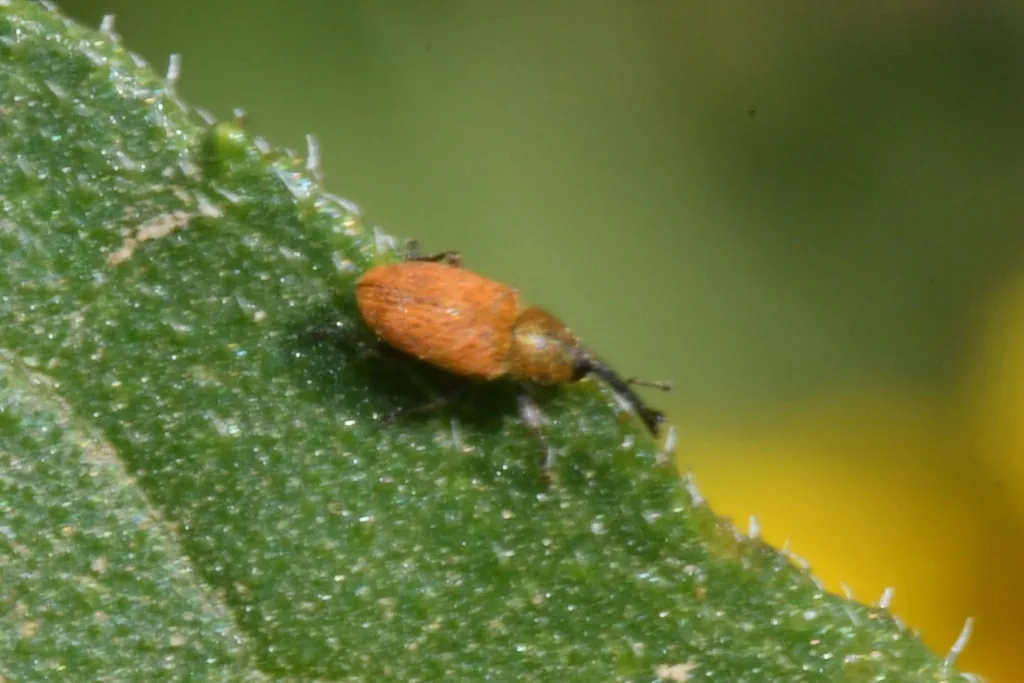
- The red sunflower seed weevil is tiny, about 2.5 to 3 mm (1/10 to 1/8 inch) long, and covered with reddish-orange, oval scales, so it looks reddish brown.[1][2]
- The gray sunflower seed weevil is gray and slightly larger, about 0.14 inch (3.5 mm) long.[2]
- The larvae of both species are small, about 0.12 inch (3 mm), cream colored, legless and C-shaped. Usually each infested seed holds a single larva.[1][2]
- Seeds hit by the gray weevil swell and stick up above the surrounding seeds, and they have no kernel inside. Seeds fed on by the red weevil are usually only partly eaten, which makes them hard to sort out from healthy seed.[1][2]
Look-alikes
| Look-alike | How to tell them apart |
|---|---|
| Minute pirate bugs | Manitoba Agriculture warns that minute pirate bugs are often present on sunflower heads and should not be counted as seed weevils when scouting.[1] |
Where it lives
Both species are covered as sunflower pests by Manitoba Agriculture, which notes that the red sunflower seed weevil is the more common of the two in the Canadian Prairies, and by the Pacific Northwest Insect Management Handbook.[1][2]
Biology and life cycle
Red sunflower seed weevil adults appear in late June on volunteer sunflowers, where they feed on the bracts and leave pinpoint holes. As the buds open they move onto the flower head and feed on the pollen of the disk flowers.[1]
Females lay their eggs inside the seed coat of developing seeds, and the larvae feed in the upper third of the seed. Weevil numbers peak when plants are at about 50 percent bloom, and egg laying follows seed filling from the outside of the head toward the center. Females do not lay eggs before the head reaches 40 percent bloom.[1]
In late August the mature larva chews an exit hole in the seed, drops to the ground beneath the head and spends the winter in the soil. It pupates there from early June to early July. A small percentage of larvae stay in the seed to pupate instead.[1][2]
Damage and signs
- Larval feeding lowers seed weight and oil content. Because most seeds are only partly eaten, damaged seed is hard to separate from healthy seed, and confection sunflower seed gets downgraded.[1][2]
- A gray seed weevil larva destroys the whole kernel, and the light, empty seeds can be lost at harvest. Even so, the gray species usually does not cause economic damage, especially in oil sunflowers, because its numbers and reproductive rate are low.[1][2]
- Larvae that stay in the seeds can cause heating and moisture problems at harvest and when bins are filled.[2]
Health risk
These are seed-feeding weevils of sunflower. Neither Manitoba Agriculture nor the Pacific Northwest handbook describes any risk to people.[1][2]
Control
Prevention
Early planting helps, because early fields finish flowering and are no longer open to egg laying by the time weevil numbers peak. Fall or spring discing reduces the number of adults that emerge.[1]
Start scouting when the yellow ray petals begin to show and keep going until the threshold is reached or most plants reach 70 percent pollen shed. Walk an X or Z pattern starting at least 100 feet (30 m) into the field, since edges give falsely high counts, and count the weevils on 5 plants at each stop, 25 plants in all. Brushing the face of each head firmly, or spraying it with a DEET mosquito repellent, drives the weevils to the surface.[1]
Sanitation
Where seed weevils are present, delaying harvest lets most of the larvae leave the seeds first.[2]
Biological control
Several kinds of parasitic wasps and flies attack the larvae in the seed, and a fungus in the soil kills them too.[1]
Pesticides
Insecticides, sometimes combined with trap cropping, are the main tool. Manitoba Agriculture puts the threshold at 10 to 12 weevils per plant for oil sunflowers and 1 to 2 per plant for confection sunflowers. If treatment is needed, apply before three out of ten plants reach 40 percent bloom, and spray in the late evening or early morning to limit harm to bees.[1]
The Pacific Northwest handbook lists beta-cyfluthrin, cyantraniliprole, deltamethrin, esfenvalerate, lambda-cyhalothrin, and lambda-cyhalothrin combined with chlorantraniliprole, and notes that thresholds vary with plant population, the cost of the insecticide and its application, and the market price of sunflower.[2]
Common questions
- When should sunflowers be checked for seed weevils?
- From the time the yellow ray petals start to show until most plants reach 70 percent pollen shed. Weevils do not lay eggs before heads reach 40 percent bloom, so any spray goes on before three out of ten plants reach that stage.[1]
- How do I tell red and gray sunflower seed weevils apart?
- The red sunflower seed weevil is about 0.1 inch long and reddish brown; the gray sunflower seed weevil is slightly larger, about 0.14 inch, and gray.[2]
- Are all the small insects on my sunflower heads seed weevils?
- Minute pirate bugs are often on sunflower heads too. Manitoba Agriculture warns not to mistake them for seed weevils when counting.[1]
Sources
- Manitoba Agriculture (Province of Manitoba), “Sunflower Seed Weevils.” www.gov.mb.ca/agriculture/crops/insects/sunflower-seed-weevils.html (accessed 2026-11-09)
- Pacific Northwest Pest Management Handbooks (Oregon State, Washington State and University of Idaho Extension), “Sunflower - Sunflower seed weevil, Pacific Northwest Insect Management Handbook.” pnwhandbooks.org/insect/agronomic/sunflower/sunflower-seed-weevil (accessed 2026-11-09)
- iNaturalist, “Smicronyx fulvus taxon page (order and family).” www.inaturalist.org/taxa/231109 (accessed 2026-11-09)