On this page
How to identify it
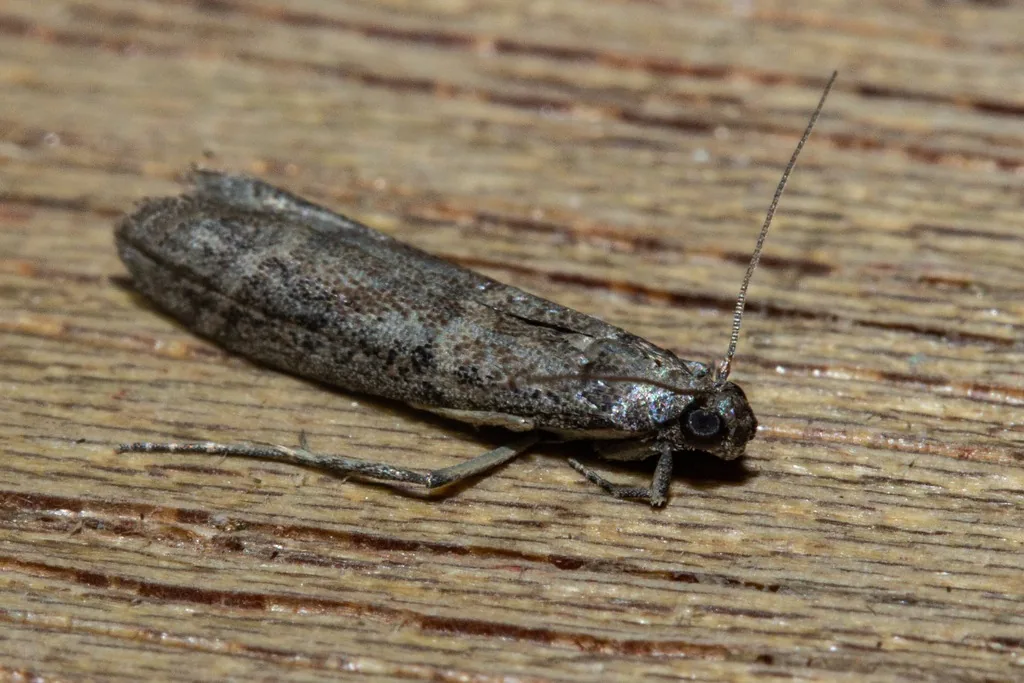
- The adult is a small moth up to 10 mm (about 3/8 inch) long with a wingspan up to 17 mm. It is grayish brown to bluish, with glossy forewings crossed by lighter stripes and whitish-gray hind wings. The wing color fades with age, so it is not a reliable way to identify the moth.[1]
- The caterpillar grows to about 15 mm (about 5/8 inch). Its color varies from white to light pink or yellowish, with dark spots at the base of its hairs and a brown head.[1]
- Signs of an infestation include webbing on the surface of stored food and in packaging.[1]
- Eggs are tiny (up to 0.5 mm), yellowish white and finely textured.[1]
Look-alikes
| Look-alike | How to tell them apart |
|---|---|
| Almond moth | A related stored-product moth in the same group. Because tobacco moth wing color fades with age, color alone does not separate them.[1] |
| Mediterranean flour moth | Another close relative listed alongside the tobacco moth as a stored-product pest.[1] |
| Indian meal moth | A closely related pantry moth that turns up in the same stored products, including peanuts in Georgia warehouses.[4][3] |
Where it lives
It is a pest of temperate climates. In the United States, a 2022-2023 survey of peanut warehouses in Georgia found it among the most common stored-product insects, with insect numbers peaking in June and July.[1][3]
Biology and life cycle
A female lays up to 300 eggs. Eggs hatch in 6 to 7 days, the caterpillar stage lasts 30 to 60 days over five larval stages, and the pupa, in a cocoon, takes 10 to 45 days. Adults live 14 to 21 days.[1]
At 20 degrees C (68 degrees F) and about 70% relative humidity, development from egg to adult takes 60 to 70 days, and there can be up to three generations a year.[1]
Full-grown caterpillars leave the food to pupate and to spend the winter.[1]
It infests cereals and grain products, dried fruit, nuts, almonds, cocoa beans, chocolate, tobacco, animal feed and herbal products.[1]
Damage and signs
- In stored tobacco the caterpillars eat the leaf down to the midrib and larger side veins, and they prefer sweet tobaccos low in nicotine.[1]
- Besides the food eaten, stored products are contaminated with droppings, webbing and cast larval skins.[1]
- Raw tobacco and manufactured tobacco products are lost to this moth and the cigarette beetle every year.[2]
Health risk
The sources treat it only as a pest of stored food and tobacco; none of them describe harm to people.[1][2]
Control
Prevention
Pheromone traps for male moths, sticky traps and checks for webbing on stored goods and packaging give early warning of an infestation.[1][2]
Sanitation
Clean storage areas thoroughly and keep storage times short. Store products cool, dry and in insect-proof containers or rooms.[1]
Biological control
Where infestations are light, releases of Trichogramma evanescens, a wasp that parasitizes the eggs, or Habrobracon hebetor, a wasp that parasitizes the caterpillars, can be used. Releasing parasitic wasps has become an important part of stored-product pest management.[1][5]
When to call a professional
In warehouses, approved contact insecticides and fumigation are used. Tobacco stores rely on sanitation, monitoring and fumigation with phosphine, but phosphine resistance and control failures have been reported.[1][2]
Common questions
- Can tobacco moths get into my pantry?
- Yes. Besides tobacco, the caterpillars infest cereals, grain products, dried fruit, nuts, cocoa and chocolate, so they can turn up in the same foods as other pantry moths.[1]
- How do I keep tobacco moths out of stored food?
- Keep storage areas clean, don't store food for long periods, and keep it cool, dry and in insect-proof containers. Check for webbing on food surfaces and packaging.[1]
Sources
- Julius Kuehn-Institut, German Federal Research Centre for Cultivated Plants, “Ephestia elutella (Huebner) (Tobacco moth, warehouse moth), stored-product pest fact sheet.” wissen.julius-kuehn.de/mediaPublic/Vorratsschutz/Schadinsekten/Steckbriefe/Ephestia_elutella_Speichermotte_Warehouse_moth.pdf (accessed 2026-11-09)
- Pest Management Science (via NCBI PubMed), “Activity of spinosad on stored-tobacco insects and persistence on cured tobacco strips (M. P. Blanc et al.; Pest Management Science 60(11): 1091-1098, 2004; abstract).” pubmed.ncbi.nlm.nih.gov/15532683/ (accessed 2026-11-09)
- Insects (via NCBI PubMed), “Peanut Aflatoxin: Impact of Postharvest Insect Infestation and Storage Systems (G. N. Mbata, J. K. Danso and R. L. Holton; Insects 15(11): 836, 2024; abstract).” pubmed.ncbi.nlm.nih.gov/39590435/ (accessed 2026-11-09)
- Frontiers in Physiology (via NCBI PubMed), “Genomic analyses provide insights into the genome evolution and environmental adaptation of the tobacco moth Ephestia elutella (J. Xu et al.; Frontiers in Physiology 14: 1187522, 2023; abstract).” pubmed.ncbi.nlm.nih.gov/37153218/ (accessed 2026-11-09)
- Insects (via NCBI PubMed), “Temperature Effect on the Growth and Development of Habrobracon hebetor Reared on Ephestia elutella Larvae (Y. Huang et al.; Insects 15(5): 336, 2024; abstract).” pubmed.ncbi.nlm.nih.gov/38786892/ (accessed 2026-11-09)
- iNaturalist, “Ephestia elutella taxon page (order and family).” www.inaturalist.org/taxa/219284 (accessed 2026-11-09)