On this page
How to identify it
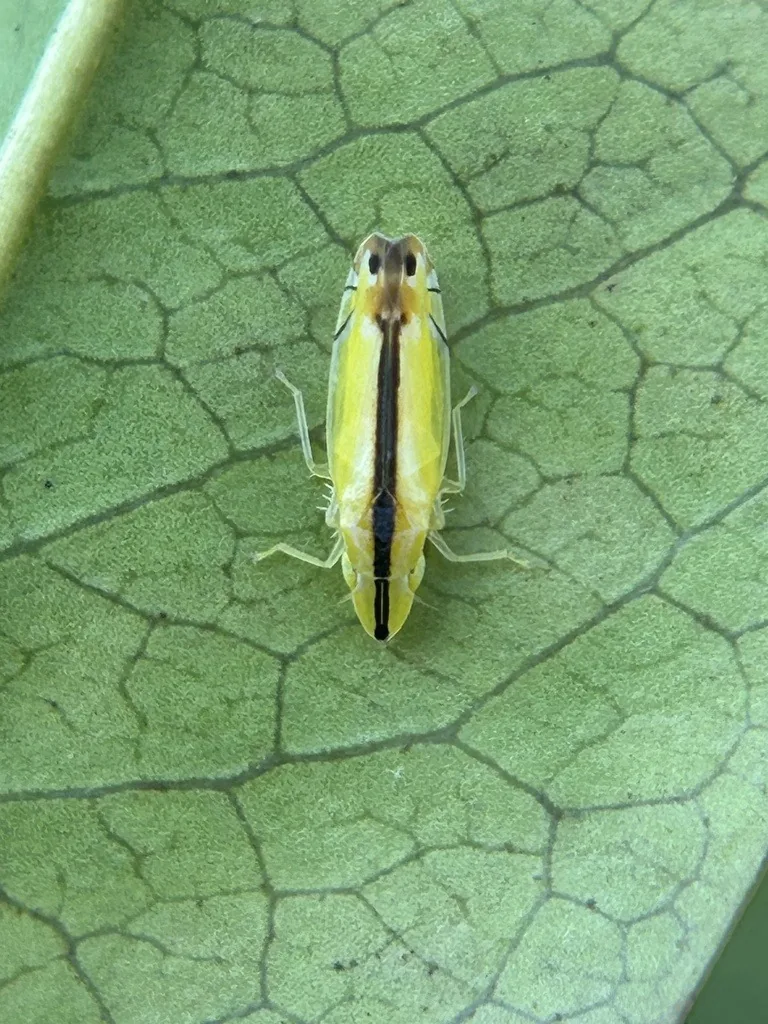
- Adults are 4.2 to 5.5 mm long and yellow, with a bold dark brown to black stripe down the middle of the back, sometimes edged in red, and two bold black eyespots at the tail end.[7][2][1]
- Its real eyes are the same yellow as its body, so the eyespots at the rear make it look as if it is walking backward.[1]
- Nymphs are pale yellow to green with two small dark spots at the rear of the body; the clear cast skins they shed keep the two spots and stay attached to leaves for a long time.[1][2]
Look-alikes
| Look-alike | How to tell them apart |
|---|---|
| Two-spotted cotton leafhopper | Only the names are alike: the two-spotted leafhopper is 4.2 to 5.5 mm long and yellow, with a dark stripe down its back and two black eyespots at the tail end. North Carolina's hopper survey says nothing else in that state's fauna can be confused with it.[7][2] |
Where it lives
Native to southern Asia, it was first recorded in North America in California in 1996 and has since spread across the southern United States from California east to North Carolina and Virginia. In Hawaii it was first found on a farm in Waimanalo, Oahu, in 1987 and now occurs on all the main islands except Niihau and Kahoolawe, from sea level to 4,000 feet.[2][1][4]
Biology and life cycle
Females insert their eggs into plant tissue, usually leaving no visible sign, so even closely inspected nursery plants can carry eggs.[1]
In University of Hawaii rearing work, adults were ready to breed 10 to 14 days after emerging and each female laid one or two eggs a day; eggs took about four weeks to hatch, and the four nymphal stages took seven to eight weeks to reach adulthood.[3][1]
Adults and nymphs turn up through most of the year, a sign of several generations a year, and adults come to lights at night; during Hawaii's winter one generation can take up to three months.[2][7]
It feeds on hundreds of plant species: CTAHR's host list passes 260, and a 1999 University of Hawaii biocontrol project counted more than 300 in 83 families. Hosts include avocado, banana, citrus, coffee, guava, macadamia, mango, hibiscus, mock orange, ti, chili pepper, sweet potato and taro, along with native koa, ohia and uluhe.[1][3]
Damage and signs
- Most plants it feeds on develop a prominent yellowing between the leaf veins; in severe cases the leaf collapses with a large brown or black patch, or the plant dies, and leaf distortion and stunting are common.[1]
- The injury is probably a reaction to the saliva injected during feeding, and it stays on the leaf being fed on: other leaves and new growth are not affected.[1]
- It has killed large patches of uluhe fern on Oahu hillsides, including Manoa and Palolo valleys, Aiea and Maunawili, with similar patches on Maui and Kauai; much of the dead uluhe along roadsides comes from its feeding.[1][4]
- Symptoms are probably worse on plants stressed by drought or poor growing conditions.[1]
Health risk
It feeds on plants; CTAHR, the Bishop Museum and North Carolina's hopper survey mention no risk to people.[1][4][2]
Control
Prevention
Look new plants over before you plant them, but expect to miss eggs: they sit inside the plant tissue with no visible sign. Clear, two-spotted cast skins on a plant's leaves show the leafhopper has been breeding there.[1]
Biological control
In Hawaii, tiny wasps in the family Mymaridae parasitize its eggs: two adventive species and an endemic Polynema were trapped on Kauai and the Big Island, and their numbers rose with the leafhopper's through the season.[6][7]
Pesticides
In a 2000 University of Hawaii trial, granular imidacloprid applied to potted plants of the endangered Munroidendron racemosum killed more than 80 percent of young nymphs for over five weeks at the higher rate; the researchers saw it as a tool for protecting rare plants in botanical gardens and the wild.[5]
Common questions
- Why does the two-spotted leafhopper look like it's walking backward?
- Its real eyes are the same yellow as its body, and the two eyespots sit at the tail end, so the rear looks like the head.[1]
- Is the two-spotted leafhopper killing uluhe ferns?
- Yes. CTAHR reports large patches of dying uluhe on Oahu hillsides and on Maui and Kauai, and the Bishop Museum says much of the dead uluhe along roadsides comes from this leafhopper's feeding.[1][4]
Sources
- University of Hawaii College of Tropical Agriculture and Human Resources, “Crop Knowledge Master: Sophonia rufofascia, The Two Spotted Leafhopper (V. P. Jones, M. T. Fukuda, D. E. Ullman, J. S. Hu and W. B. Borth).” cms.ctahr.hawaii.edu/ckm/Home/Insects-and-Other-Pests/Leafhoppers/Sophonia-rufofascia (accessed 2026-10-19)
- North Carolina Division of Parks and Recreation (NC Biodiversity Project), “Hoppers of North Carolina: Sophonia orientalis, Two-spotted Leafhopper.” auth1.dpr.ncparks.gov/bugs/view_1.php?id=14344 (accessed 2026-10-19)
- University of Hawaii College of Tropical Agriculture and Human Resources, “Biological Control of the Two-spotted Leafhopper (T-STAR project report, July 1998 to March 1999; J. Duan and R. Messing).” www.ctahr.hawaii.edu/t-star/leafhopper.htm (accessed 2026-10-19)
- Bishop Museum, Hawaii Biological Survey, “Good Guys & Bad Guys, card 98: Two-Spotted Leafhopper.” hbs.bishopmuseum.org/good-bad/sophonia.html (accessed 2026-10-19)
- Hawaiian Entomological Society (University of Hawaii ScholarSpace), “Imidachloprid as a Protectant for Endangered Plants Attacked by Sophonia rufofascia (Proceedings of the Hawaiian Entomological Society 34, May 2000; P. A. Follett, C. Empy-Campora and V. P. Jones).” scholarspace.manoa.hawaii.edu/items/1b141af6-cc53-4633-8809-b46a75202b8d (accessed 2026-10-19)
- U.S. Geological Survey Publications Warehouse, “Distribution and abundance of mymarid parasitoids (Hymenoptera: Mymaridae) of Sophonia rufofascia in Hawaii (Biological Control, 2002; P. Yang, D. Foote, A. Alyokhin, L. Lenz and R. Messing).” pubs.usgs.gov/publication/70024769 (accessed 2026-10-19)
- Texas Invasive Species Institute, “Two-spotted leafhopper, Sophonia orientalis.” tsusinvasives.org/home/database/sophonia-orientalis (accessed 2026-10-19)
- iNaturalist, “Sophonia orientalis taxon page (order and family).” www.inaturalist.org/taxa/448241 (accessed 2026-10-06)