On this page
How to identify it
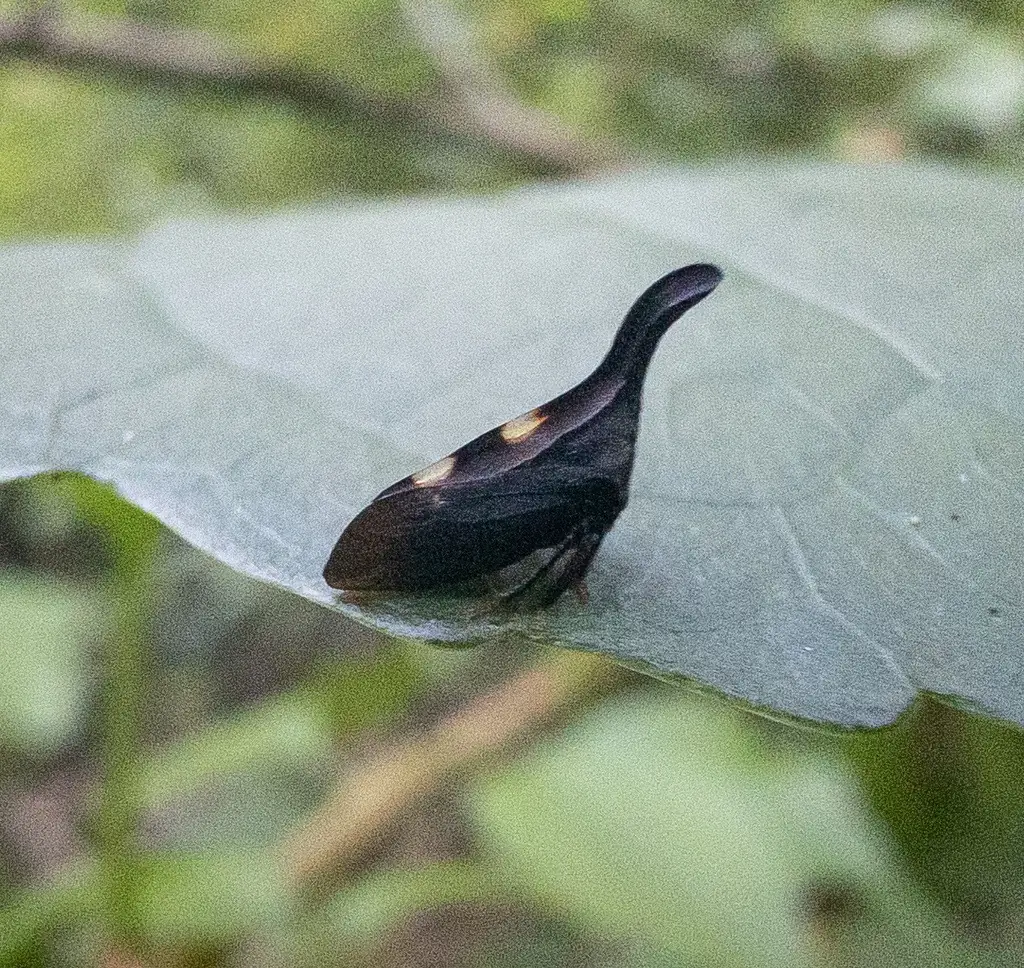
- Adults are about 8 mm long, brown-black, with two yellowish spots on the back. The hind legs are narrow and spined while the two front pairs are wide and flattened.[2]
- Adults often sit lined up in a row along a new shoot.[1]
- Nymphs are brown to dark gray with a pale white-gray overlay and feed in masses at the tips of new shoots.[1][2]
- Eggs are laid inside twigs through slits in the bark and covered with a secretion called egg froth that protects them through the winter.[2][1]
- Which host plant it is on matters: different species in the complex live on different hosts with strong host specialization.[3]
Look-alikes
| Look-alike | How to tell them apart |
|---|---|
| Buffalo treehopper | Another treehopper of woody plants. The twomarked treehopper is brown-black with two yellowish spots on the back and is tied to hosts such as redbud, black walnut, black locust, viburnum, hoptree and grape.[2][1] |
| Oak treehopper | Neither source records the twomarked treehopper on oak; its hosts are nut trees, black locust, redbud, viburnum, hoptree, bittersweet, willow and grapevines, and its two yellowish dorsal spots are the mark to look for.[1][2] |
| Keeled treehopper | The twomarked treehopper feeds on woody hosts, lines up on new shoots and leaves frothy egg masses on twigs; its adults are brown-black with two pale spots.[1][2] |
Where it lives
Mainly eastern North America, where the species complex is spread across its various host plants; Illinois Extension rates it as occasional (2 on a 1 to 5 frequency scale) but abundant where it occurs.[2][1]
Biology and life cycle
Hosts include hoptree (wafer ash), black walnut, butternut and other nut trees, shagbark hickory, black locust, viburnum including nannyberry, redbud, bittersweet, willow and grapevines. Each species in the complex is specialized on its own host.[1][2][3]
It overwinters as eggs under the bark of twigs, protected by the froth. Nymphs hatch in spring, move to the tips of the new shoots and feed in masses; they become adults after a little more than a month.[1][2]
Females lay eggs until August and keep laying until frost kills them. The saw-like ovipositor cuts a small slit in the twig, the eggs are forced under the bark, and the female seals the cut.[1]
Adults court by vibration: males send substrate-borne vibrations through the host plant, females sense them with structures on their legs and reply with their own vibrations when receptive.[2]
Damage and signs
- Feeding produces honeydew on which black sooty mold grows, turning the plant blackish, and egg laying leaves slits in the bark. Illinois Extension rates the damage 3 on a 1 to 5 severity scale.[1]
- On grapevines the treehopper does no direct feeding damage, but it can transmit Grapevine red blotch associated virus, which alters berry chemistry, delays ripening and lowers the quality and market value of the wine.[2]
Health risk
A sap-feeding plant insect; neither extension source mentions any effect on people or pets.[1][2]
Control
Prevention
Illinois Extension's advice is that this insect rarely causes enough damage to warrant control, even though it is abundant; the symptoms it leaves are honeydew, sooty mold and slits in the bark. Neither source describes a spray program.[1][2]
Common questions
- What are the white frothy blobs on my redbud twigs?
- Egg froth of the twomarked treehopper: the female cuts a slit in the twig, pushes her eggs under the bark and covers the site with a protective secretion that lasts through winter.[2][1]
- Do I need to spray?
- Rarely. Illinois Extension says the insect seldom does enough damage to warrant control; the honeydew and sooty mold are the main annoyance.[1]
- Why does it matter for grapes?
- It does not damage grapes by feeding, but Penn State reports it can carry Grapevine red blotch associated virus, which hurts berry chemistry, ripening and wine quality.[2]
Sources
- University of Illinois Extension, “Twomarked Treehopper (Enchenopa binotata), Hort Answers.” web.extension.illinois.edu/hortanswers/detailProblem.cfm?PathogenID=90 (accessed 2026-11-10)
- Penn State Center for Pollinator Research, “Bug of the Month: Two-marked treehopper, Enchenopa binotata complex (L. Laiton Jimenez, January 2023).” pollinators.psu.edu/assets/uploads/documents/BOTMJan2023_2023-01-20-205017_mvuw-Enchenopa-binotata-complex.pdf (accessed 2026-11-10)
- The American Naturalist (University of Chicago Press), “Adaptation without Specialization Early in a Host Shift (Rodriguez, Wood, Stearns, Snyder, Tilmon, Cast, Hunt and Cocroft 2021, The American Naturalist 198:333-346).” doi.org/10.1086/715629 (accessed 2026-11-10)
- iNaturalist, “Enchenopa binotata taxon page (order and family).” www.inaturalist.org/taxa/1087292 (accessed 2026-11-10)