On this page
How to identify it
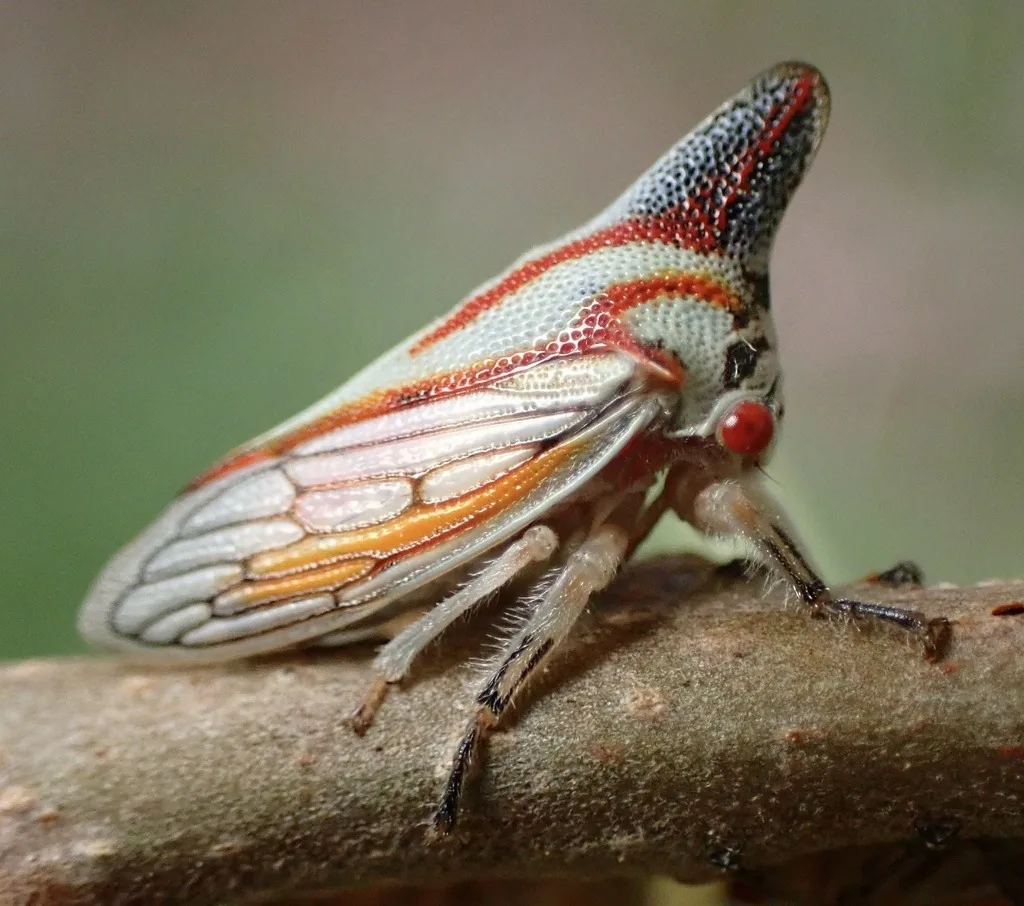
- An enlarged pronotum (the shield-like first segment of the thorax) extends back over the abdomen and, in many species, forward over the head; it is often humped or drawn into a thorn, spikes or other odd shapes, which distinguishes treehoppers from most true bugs they resemble.[1][2]
- Small: 1/2 inch or less in most species, with a few reaching 3/4 inch.[1][2]
- Mostly camouflage colors, tan, brown, gray, black or leaf-green with cryptic blotches, though some species carry bold patches or bands; the surface may be bumpy, hairy or jagged.[1]
- Rows of spines along the hind tibia, as in cicadas and leafhoppers; short bristle-like antennae; both nymphs and adults jump readily when disturbed.[2][1]
- Nymphs have numerous spines on the back of the abdomen and often bristly hairs, and they look like small wingless versions of the adults rather than grubs.[2][1]
- They sit motionless where you would expect a thorn or plant wart, often in the crotch of a branch or twig, sometimes in clusters, and the plant they are feeding on is usually a key to the species.[1]
Look-alikes
| Look-alike | How to tell them apart |
|---|---|
| Leafhoppers | Close relatives in the same superfamily with the same spiny hind legs, but their pronotum is not expanded into a hood or thorn; leafhopper bodies are parallel-sided or taper to the rear.[1][2][3] |
| Spittlebugs and froghoppers | Another group of small hoppers, listed by Missouri among the look-alikes; their nymphs surround themselves with small foamy masses that look like spit, something treehopper nymphs do not do.[1][4] |
| Buffalo treehopper | A brown or green treehopper about 2/5 inch long with a yellowish underside, found on ash, elm, fruit trees, hawthorn, locust, poplar and many herbaceous plants including tomatoes and peppers.[2] |
| Oak treehopper | Bronze to olive-green with reddish bands and a finely pitted pronotum; adults aggregate in rows on oak twigs in spring and the nymphs are black with red and yellow markings and two black spines.[2] |
| Threecornered alfalfa hopper | A green treehopper about 1/5 inch long with no distinct spines on the back; its nymphs are greenish with 12 pairs of hairy spines and a tail-like process, and it feeds on legumes and weeds and vectors Grapevine red blotch associated virus.[2] |
Where it lives
Treehoppers are found statewide in Missouri and across North America, with more than 260 species north of Mexico and at least 40 in California; individual species follow the distribution of their food plants.[1][2]
Biology and life cycle
Treehoppers feed by inserting a tube-like beak into a plant and drinking sap, much as aphids do. Woody trees and shrubs are the usual hosts, though nymphs and the adults of some species feed on herbaceous plants.[1]
Females insert their eggs into twigs. In Missouri the eggs overwinter and tiny nymphs hatch in spring; the nymphs resemble the adults and pass through several, commonly five, instars, the later ones with wing pads, before the final molt to the winged adult.[1][2]
Depending on location and species there are one to several generations a year. Some species feed together in groups, and in some the female guards her eggs and young.[2][1]
Many treehoppers have a mutual arrangement with ants, which drink the sugary excretions of the hoppers and protect them from predators in return. Treehoppers themselves feed many birds and predatory insects.[1]
Camouflage is behavioral as well as visual: treehoppers rest motionless where a thorn or wart would be, and a cluster on a twig can be very convincing. Some species come to lights at night.[1]
Damage and signs
- Feeding damage in landscapes is generally slight and does not threaten plant health. Treehoppers do excrete sticky honeydew, on which blackish sooty mold grows, fouling leaves, twigs and surfaces beneath infested plants.[2][1]
- The main injury is egg laying: females make numerous small slits or punctures in bark, which roughens it, and heavily egg-laden twigs may die back, with crooked or distorted regrowth where tips are killed. On herbaceous hosts, feeding and egg laying sometimes girdle and kill green stems.[2][1]
- Mature woody plants tolerate extensive egg laying; heavily infested young plants may grow more slowly. Only a few species are considered pests.[2][1]
Health risk
Treehoppers are plant feeders. Neither source reports any bite, sting or health risk to people or pets.[1][2]
Control
Prevention
Most treehoppers need no control; they rarely cause real trouble for their plants and feed birds and beneficial insects. Treat only where a known pest species was abundant the previous season and the damage cannot be tolerated.[1][2]
Sanitation
For species that feed on many plants, such as the buffalo treehopper and the threecornered alfalfa hopper, removing alternate hosts such as herbaceous weeds near the plants you value can reduce feeding on them.[2]
Traps and physical control
A forceful stream of water can give some control on small plants.[2]
Pesticides
If treehoppers were abundant on deciduous trees, shrubs or vines the previous season, horticultural (narrow-range) oil applied to thoroughly cover terminals during the dormant season kills overwintering eggs. During the growing season, high numbers of nymphs and adults can be reduced by spraying the exposed insects with horticultural oil, insecticidal soap (potassium salts of fatty acids) or another insecticide.[2]
Common questions
- There are green 'thorns' on my tomato stems that jump when I touch them. What are they?
- Treehoppers. The thorn is the enlarged pronotum behind the head, and the insects jump readily when disturbed. Species such as the buffalo treehopper feed on herbaceous plants including tomatoes and peppers as well as on trees.[2][1]
- The bark on my young tree's twigs is rough and split in rows. Is that treehoppers?
- Possibly. Females cut numerous small slits in bark to lay eggs, which roughens the bark; heavily used twigs can die back and regrow crooked. Mature trees tolerate it, and dormant-season horticultural oil on the terminals kills the overwintering eggs if the damage was intolerable last year.[2]
- How do I tell a treehopper from a leafhopper?
- Both have spiny hind legs and jump, but a treehopper's pronotum is expanded into a hood, hump or thorn that covers much of the body, while a leafhopper's is not. Treehoppers also tend to sit still in twig crotches rather than running sideways over leaves.[1][2]
Sources
- Missouri Department of Conservation, “Treehoppers (Field Guide).” mdc.mo.gov/discover-nature/field-guide/treehoppers (accessed 2026-11-10)
- University of California Statewide IPM Program, “Treehoppers (Home and Landscape).” ipm.ucanr.edu/home-and-landscape/treehoppers/ (accessed 2026-11-10)
- Missouri Department of Conservation, “Leafhoppers (Field Guide).” mdc.mo.gov/discover-nature/field-guide/leafhoppers (accessed 2026-11-10)
- Missouri Department of Conservation, “Spittlebugs and Froghoppers (Field Guide).” mdc.mo.gov/discover-nature/field-guide/spittlebugs-froghoppers (accessed 2026-11-10)
- iNaturalist, “Membracidae taxon page (order and family).” www.inaturalist.org/taxa/49024 (accessed 2026-11-10)