On this page
How to identify it
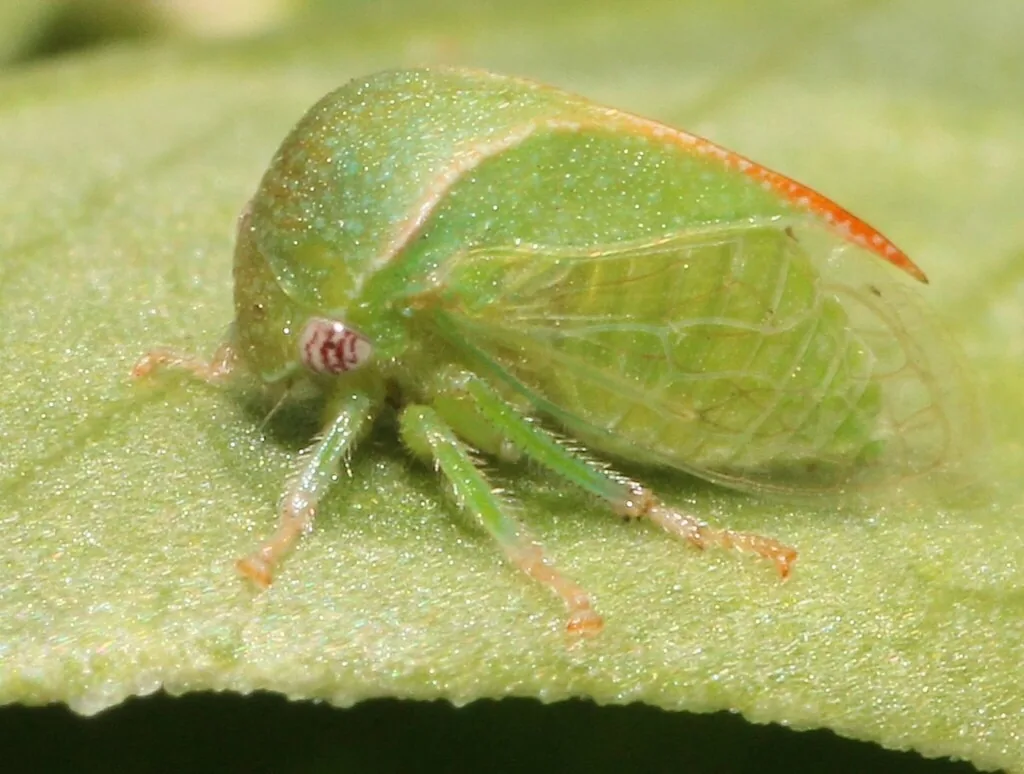
- Adults are green, robust and wedge-shaped, about 1/4 inch (6.4 mm) long, with clear wings. The body is highest and widest at the head and tapers toward the rear.[2][1]
- The name comes from the hardened triangular area over the thorax, which gives the adult a three-cornered outline seen from above.[2][1]
- Nymphs are grayish white and soft-bodied, shaped much like the adults but with a row of saw-toothed spines along the back. They cannot fly and stay low on the plant, feeding on the stems.[2][1]
- The telltale sign is a ring of feeding punctures around the stem that girdles it. The stem often swells above the girdle into a gall-like lump, sometimes with aerial roots or a callus.[1][2]
Look-alikes
| Look-alike | How to tell them apart |
|---|---|
| Potato leafhopper and other Empoasca leafhoppers | Also sap feeders in alfalfa, but Empoasca leafhoppers inject toxins as they feed. The threecornered alfalfa hopper does not, so it is usually less damaging than those leafhoppers.[2] |
Where it lives
Well distributed in the United States, from the Gulf states to Canada. In California it occurs in alfalfa year-round and is becoming more numerous in the Sacramento Valley.[1][2]
Biology and life cycle
In Kentucky it spends the winter as adults sheltering under plant debris or as eggs in protected plant tissue. Adults stir during warm spells in winter and become active as temperatures rise in April or May.[1]
In early spring, overwintered adults and newly hatched nymphs gather in weedy field margins, including vetch, and later move into crops. In soybean they arrive from other crops and weeds in May and June, feeding at the field edges first.[2][1]
Females insert their eggs into stems; in soybean about six eggs go into a slit under the epidermis near the base of the stem early in the season. Eggs take 7 to 10 days to develop at 88°F, and the five nymphal stages are completed in 8 to 13 days.[1][2]
Each female produces about 220 offspring. Soybean fields usually see two generations and three peaks of adults: overwintered adults moving in, first-generation adults, and second-generation adults leaving the field. Southern California has three to four generations a year.[1][2]
In California alfalfa, numbers usually peak in late September and October in the San Joaquin Valley, while the low desert has a peak in late July to early August and a larger one in September to early October.[2]
Hosts include cowpea, clover, sugarcane, potato, cotton, sunflower, tomato and some grasses, herbs and weeds, but legumes are preferred.[1][2]
Damage and signs
- Adults and nymphs suck sap from the phloem, mostly on the main stem and less often on branches or leaf stalks. The ring of punctures kills tissue at the feeding site and girdles the stem, and egg laying in the stem adds to the injury.[1][2]
- Girdled plants weaken and lodge or break off at the injury in wind and storms or under their own weight. In alfalfa, the part of the plant above the girdle turns red, purple or yellow.[1][2]
- It is an economic pest of alfalfa, soybean and peanut. In soybean it is sporadic, but outbreaks can thin stands and cut yields. Research found yield loss when plants were attacked while shorter than 10 inches and none when they were taller, and leaf-stalk feeding may not cause substantial damage.[1]
- Adults have recently been shown to transmit red blotch in grape vineyards.[2]
Health risk
A crop pest. Kentucky and UC IPM describe plant damage only and mention no risk to people or pets.[1][2]
Control
Prevention
Manage weeds in and around fields. Kentucky finds weed management around soybean fields effective, and UC IPM advises managing weedy alfalfa margins, such as vetch, where adults and young nymphs gather in early spring before moving into the crop.[1][2]
In alfalfa, an early harvest also helps manage this pest.[2]
Traps and physical control
Monitor with a 15-inch sweep net at 8 to 12 sites along a W-shaped path through the field, and look for stems with reddish discoloration and girdling at the base. Nymphs are hard to find because they stay low and cannot fly.[1][2]
Biological control
Assassin bugs and nabid bugs prey on the first three nymphal stages, which sit inactive low on the plants. Adults usually escape predators because they are active and have a hardened exoskeleton.[2]
Pesticides
Neither Kentucky nor UC IPM has a set treatment threshold, so combine sweep counts with the damage you see before deciding on insecticides. For soybeans that are setting pods, Louisiana recommends a treatment threshold of three nymphs per row foot or one adult per sweep.[1][2]
Common questions
- Why are my soybean or alfalfa stems swollen and breaking off?
- The threecornered alfalfa hopper is one cause. Its ring of feeding punctures girdles the stem, the stem swells above the girdle, and weakened plants lodge or snap at the injury. In alfalfa the growth above the girdle turns red, purple or yellow.[1][2]
- When does the damage matter most in soybean?
- When plants are attacked while still under 10 inches tall. Research cited by Kentucky found no yield effect from attacks on taller plants.[1]
- Does the threecornered alfalfa hopper affect grapes?
- UC IPM notes that adults have recently been shown to transmit red blotch in grape vineyards.[2]
Sources
- University of Kentucky Entomology Extension, “Threecornered Alfalfa Hopper in Soybeans, ENTFACT-158 (R. T. Villanueva).” entomology.ca.uky.edu/ef158 (accessed 2026-11-08)
- University of California Statewide IPM Program, “Threecornered Alfalfa Hopper, UC IPM Pest Management Guidelines: Alfalfa.” ipm.ucanr.edu/agriculture/alfalfa/threecornered-alfalfa-hopper/ (accessed 2026-11-08)
- iNaturalist, “Spissistilus festinus taxon page (order and family).” www.inaturalist.org/taxa/120884 (accessed 2026-11-08)