On this page
How to identify it
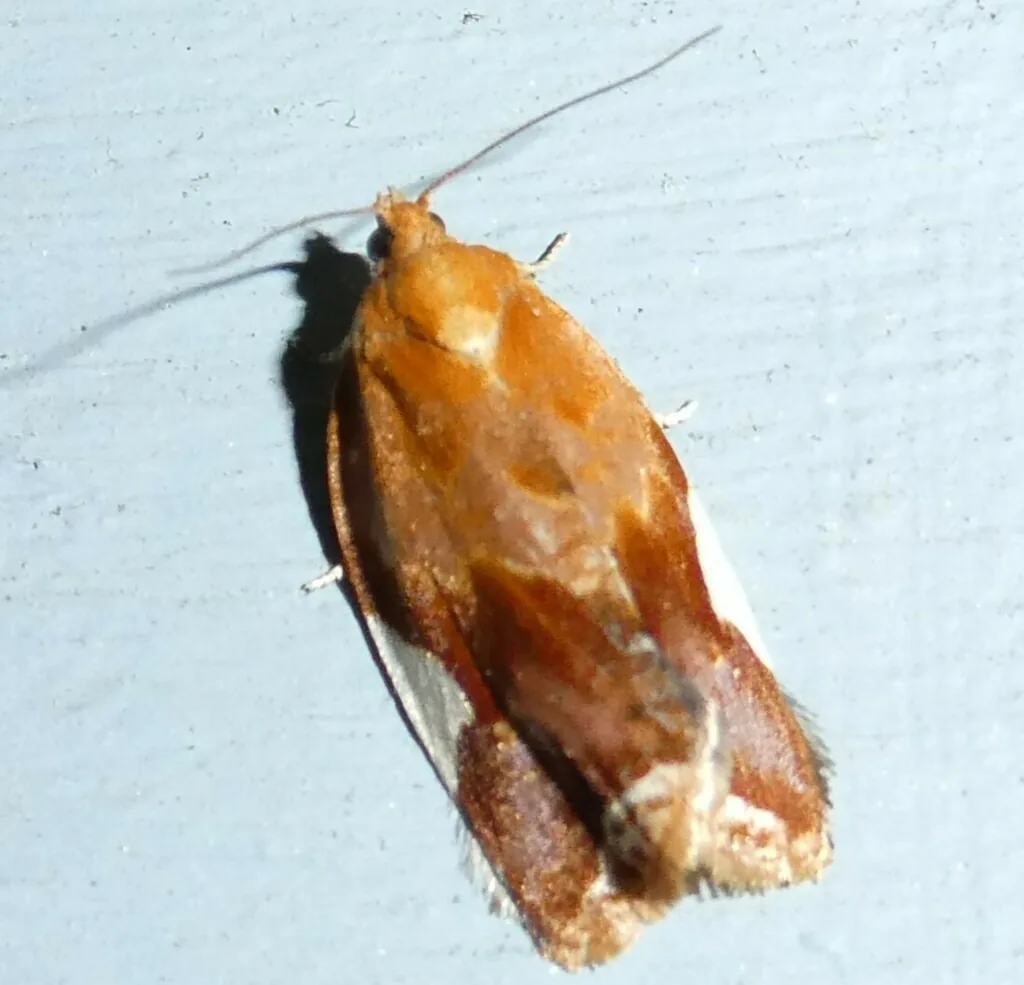
- The moth's forewings are orange near the body and turn darker and purplish toward the pale outer edge. Most have a sharp white triangle on the front edge of each forewing, though it is smaller in some western moths. The wing pattern alone is enough to tell it from other North American tortricid moths.[2]
- Forewings are about 8.5 to 11 millimeters (roughly 3/8 inch) long, with females slightly larger than males.[2]
- Full-grown caterpillars are 14 to 18 millimeters (about 1/2 to 3/4 inch) long, slender and pale or yellowish green, with darker green stripes along the back, and a yellowish-brown head and shield behind the head.[2][1]
Look-alikes
| Look-alike | How to tell them apart |
|---|---|
| Other leafroller caterpillars | The caterpillars are easily confused with those of related leafrollers, including other Clepsis species, Argyrotaenia leafrollers, Choristoneura budworms and leafrollers, and the light brown apple moth. The adult's white triangle is the clearer clue.[2] |
| Garden tortrix | A relative in the same genus. The whitetriangle leafroller's forewing pattern is enough to tell it from other North American tortricid moths, including this one.[2] |
Where it lives
It ranges from the northeastern United States west across southern Canada and the northern United States to British Columbia, and south to California and the Rocky Mountains. Natural Resources Canada also gives Virginia as a southern limit in the east.[2][1]
Biology and life cycle
It is a general feeder recorded on more than 40 species of trees and shrubs. Hosts include Douglas-fir, firs, spruces and pines as well as maple, birch, alder, aspen, willow, apple, cherries, blueberry, currant, rose and blackberry. It was first described from caterpillars on peach, but peach is not thought to be a main host.[2][1]
There is one generation a year, with moths from June to August. Eggs are laid in overlapping patches on the upper sides of leaves or on smooth bark.[2][1]
Newly hatched caterpillars can't build their own shelters. They lower themselves on silk looking for empty shelters left by other leafrollers, such as the eyespotted bud moth (Spilonota ocellana), and if they find none they drop to the ground and feed on low plants for the rest of the summer and fall.[2]
The sources differ on winter: the USDA APHIS fact sheet says half-grown caterpillars overwinter and finish feeding in spring, climbing back into trees and shrubs, while Natural Resources Canada says it appears to overwinter as eggs, with caterpillars from April to June.[2][1]
Caterpillars pupate under bark or in fallen leaves near the base of the tree; in Canada, pupation takes place in June and July.[2][1]
Damage and signs
Health risk
The sources describe it only as a leaf-feeding caterpillar of trees and shrubs; they mention no harm to people.[1][2]
Control
Prevention
Neither source recommends any control. Natural Resources Canada describes it as a common, innocuous defoliator in forests.[1][2]
Common questions
- What is the small orange moth with a white triangle on its back?
- Most likely the whitetriangle leafroller. Its orange forewings, darker toward the tips, with a white triangle on each front edge, separate it from other North American leafroller moths.[2]
- Is the whitetriangle leafroller a serious pest?
- Not in forests, where Natural Resources Canada calls it a common, innocuous defoliator. In fruit plantings the caterpillars can mark fruit by webbing leaves to it or feeding in the blossom end.[1][2]
Sources
- Natural Resources Canada, Canadian Forest Service, “Whitetriangle leafroller, Trees, insects and diseases of Canada's forests.” tidcf.nrcan.gc.ca/en/insects/factsheet/12030 (accessed 2026-11-09)
- USDA APHIS Identification Technology Program, “Clepsis persicana fact sheet, Tortricids of Agricultural Importance (T. M. Gilligan and M. E. Epstein).” idtools.org/id/leps/tortai/Clepsis_persicana.htm (accessed 2026-11-09)
- iNaturalist, “Clepsis persicana taxon page (order and family).” www.inaturalist.org/taxa/217190 (accessed 2026-11-09)