🧪 Active Ingredient Profile
Fipronil — Termidor, Frontline & Ant Bait Applications
Phenylpyrazole · CAS 120068-37-3
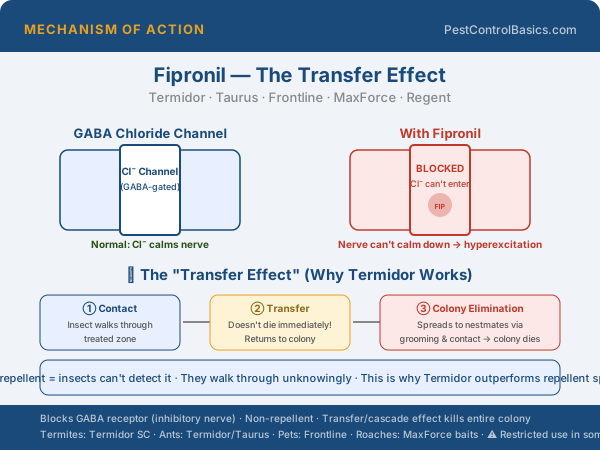
Fipronil is the active ingredient in Termidor (the gold standard termite treatment), Frontline flea products, and several ant baits. Its non-repellent, slow-acting properties make it ideal for products that need to transfer through colonies.
Mode of Action
Blocks GABA-gated chloride channels in insect nervous systems — distinct from pyrethroids (sodium channels); highly effective at low concentrations
🦺 Personal Protective Equipment (PPE)
Required PPE varies by formulation and application method. Always read the product
label — the label is the law and overrides general guidance.
- Chemical-resistant gloves
- Eye protection when mixing
- Long sleeves and pants
- Keep children and pets out during application
- Wash hands after handling
⚠️ Label compliance: The product label is a legal document under FIFRA.
Applying any pesticide in a manner inconsistent with its label is a federal violation.
📋 Application Best Practices
- Read the full label before each use — formulations change and label requirements may differ from previous products you've used.
- Apply at the right rate — more is not more effective. Over-application wastes product, creates unnecessary exposure, and is illegal.
- Target harborage and entry points, not just visible pest activity. Treating where pests hide is more effective than treating where you see them.
- Record the application — note the product, rate, area treated, and date. Required for commercial applications; best practice for homeowners.
- Ventilate the treatment area after application and before re-entry.
💡 Storage: Store in original container, away from children, in a cool dry location. Never transfer to food or beverage containers. Check local regulations for disposal — most areas have household hazardous waste collection events.
🌿 Environmental & Ecological Impact
🐝 Bees / PollinatorsVERY HIGH
🐟 Fish / Aquatic LifeMODERATE
🐦 BirdsMODERATE
🐕 Mammals / PetsLOW
🦐 Aquatic InvertebratesVERY HIGH
💡 Extremely toxic to bees and aquatic invertebrates. Used at very low concentrations in baits to minimize exposure.
❓ Frequently Asked Questions
Q: Is fipronil safe for pets?
Follow the product label. Keep pets out of treated areas until completely dried (2–4 hours for sprays). Once dry, treated surfaces pose minimal risk to dogs and cats.
Q: Can I use fipronil indoors?
Check the specific product label — formulations vary. Baits and dusts often have indoor labeling; concentrates and granulars are typically outdoor.
Q: How long does fipronil last after application?
Residual varies by formulation, surface type, weather, and UV exposure. Indoor applications last longer than outdoor. Check the product label for re-application intervals.
Q: What should I do if exposed?
Remove contaminated clothing, wash skin with soap and water. For eye contact, rinse 15–20 minutes. For ingestion or severe symptoms, call Poison Control (1-800-222-1222). Have the product label available.
🔮
Reviewed by Derek GiordanoContent reviewed by a licensed pest management professional and cross-referenced against EPA, university extension, and manufacturer technical data. Last reviewed: April 2026.
What's actually in the active ingredient column
Most pesticide products use a small number of active ingredients across many brand names. Pyrethroids (bifenthrin, cypermethrin, deltamethrin, lambda-cyhalothrin, permethrin) are the dominant household residual class — fast-acting, low mammalian toxicity, but increasingly affected by resistance in major pests. Neonicotinoids (imidacloprid, dinotefuran, thiamethoxam) are systemic-leaning and have specific uses for ant baits, termite treatment, and some flea products. Phenylpyrazoles (fipronil) underlie many termite, ant bait, and pet flea products. Insect growth regulators (pyriproxyfen, methoprene, hydroprene, novaluron) interrupt development rather than killing directly and pair well with adulticides. Botanicals (pyrethrum, spinosad) offer rapid knockdown but limited residual. Knowing the active ingredient class lets you rotate products properly and recognize when a 'new product' is really an old active in new packaging.
Choosing the right product formulation for the situation
Active ingredient gets most of the attention, but formulation often determines outcome. The same active ingredient in different formulations performs very differently: microencapsulated formulations last longer on porous surfaces and reduce human re-entry exposure, wettable powders give the longest residual on porous substrates but leave visible residue, suspended concentrates give a balance of residual and appearance, dusts are uniquely effective in wall voids and dry harborage but should never be broadcast indoors, baits are appropriate when pests must transport active to the colony or nest, and aerosols are appropriate for direct contact and quick knockdown but rarely give meaningful residual. Choosing formulation by the substrate (porous vs. nonporous), the access (open spray vs. crack-and-crevice vs. void), and the goal (knockdown vs. residual vs. transferable) routinely improves outcomes more than upgrading active ingredient.
Storing pesticides safely
Pesticide storage at home should follow specific practices for safety and product integrity. Original containers only — label information must remain attached. Locked storage cabinet or location inaccessible to children and pets. Cool, dry environment (not in unheated garages where temperature swings degrade product, and not in direct sun). Don't store with food, beverages, or personal care items. Don't store near ignition sources for flammable products. Keep an inventory and dispose of products that have exceeded shelf life (most pesticides retain efficacy for several years if stored properly, but separated emulsions, crystallized concentrates, or color-changed products should be discarded). Disposal: check with your local hazardous waste program; most municipalities have collection days or permanent drop-off sites for household pesticide disposal.
Application equipment that improves consistency
Better application equipment improves results more than better product. A one-gallon pump sprayer with adjustable nozzle ($30-50) outperforms hose-end sprayers for residual product application because it delivers consistent dilution. A hand duster ($15-25) is the only effective way to apply dust to wall voids, cracks, and crevices — pre-bottled dust products typically deliver inconsistent coverage. A foam machine adapter is useful for treating wall voids where dust would be inappropriate. Measuring cups and a measuring syringe ensure correct dilution at the label rate. A respirator (organic vapor cartridge) is required for some products and reasonable insurance for others. Equipment investments pay back across many treatments and are usually the missing element when product application produces inconsistent results.
When to escalate from DIY to professional
DIY pest control is appropriate for most common household pests when caught early and treated correctly. Escalation to a licensed professional makes sense in specific situations, not just when frustration builds. Wall-void and structural infestations — termites, carpenter ants, rodents nesting inside walls — usually require equipment and access homeowners don't have. Bedbugs at moderate-to-heavy infestation levels almost always require professional treatment; DIY rarely succeeds past the first few isolated bugs. Multi-unit dwellings (apartments, condos) need building-wide coordination that individual unit treatments can't replicate. Health-sensitive households — anaphylaxis risk to stings, immunocompromised individuals, pregnancy, infants — should default to professional because professionals can use the lowest-toxicity option that solves the problem rather than what's available at retail. The financial break-point is roughly when DIY material costs approach one professional visit; below that, DIY is usually fine.
Pesticide rotation and the resistance management problem
Resistance management — using multiple active ingredients in sequence so that no single mode of action selects for resistant individuals — is standard practice in agricultural and commercial pest control but rarely makes it into residential treatment decisions. The underlying concern is real: chronic use of a single pyrethroid product against bed bugs has produced widespread pyrethroid resistance, with some populations now showing resistance factors of 1000x or more. The same pattern is documented in German cockroach resistance to chlorpyrifos and other historical actives, mosquito resistance to organophosphates in heavy-use regions, and house fly resistance across multiple compound classes. For residential treatment, the practical implication is to avoid using the same active ingredient repeatedly across multiple treatment cycles; rotating between products in different chemical families (e.g., pyrethroid → neonicotinoid → insect growth regulator → carbamate, or whatever subset is appropriate to the target pest) reduces selection pressure and preserves efficacy. The product label specifies the active ingredient family, allowing rotation choices to be made on actual chemistry rather than brand name.
Trap and bait psychology: why placement beats product choice
Across pest categories, placement is more important than the specific brand or formulation chosen, and the diagnostic data backs this up. A mediocre bait placed in the correct location outperforms a premium bait placed wrong; a basic snap trap on a runway outperforms a designer electronic trap in the middle of a room. The underlying reason is pest behavior: most pests follow predictable physical patterns — walls, edges, vertical surfaces, harborage-to-food routes — and traps or baits intersecting those patterns get encountered, while traps placed for human convenience often don't. Practical placement principles that apply across pest types: along walls rather than in open spaces, between harborage and food/water sources, near observed activity rather than in 'symmetric' patterns, and in higher density (more units, closer together) than feels intuitively right. Cockroach gels go in corners and crevices, not on open surfaces; rodent traps go perpendicular to walls with trigger toward the wall; pheromone traps for moths go where moth flight has been observed, not centrally; ant baits go on observed trails, not where ants are 'expected.' Spending time observing pest behavior before deploying traps almost always pays back.
Application timing within the day and weather conditions
Pesticide applications produce significantly different results depending on application timing, and matching application to conditions improves outcomes substantially. For outdoor liquid applications, early morning (after dew has evaporated, before pollinators are active) and late evening (after pollinators have stopped foraging, before evening dew) produce best results: temperatures are moderate, wind is typically lower, and non-target exposure is reduced. Mid-day applications during high temperatures cause volatility losses and faster degradation. For interior treatments, timing depends on the pest: cockroach baiting works at any time but should follow rather than precede cleaning; bed bug treatments need to follow vacuuming and clutter reduction; ant baits work best when active trails are present, which often means specific times of day for specific species. Rain within 4 hours of outdoor liquid application washes off most surface residue except specifically rainfast formulations; checking the next 24-hour forecast before any outdoor treatment is the basic discipline that prevents this loss. Temperatures above 90°F or below 50°F outside the product label's recommended range produce reduced efficacy.
Reduced-risk pesticide selection: a category worth knowing
The EPA's reduced-risk pesticide program identifies active ingredients and formulations that meet specific criteria for lower toxicity to non-target organisms, reduced potential for groundwater contamination, lower likelihood of resistance development, or better compatibility with integrated pest management. Products in this category aren't free of toxicity — they're pesticides, and all pesticides have some toxic profile — but they represent the lower end of the risk distribution within their pest categories. For homeowners who want to use pesticides but are concerned about minimizing exposure and environmental impact, looking for products with reduced-risk actives is a defensible filter. Examples include some of the diamide insecticides, spinosyns, and certain microbial products. The catch is that retail availability lags behind the professional market for many reduced-risk products, and consumer pesticide aisles still skew heavily toward older pyrethroid and carbamate formulations. For homeowners willing to source products from agricultural supply channels or work with a pest control company that uses these products, the option exists; for those buying off the shelf at typical retail, the choices are narrower.
The role of inspection in long-term cost reduction
An inspection is the cheapest tool in pest management, and homeowners systematically underspend on it. The economics are unambiguous: an annual or semiannual inspection costs a small fraction of what any moderate treatment costs, and it catches problems while they're still cheap to address. Termite damage detected in its first season requires perimeter treatment; the same damage discovered three years later may require structural repairs running into five figures. Rodent activity detected through droppings before nesting establishes requires sealing and a few traps; the same activity discovered after a multi-generation infestation has set up in wall voids requires removal, exclusion, sanitation, and sometimes drywall work. The pattern repeats across nearly every pest category. Even households that don't engage a regular pest service should treat the annual inspection as a baseline expense — equivalent to the way they probably treat HVAC tune-ups, gutter cleaning, or smoke detector battery changes. The marginal cost of one trained set of eyes on the property each year is one of the most defensible expenses in home maintenance.
Pesticide drift and the neighbor dimension
Pesticide drift — the off-target movement of applied product through air, water, or runoff — is an under-discussed dimension of residential pesticide use, but it's an increasingly common source of conflict between neighbors and a real factor in the cumulative environmental load of pesticide use. Foliar sprays applied in even light wind drift further than most homeowners expect, particularly with finer droplet sizes. Granular products applied near property lines wash into adjacent properties in significant rainfall. Mosquito fogging can move across multiple properties depending on conditions. The implications are partly legal — drift onto neighboring property without consent has been the basis of successful nuisance claims in some jurisdictions — and partly ethical. Applying products only in low-wind conditions, choosing coarser droplet sizes when possible, using granulars rather than sprays near property lines, and timing applications to avoid imminent rainfall all reduce drift. For homeowners concerned about pesticide exposure from neighbors' applications, the productive conversation is usually about timing and product choice rather than about pesticide use in general, and approaching it that way tends to produce cooperation rather than escalation.