The short answer
- Confirm it first. The CDC says finding a live nymph or adult louse on the scalp or hair is the best way to diagnose head lice, and misdiagnosis is common.[1]
- Nits are glued to the hair near the scalp and won't flick off. Dandruff, hair spray and gel flakes brush or flick away easily.[8][10]
- Nits found only more than 1/4 inch from the scalp, with no live lice, usually mean an old infestation that doesn't need treatment, according to the CDC.[1]
- Treat only people who have lice (live lice, or nits within 1/4 inch of the scalp), all at the same time. Use one lice product exactly as the label says, and check with a health care provider before treating young children.[4][2][8]
- Lice in the US are widely resistant to permethrin and pyrethrins. If you find no dead lice 8 to 12 hours after treatment, or the lice seem as active as before, talk to your health care provider about a different medicine.[2][10][11]
- Comb wet hair with a fine-toothed metal nit comb, and keep checking for 2 to 3 weeks after treatment.[2][10]
- Skip the bug bombs and furniture sprays. Wash bedding and clothes used in the last 2 days in hot water, dry them on high heat, and vacuum. Lice die within about 2 days off a head.[2][1][10]
- The CDC says children with head lice don't need to be sent home early from school; they can be treated at home and return after starting treatment.[4]
Human lice profiles
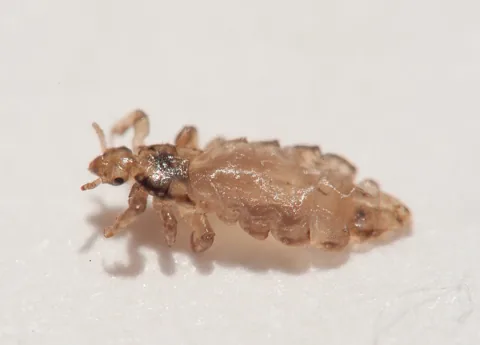 Head Louse
Pediculus humanus capitis
Head lice are wingless insects that live their whole lives on the human head, feeding on tiny blood meals from the scalp. They don't spread disease, and the fix is treating the person and combing out nits, not treating the house.
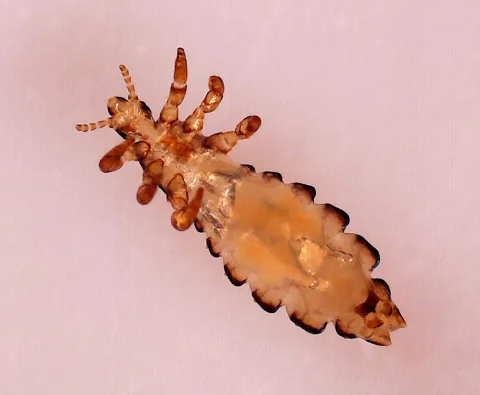 Body lice
Pediculus humanus humanus
Body lice are small insects that feed on human blood but live and lay their eggs on clothing and bedding. Unlike head lice, they can spread disease, and an infestation is usually cleared with regular bathing and hot-water laundering.
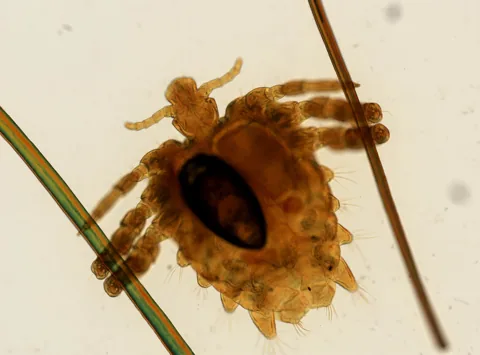 Crab Lice (Pubic Lice)
Pthirus pubis
Crab lice, or pubic lice (Pthirus pubis), are blood-feeding insects found only on people, usually in pubic hair, and they spread mostly through sexual contact.
What head lice are
The head louse, Pediculus humanus capitis, spends its whole life on the human head and takes tiny blood meals every few hours. Lice are found mostly on the scalp but sometimes on eyebrows and eyelashes. They are one of three kinds of lice that live on people; body lice and pubic lice are different insects, and having one kind doesn't mean you'll get another.[10][1][7]
- Size: adults are about 2 to 3 mm long, the size of a sesame seed, per the CDC. UC IPM gives 1/12 to 1/8 inch, and color from beige to gray.[1][10]
- Movement: each of their six legs ends in a claw that grips the hair. Lice crawl quickly but can't hop, jump or fly.[10][1]
- Eggs (nits): oval and about 0.8 mm (1/32 inch) long, glued to single hairs close to the scalp. The CDC says a female lays about six eggs a day; UC IPM says about 5 or more in 24 hours and about 100 over her life.[10][1]
- Development: the CDC says nits hatch in about a week (6 to 9 days); UC IPM gives 7 to 10 days. Nymphs take about 7 to 10 days more to become adults, and females start laying a day after that.[1][10]
- Lifespan: adults live about 30 days on a person, per the CDC, or 3 to 4 weeks per UC IPM. Off a head they die within about 1 to 2 days, and nits kept away from scalp temperature usually die within a week.[1][10]
- Who gets them: in the US, mostly preschool and elementary school children and their families and caregivers. The CDC cites an estimated 6 to 12 million infestations a year among children 3 to 11 years old.[1][5]
- Health risk: head lice don't spread disease. Scratching can cause sores that sometimes get infected with skin bacteria.[1][7]
- Hair type: the head louse common in the US grips round hair best, so infestation is much less common in people with Afro-textured hair. UC IPM notes that braiding still gives lice chances on any hair type.[1][10]
How head lice spread
Most head lice pass by direct head-to-head contact, which is common when children play together at school or at home. Less often, they spread through shared hats, scarves, coats, sports uniforms, hair ribbons, combs, brushes or towels, or by lying where an infested person recently lay.[1][10]
- Pets: dogs, cats and other animals don't get or spread head lice.[1][8]
- Swimming pools: lice can survive under water for several hours, but the CDC says they're unlikely to spread in a pool, and pool chlorine doesn't kill them.[1]
- Wigs and hairpieces: the CDC calls catching lice from one extremely unlikely, especially if nobody with lice has worn it in the past 48 hours.[1]
- Cleanliness: getting head lice has nothing to do with personal hygiene or a dirty home.[1][7][8]
How to check a head for lice
Itching is the most common symptom. It comes from an allergic reaction to the bites, and the first time a person has lice it can take four to six weeks to start, per the CDC; UC IPM says 1 to 4 weeks. Some people never itch, so itching isn't a reliable test. Other signs are a tickling feeling of something moving in the hair, trouble sleeping, and sores from scratching.[1][10]
Lice are small, move fast and avoid light, so they're easy to miss. UC IPM says wet combing is the best way to inspect a head.[1][10]
- Work under bright light. MedlinePlus suggests full sun or the brightest lights in your home in daytime, and a magnifying glass helps.[6][1]
- Look first at the nape of the neck and behind the ears, where nits are most often found.[1][4][6]
- Comb wet hair section by section with a fine-toothed louse comb, which makes small, fast lice easier to find.[10][1]
- If one person has lice, check everyone in the household. The CDC says to check household members every 2 to 3 days once lice are found.[4][2]
- When school outbreaks are going on, UC IPM suggests checking your child's head nightly with a metal lice comb. The Minnesota Department of Health encourages parents to check regularly through the year rather than relying on school checks.[10][8]
Nits vs dandruff and other look-alikes
Nits are often confused with dandruff, hair spray droplets and dirt. The quick test is to try to move it: a nit is cemented to one hair and stays put, while flakes, gel and spray residue flick or wash off.[1][8][10]
- Position: live nits are attached firmly within 1/4 inch of the base of the hair. Nits more than 1/4 inch out are almost always hatched or dead.[1][10]
- Color: UC IPM says developing eggs are dark and turn white after hatching. Minnesota describes nits as small, grayish and oval.[10][8]
- Exceptions: UC IPM says unhatched nits can sit farther from the scalp in very thick or braided hair, on people who wear hats constantly, and in warm climates.[10]
- Empty shells: an empty nit casing sticks to the hair like a live nit. A magnifying lens helps tell hatched from unhatched nits.[10]
- Nits alone don't prove an active infestation. UC IPM says diagnosis requires finding a living louse, and the CDC says nits only more than 1/4 inch from the scalp mean the infestation is probably old and doesn't need treatment.[10][1]
Treatment options
Treat only active infestations. The CDC says to treat all infested household members and close contacts, and people they share a bed with, at the same time. Minnesota does not recommend treating people without lice or nits. The CDC doesn't recommend specific products; ask a doctor, pharmacist or health department which they suggest, and consult a provider before treating young children.[2][8][4]
The CDC groups FDA-approved head lice medicines by active ingredient. Some kill only lice and need a second treatment once the eggs hatch; others also kill eggs or keep newly hatched lice from surviving. Ages below are the CDC's.[3][2]
- Pyrethrins with piperonyl butoxide (over the counter): plant extracts from chrysanthemum flowers that kill live lice but not eggs. Treat again 9 to 10 days later. Approved for age 2 and up; avoid if allergic to chrysanthemums or ragweed. The CDC says resistance may reduce how well they work.[3]
- Permethrin 1% lotion (over the counter): a synthetic pyrethroid that kills lice but not eggs, though it keeps killing newly hatched lice for several days. You may need to treat again on day nine. Approved from 2 months of age. Lice have developed some resistance to it.[3]
- Ivermectin 0.5% lotion: one application on dry hair, with no nit combing needed in most patients, for people 6 months and older. It doesn't kill eggs but appears to keep newly hatched lice from surviving. The FDA switched this lotion from prescription to over-the-counter in October 2020; the CDC's clinical page still lists it as prescription. Don't reuse it without talking to a provider.[3][5]
- Spinosad 0.9% topical suspension (prescription): made from soil bacteria, kills both lice and unhatched eggs, so retreatment is usually not needed and nit combing isn't required. Approved from 6 months. Repeat only if crawling lice are seen seven days after the first treatment.[3][2]
- Benzyl alcohol 5% lotion (prescription): kills lice but not eggs, so treat again after 7 days. For people 6 months and older; its safety over age 60 is unknown and it can irritate skin. UC IPM notes it is flammable.[3][10]
- Malathion 0.5% lotion (prescription): an organophosphate that kills lice and some eggs, for ages 6 and up. It's flammable: no smoking, hair dryers, curling irons or flat irons while it's on and the hair is wet. Treat again if live lice are present 7 to 9 days later.[3]
- Dimethicone (non-prescription, not on the CDC's list): a silicone that UC IPM says blocks the lice's breathing system. UC IPM reports 70% to 97% of patients lice-free after 2 weeks in randomized trials of 4% dimethicone, no reported resistance, and no absorption through the skin. UC IPM advises a second treatment after 7 days.[10]
- Oral ivermectin: the CDC says tablets are not FDA-approved for lice but are effective as a single dose repeated in 9 to 10 days. They are not for children under 15 kg or for pregnant women.[3]
- Lindane shampoo: no longer available in the US because of its risk of severe nervous-system side effects, and the CDC reports the AAP no longer recommends it.[3]
Using a lice treatment safely
Lice medicines are insecticides, and the CDC warns they can be dangerous if misused or overused. Read the label for how long to leave the product on and how to rinse it out.[3][2]
- Don't use conditioner or a shampoo-conditioner before applying lice medicine, and don't rewash the hair for 1 to 2 days after rinsing it out.[2]
- Remove clothing that could get wet or stained. Shoulder-length or longer hair may need a second bottle.[2]
- Rinse over a sink, not in the shower or bath, with warm rather than hot water. The CDC reports this AAP advice limits skin exposure and absorption, and UC IPM notes hot water dilates blood vessels.[3][10]
- Apply it only to the scalp and the hair attached to it, not other body hair, and keep it out of the eyes; flush right away if it gets in.[7][3]
- Use one product at a time and no extra amounts, unless a provider tells you otherwise. Don't use the same medicine more than 2 to 3 times if it isn't working.[3][7]
- Have the person put on clean clothes after treatment.[2]
- A few lice moving slowly 8 to 12 hours later is normal; it takes time. Comb out the dead and remaining lice instead of reapplying.[2]
- Follow the label's retreatment schedule. For products that don't kill eggs, the CDC says that's about a week after the first treatment (7 to 9 days depending on the drug).[2]
- Scratched, open sores on the scalp can rule out many insecticide products until the scalp heals, per UC IPM.[10]
- Never use household bug sprays, pet flea or tick shampoos, or kerosene on a person. UC IPM says serious injuries have happened when products not meant for lice were used.[10]
Resistance: why the old standbys often fail
Lice resistant to permethrin and pyrethrins carry knockdown resistance (kdr) mutations. In lice collected from 138 sites in 48 states between 2013 and 2015, Gellatly and colleagues found a mean resistance allele frequency of 98.3%, and 42 states had 100%. An earlier study of North American lice found the main mutation in 84.4% of US lice sampled from 1999 to 2009 and 99.6% from 2007 to 2009. The researchers linked these mutations to the falling effectiveness of permethrin.[11][12]
A 2016 review of US treatments found a marked decline in the effectiveness of permethrin and synergized pyrethrins, probably from resistance. UC IPM calls resistance the most common cause of treatment failure, and the Minnesota Department of Health says lice resistant to over-the-counter products occur in that state. The CDC is more cautious, saying the prevalence of resistance to these products hasn't been well studied and is unknown.[13][10][9][3]
- Signs of resistance: UC IPM says lice should die within a day of a pyrethrin or permethrin treatment. Live lice the next day suggest resistance; stop that product and switch to one that kills lice a different way.[10]
- Other reasons treatment fails, per the CDC: misdiagnosis, conditioner used before treatment, not following directions, and reinfestation from someone who wasn't treated.[2]
- Ingredients UC IPM names as alternatives where resistance hasn't developed: benzyl alcohol, spinosad and dimethicone. The 2016 review found ivermectin lotion, malathion and spinosad safe and effective with one application without nit combing; benzyl alcohol needs two.[10][13]
Wet combing and nit removal
Combing removes the nits and lice that survive treatment, and UC IPM calls it the key to control. Some families clear lice with careful, regular combing alone, though UC IPM says curly or very thick hair makes that hard.[10]
- Comb: a fine-toothed metal nit comb works better than plastic, per UC IPM and MedlinePlus. The CDC says flea combs made for cats and dogs also work.[10][6][2]
- Method: wet, well-conditioned hair is easiest. Detangle, then work in sections about 1 inch by 1/2 inch from the crown, pulling the comb from the scalp outward and pinning each finished section aside. Wipe the comb on tissue after each pass and bag the tissues.[10]
- How often: UC IPM says daily as long as you find live lice or nits within 1/4 inch of the scalp. The CDC says check and comb every 2 to 3 days for 2 to 3 weeks after each treatment. Nit removal isn't needed after spinosad.[10][2]
- Hair that can't be combed (braids, locs, extensions): UC IPM says a series of 3 dimethicone treatments 5 to 6 days apart can reliably clear lice without combing.[10]
- Cleaning the comb: UC IPM says boil a metal comb for 15 minutes. The CDC says soaking combs and brushes in water of at least 130°F for 5 to 10 minutes works.[10][2]
- No need to shave or cut the hair short, though UC IPM says shorter hair is easier to comb.[10]
What doesn't work or isn't worth it
- Mayonnaise, olive oil, margarine and butter: the CDC has no scientific evidence that smothering lice with these works. A 2016 review found home remedies such as mayonnaise and essential oils haven't been shown safe or effective and may carry a risk of severe adverse events.[2][13]
- Other 'suffocant' home treatments: the Minnesota Department of Health says there is little scientific information supporting them and it can't recommend them without more evidence.[8]
- Bug bombs, foggers and fumigant sprays: not necessary, and the CDC warns they can be toxic if inhaled or absorbed through the skin.[1][2]
- Insecticide sprays on furniture, bedding, clothes or carpet: UC IPM and Minnesota say they don't help control head lice.[10][8]
- Lice shampoo as prevention: UC IPM says insecticidal shampoos should never be used unless live lice are seen on the scalp.[10]
- Repeating a product that already failed: more of it adds exposure and risks breeding resistant lice. Switch active ingredients instead.[10][3]
- Pool chlorine: it doesn't kill head lice.[1]
Cleaning the house: what's enough
Lice stay on the head, and ones that fall off die within about 2 days. Nits that fall off won't hatch or reattach, per Minnesota. The CDC says the risk of catching lice from a louse on a rug, carpet or furniture is very small and that spending much time and money on housecleaning isn't necessary. Do the cleaning on treatment day, focused on what touched the person's head in the 2 days before.[1][2][8][10]
- Laundry: machine wash clothes, towels and bed linens the person used in the 2 days before treatment in hot water and dry on high heat. The CDC gives 130°F, Minnesota above 130°F, and UC IPM at least 140°F.[2][8][10]
- Things you can't wash: seal them in a plastic bag for two weeks, per the CDC. UC IPM says headphones, hats and bike helmets can instead go in a plastic bag in a freezer at 5°F or lower for 10 hours.[2][10]
- Combs, brushes and hair clips: soak in hot water, at least 130°F, for 5 to 10 minutes per the CDC; UC IPM says at least 15 minutes.[2][10]
- Vacuum floors, furniture and car seats, mainly where the person sat or lay.[2][10][8]
- Repeat the cleaning whenever live lice are found again on the head, per Minnesota.[8]
School, child care and no-nit policies
The CDC says students with head lice don't need to be sent home early. They can go home at the end of the day, be treated, and return to class after starting appropriate treatment. Nits may stay in the hair, but successful treatment kills crawling lice.[4][1]
According to the CDC, the American Academy of Pediatrics and the National Association of School Nurses advocate ending 'no-nit' policies, which keep a child out until every nit is gone. Policies still vary, and MedlinePlus says many schools and day cares don't allow children back until lice are fully treated, so check yours.[4][6]
- Reasons the CDC gives against no-nit rules: many nits are more than 1/4 inch from the scalp and unlikely to hatch or are empty shells, nits are cemented to hair and very unlikely to transfer, unnecessary days off burden students, families and communities far more than the lice do, and nonmedical nit checks often misdiagnose.[4]
- Screening: Minnesota says wide-spread head lice screening by schools hasn't been shown to work, and encourages parents to check at home.[8]
- Reporting: most health departments don't require head lice to be reported, but the CDC says telling the school nurse, teachers and classmates' parents helps limit spread.[4]
- Tell close contacts: UC IPM says untreated contacts can reinfest your child when they get together again, which is why treating everyone at the same time matters.[10]
- Prevention to teach children: avoid head-to-head contact during play, sports, sleepovers and camp, and don't share hats, scarves, hair ribbons, barrettes, combs, brushes or towels.[1]
When to call a health care provider
- You aren't sure it's lice. The CDC suggests seeing a provider when in doubt.[1][8]
- The child is very young. The CDC says to consult a provider before treating young children, and product age limits vary (2 months for permethrin, 2 years for pyrethrins, 6 years for malathion).[2][3]
- Treatment isn't working: no dead lice 8 to 12 hours after treatment, or crawling lice after a full course and retreatment. The CDC suggests a different medicine.[2][3]
- Scratched sores look infected. Bacteria from the skin can infect scratch sores.[1][7]
Common questions
- How do I tell nits from dandruff?
- Try to slide it off the hair. Dandruff, hair spray and gel flakes flick or wash off easily. A nit is glued to one hair, usually within 1/4 inch of the scalp, and doesn't move.[8][10][1]
- Do I need to treat if I only find nits?
- Not always. The CDC says if you find no live lice and the only nits are more than 1/4 inch from the scalp, the infestation is probably old and doesn't need treatment. Nits close to the scalp are worth a careful wet-comb check for live lice.[1][10]
- Why didn't the lice shampoo work?
- Common reasons are resistance, a wrong diagnosis, conditioner used before treatment, not following the label, and reinfestation from someone untreated. Lice resistant to permethrin and pyrethrins are now found across the US. If lice are still active 8 to 12 hours later, ask a provider about a different active ingredient.[2][11][10]
- Do I have to bag stuffed animals and clean the whole house?
- No. Only items in contact with the person's head in the 2 days before treatment need cleaning. Wash them hot, dry on high heat, or bag them for two weeks, then vacuum. The CDC says heavy housecleaning isn't necessary.[2][1][10]
- Can my child go to school with lice?
- The CDC says yes: children don't need to be sent home early and can return after starting treatment, even if nits remain. Some schools still have stricter rules, so check yours.[4][6]
- Can we get head lice from our dog or cat?
- No. Animals don't get or spread head lice.[1][8]
- Does mayonnaise or olive oil kill lice?
- The CDC has no scientific evidence that smothering lice with mayonnaise, olive oil, margarine or butter works, and a 2016 review found home remedies haven't been shown safe or effective.[2][13]
Photo credits
- Head Louse: (c) Rolf Lawrenz, some rights reserved (CC BY) — via iNaturalist, CC BY 4.0
- Body lice: (c) Christine Young, some rights reserved (CC BY) — via iNaturalist, CC BY 4.0
- Crab Lice (Pubic Lice): Daniel J. Drew, public domain (CC0), via Wikimedia Commons
Sources
- U.S. Centers for Disease Control and Prevention, “About Head Lice.” www.cdc.gov/lice/about/head-lice.html (accessed 2026-11-10)
- U.S. Centers for Disease Control and Prevention, “Treatment of Head Lice.” www.cdc.gov/lice/treatment/index.html (accessed 2026-11-10)
- U.S. Centers for Disease Control and Prevention, “Clinical Care of Head Lice.” www.cdc.gov/lice/hcp/clinical-care/index.html (accessed 2026-11-10)
- U.S. Centers for Disease Control and Prevention, “Providing Care for Individuals with Head Lice.” www.cdc.gov/lice/caring-head/index.html (accessed 2026-11-10)
- U.S. Food and Drug Administration, “FDA Approves Lotion for Nonprescription Use to Treat Head Lice (October 27, 2020).” www.fda.gov/news-events/press-announcements/fda-approves-lotion-nonprescription-use-treat-head-lice (accessed 2026-11-10)
- MedlinePlus, U.S. National Library of Medicine, “Head lice (Medical Encyclopedia).” medlineplus.gov/ency/article/000840.htm (accessed 2026-11-10)
- MedlinePlus, U.S. National Library of Medicine, “Head Lice (health topic).” medlineplus.gov/headlice.html (accessed 2026-11-10)
- Minnesota Department of Health, “Head Lice Fact Sheet.” www.health.state.mn.us/diseases/headlice/headlice.html (accessed 2026-11-10)
- Minnesota Department of Health, “Head Lice Information for Health Professionals.” www.health.state.mn.us/diseases/headlice/hcp.html (accessed 2026-11-10)
- University of California Statewide IPM Program, “Pest Notes: Head Lice.” ipm.ucanr.edu/home-and-landscape/head-lice/ (accessed 2026-11-10)
- Journal of Medical Entomology, abstract via PubMed, “Gellatly et al. 2016, Expansion of the knockdown resistance frequency map for human head lice in the United States using quantitative sequencing.” pubmed.ncbi.nlm.nih.gov/27032417/ (accessed 2026-11-10)
- Journal of Medical Entomology, abstract via PubMed, “Yoon et al. 2014, Knockdown resistance allele frequencies in North American head louse populations.” pubmed.ncbi.nlm.nih.gov/24724296/ (accessed 2026-11-10)
- Pediatric Dermatology, abstract via PubMed, “Koch et al. 2016, Management of head louse infestations in the United States: a literature review.” pubmed.ncbi.nlm.nih.gov/27595869/ (accessed 2026-11-10)