On this page
How to identify it
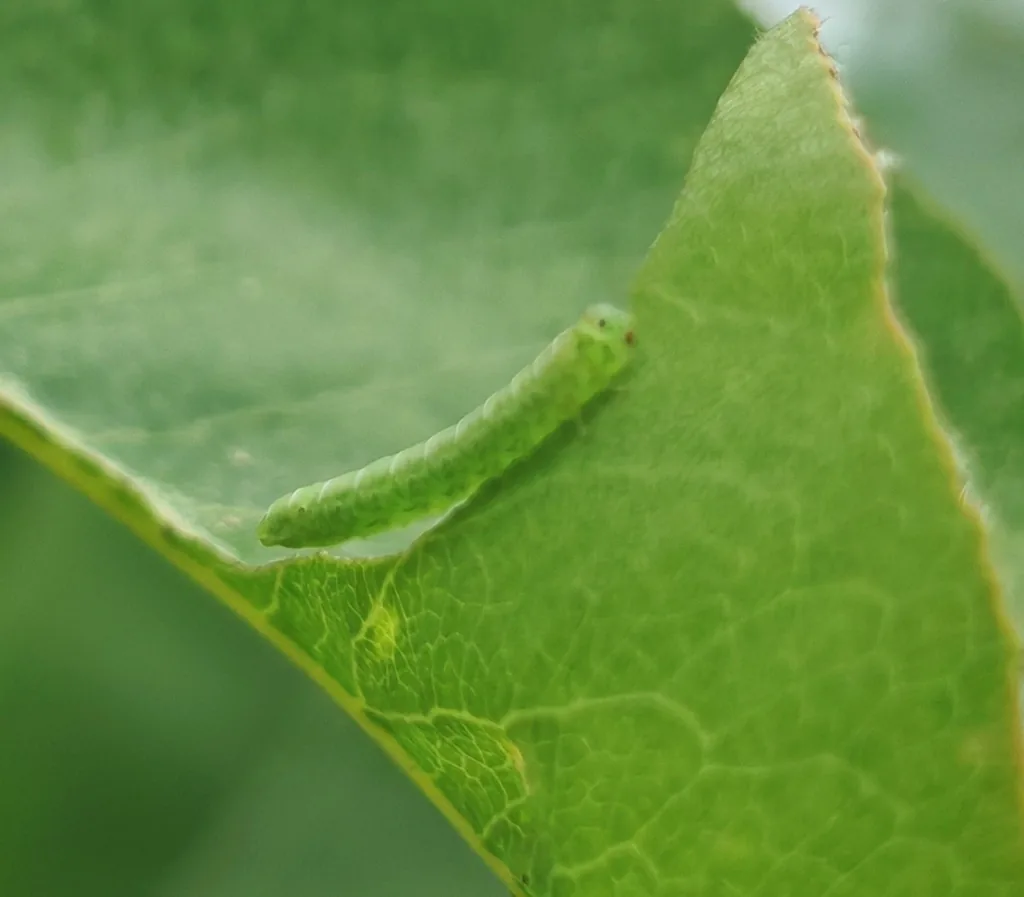
- Larvae are bright green and up to about 1/2 inch long, with a light brown head that has a small black eye spot on each side.[1][2]
- Besides three pairs of true legs, a larva has six pairs of prolegs on abdominal segments two through seven. Most other caterpillar-like larvae that feed in the open on leaves have five or fewer pairs.[1]
- Larvae are hard to see because they often feed with the body lined up along the inside edge of the hole they are chewing.[1]
- Adults are stout wasps about 1/4 inch long with a broad waist, two pairs of veined wings, and a black body with yellow on the legs and just behind the head.[1]
- Eggs are tiny, translucent to white, and inserted singly into leaf tissue, usually along the edges of leaves in the lower part of the tree.[1][2]
Look-alikes
| Look-alike | How to tell them apart |
|---|---|
| Pear sawfly (pear slug) | A different and more damaging sawfly, Caliroa cerasi. Its larvae are covered with an olive-green coating that makes them look like slugs, while California pear sawfly larvae look like caterpillars.[1][2] |
| Leafcutting bees | When California pear sawfly larvae feed along leaf edges, the damage can look like the half-moon cuts leafcutting bees make. Those bees are beneficial pollinators.[1][2] |
Where it lives
Covered by UC IPM in California, where it is not commonly abundant, and by the Pacific Northwest handbook as a minor pest of pear.[1][2]
Biology and life cycle
It spends the winter in the soil. UC IPM describes a mature, inactive larva (prepupa) in a silk cocoon in leaf litter and topsoil, which pupates in early spring.[1][2]
Adults emerge in early spring. After mating, females lay eggs in the leaf margins, and most eggs hatch by petal fall.[1][2]
Larvae feed into May, then drop to the ground to spend the winter. There is one generation per year.[1][2]
Birds, predatory wasps and other natural enemies feed on the larvae and sometimes cause their numbers to drop sharply in a short time.[1]
Damage and signs
- Larvae chew circular holes in the leaves. When they are abundant, whole leaves can be eaten down to the midrib.[1][2]
- Larvae and their damage occur only in spring, and the larvae do not feed on fruit.[1][2]
- The PNW handbook notes that heavy feeding can strip a tree, or an orchard, within weeks, but UC IPM says otherwise healthy trees can tolerate a significant amount of leaf chewing.[2][1]
Health risk
The sources describe it only as a leaf-feeding pest of pear; neither mentions any risk to people or pets.[1][2]
Control
Prevention
Check trees early in the year for the round feeding holes. In California, UC IPM generally recommends no control for this sporadic pest.[2][1]
Biological control
Leave birds, predatory wasps and other natural enemies to work; they can bring larval numbers down quickly.[1]
Pesticides
If control is needed, the PNW handbook's home-use options include insecticidal soap, azadirachtin (neem extract, which may injure some pear varieties), pyrethrins and spinosad; it also lists carbaryl and several pyrethroids, which are highly toxic to bees. In organic pear orchards with high populations, spinosad has given control.[2]
Common questions
- What is chewing round holes in my pear leaves in spring?
- It may be the California pear sawfly. Look for bright green larvae with a light brown head lying along the edges of the holes.[1][2]
- Is this the same as the pear slug?
- No. Pear slug larvae are covered with olive-green slime and look like slugs, and that species does more damage. California pear sawfly larvae look like caterpillars.[1][2]
- Do I need to spray?
- Usually not. The larvae feed only in spring, never on fruit, and healthy trees tolerate a lot of leaf chewing.[1]
Sources
- University of California Statewide IPM Program, “Pest Notes: California Pear Sawfly (Home and Landscape).” ipm.ucanr.edu/PMG/GARDEN/FRUIT/PESTS/capearsawfly.html (accessed 2026-11-09)
- Pacific Northwest Pest Management Handbooks (Oregon State University, Washington State University and University of Idaho Extension), “Pear-California pear sawfly, Pacific Northwest Insect Management Handbook.” pnwhandbooks.org/insect/tree-fruit/pear/pear-california-pear-sawfly (accessed 2026-11-09)
- iNaturalist, “Pristiphora abbreviata taxon page (order and family).” www.inaturalist.org/taxa/495332 (accessed 2026-11-09)