On this page
How to identify it
- Unfed adults are brown, oval and up to 0.2 inch long; a female full of blood can reach almost 1/2 inch. Grooves run lengthwise down the back.[1]
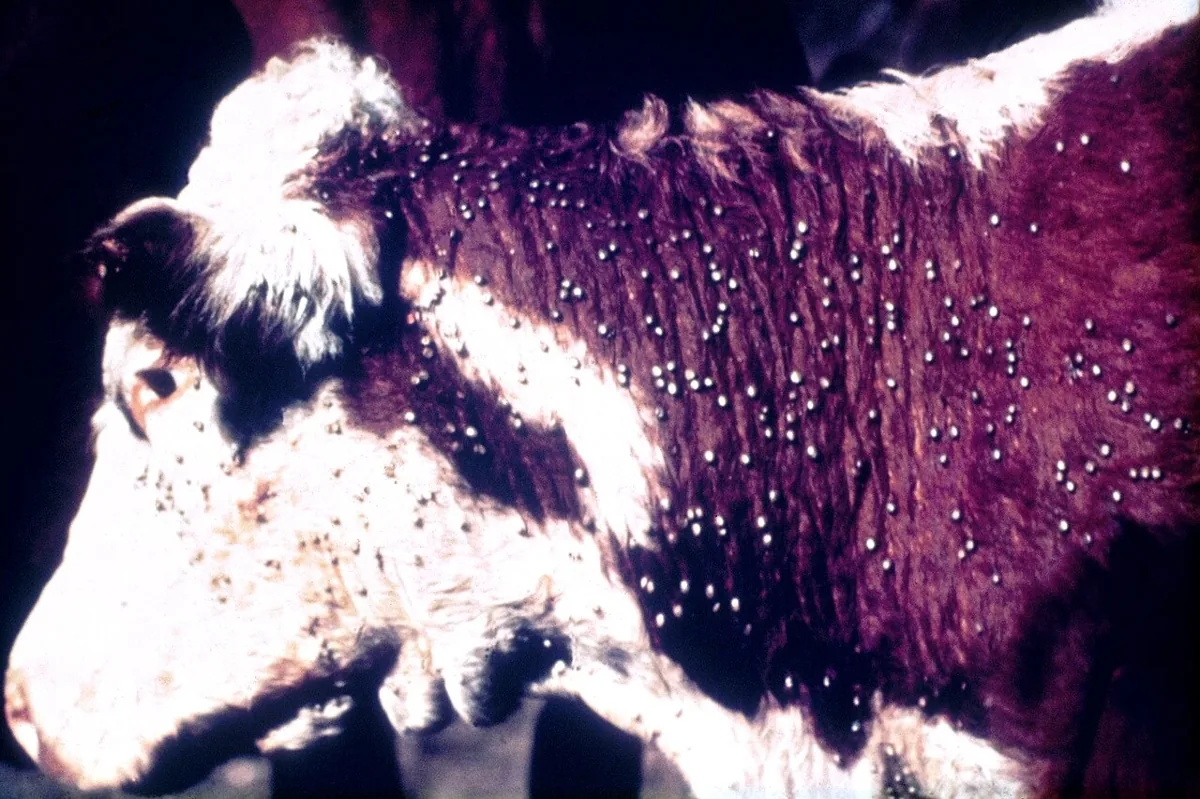
- On cattle they are usually found from the dewlap back to the perianal area, especially between the elbow and the stifle and on the inside of the hind legs. In a heavy infestation they can be anywhere on the body.[1]
- They are one-host ticks: the larva, nymph and adult stages all happen on one animal, and a female stays on that animal for life.[2][6]
Look-alikes
| Look-alike | How to tell them apart |
|---|---|
| Gulf Coast tick | Gulf Coast ticks attack a wide range of birds and mammals and feed mainly on the head and ears of cattle. Fever ticks spend their whole life on one animal and are usually found from the dewlap to the perianal area.[6][1][2] |
| Lone star tick | Every stage of the lone star tick bites people, pets, livestock and wildlife, and deer are the main hosts for adults. Fever ticks are one-host ticks of cattle and other hoofed animals.[6][2] |
| Brown dog tick | A tick in the same genus that prefers dogs and often infests houses where dogs are kept inside, unlike the fever ticks of cattle and hoofed wildlife.[6][2] |
Where it lives
In the United States, infestations now occur mainly along the Texas-Mexico border, with occasional outbreaks outside the Permanent Fever Tick Quarantine Zone. That buffer zone covers more than half a million acres from the Gulf of Mexico near Brownsville to Amistad Dam north of Del Rio and separates Mexico, where the ticks are prevalent, from the fever-tick-free rest of the country.[2][3][1]
Biology and life cycle
After mating, a female feeds until she is fully engorged with blood, drops to the ground, lays up to 4,000 eggs and dies.[1][2]
The young ticks that hatch crawl up tall plants and attach to animals that walk by. The whole cycle takes 3 to 4 weeks, and there can be up to four generations a year.[1][2]
Besides cattle, the ticks attach to horses, white-tailed deer, nilgai antelope, red deer and other exotic hoofstock.[1][2][3]
Ticks pick up Babesia when they feed on an infected animal. The parasites pass to the female's larvae, which then infect the animals they feed on.[2]
Damage and signs
- The Babesia parasites destroy red blood cells. Signs of cattle fever include acute anemia, high fever, an enlarged spleen and liver, rapid breathing, weight loss, lower milk production and sudden death.[2][3][1]
- Of infected cattle that have never been exposed to the disease, 70 to 90 percent die.[1][3]
- The disease caused enormous losses to the U.S. cattle industry in the late 1800s and early 1900s, and an 1893 outbreak led the Texas Legislature to create the agency now called the Texas Animal Health Commission.[2]
Health risk
They are ticks of cattle and hoofed wildlife; the Texas A&M and Texas Animal Health Commission publications describe the threat to livestock and mention no risk to people.[1][2][3]
Control
Prevention
Another option starves the ticks out: cattle are dipped until they pass two tick-free inspections, moved to a clean pasture, and the infested pasture is left empty for nine months. It is often cheaper for the landowner but much less effective, because free-ranging deer and exotics that aren't treated can keep the tick cycle going.[1][3][2]
Keep newly bought animals apart from your herd until you are sure they are free of disease and pests, and report unusual tick infestations early so fever ticks can't build up on the property.[1][3][2]
Pesticides
TAHC writes the treatment plan, and every animal in the herd must be treated for a 6 to 9 month quarantine. Options include an injectable doramectin given every 25 to 28 days, or dipping or spraying every 7 to 14 days under a TAHC or USDA inspector. Doramectin products have a pre-slaughter withdrawal period.[2][3][1]
Free-ranging deer can only be treated with ivermectin-treated corn, which only TAHC and USDA personnel may legally feed, or with four-poster feeders whose rubbing posts carry permethrin. There is currently no effective treatment for nilgai.[3][2][1]
When to call a professional
If you see ticks you think could be fever ticks, have the animals inspected by your veterinarian, a Texas Animal Health Commission (TAHC) region office or USDA personnel. Fever ticks are reportable to TAHC, and inspections and treatments are free.[3][5][2]
A confirmed find puts the premises, including its livestock and wildlife, under quarantine right away. Animals can't be moved off it or nearby properties without inspection and approval from TAHC or USDA inspectors.[1][3]
TAHC's 2016 vaccine fact sheet adds a vaccine, mandatory for beef cattle over two months old in the Permanent Quarantine Zone, that kills or weakens fever ticks as they feed so that weak survivors can't reproduce. Only USDA or TAHC personnel or their authorized agents give it, it doesn't replace treatment or inspections, and cattle outside quarantine areas aren't vaccinated because it could hide tick movement.[4]
What a fever tick quarantine involves
A fever tick quarantine covers places as well as animals. TAHC classifies the surrounding land as infested, exposed, adjacent or check premises, each with its own movement restrictions, inspections or treatments.[3][1]
An infested premises is one where fever ticks were found on livestock or wildlife that had been there more than 14 days. An adjacent premises borders an infested or exposed one, even across a road, double fence or fordable stream.[3][1]
After the 6 to 9 months of treatment, the herd goes through a six-month check quarantine with no treatment to confirm it stays tick-free before release.[2]
Common questions
- What happens if fever ticks are found on my cattle?
- The premises is quarantined and the Texas Animal Health Commission sets a treatment plan for the herd. Dipping is done under the supervision of a TAHC or USDA inspector, and inspections and treatments are free.[1][3][2]
- I hunt in South Texas. What do I need to do with a deer taken in a quarantine area?
- Deer, nilgai and other exotic hoofstock, including heads, hides and capes, must be inspected by TAHC or USDA before they are moved. Hides then have to be frozen for 24 hours or treated with an approved acaricide by TAHC and USDA personnel.[3][5][1]
- Are cattle fever ticks still found in the United States?
- Yes, mainly along the Texas-Mexico border, with occasional outbreaks outside the permanent quarantine zone.[2]
Sources
- Texas A&M AgriLife Extension Service, “Cattle Fever Ticks, ENTO-065 (S. L. Swiger, February 2017).” livestockvetento.tamu.edu/files/2018/11/ENTO-065-Cattle-Fever-Ticks.pdf (accessed 2026-11-08)
- Texas Animal Health Commission, “Fact Sheet: Cattle Fever Ticks (revised March 2024).” www.tahc.texas.gov/news/brochures/TAHCFactsheet_FeverTick.pdf (accessed 2026-11-08)
- Texas Animal Health Commission, “Frequently Asked Questions: Cattle Fever Ticks (updated January 2017).” www.tahc.texas.gov/news/brochures/TAHCBrochure_FeverTickFAQ.pdf (accessed 2026-11-08)
- Texas Animal Health Commission, “Fever Tick Vaccine Fact Sheet (September 2016).” www.tahc.texas.gov/news/brochures/TAHCBrochure_FeverTickVaccineFactSheet.pdf (accessed 2026-11-08)
- Texas Animal Health Commission, “Fever Ticks & Pests.” www.tahc.texas.gov/animal_health/feverticks-pests/ (accessed 2026-11-08)
- Texas A&M AgriLife Extension Service, Livestock Veterinary Entomology, “Ticks (Livestock Veterinary Entomology).” livestockvetento.tamu.edu/insectspests/ticks/ (accessed 2026-11-08)
- iNaturalist, “Rhipicephalus annulatus taxon page (order and family).” www.inaturalist.org/taxa/964275 (accessed 2026-11-08)