On this page
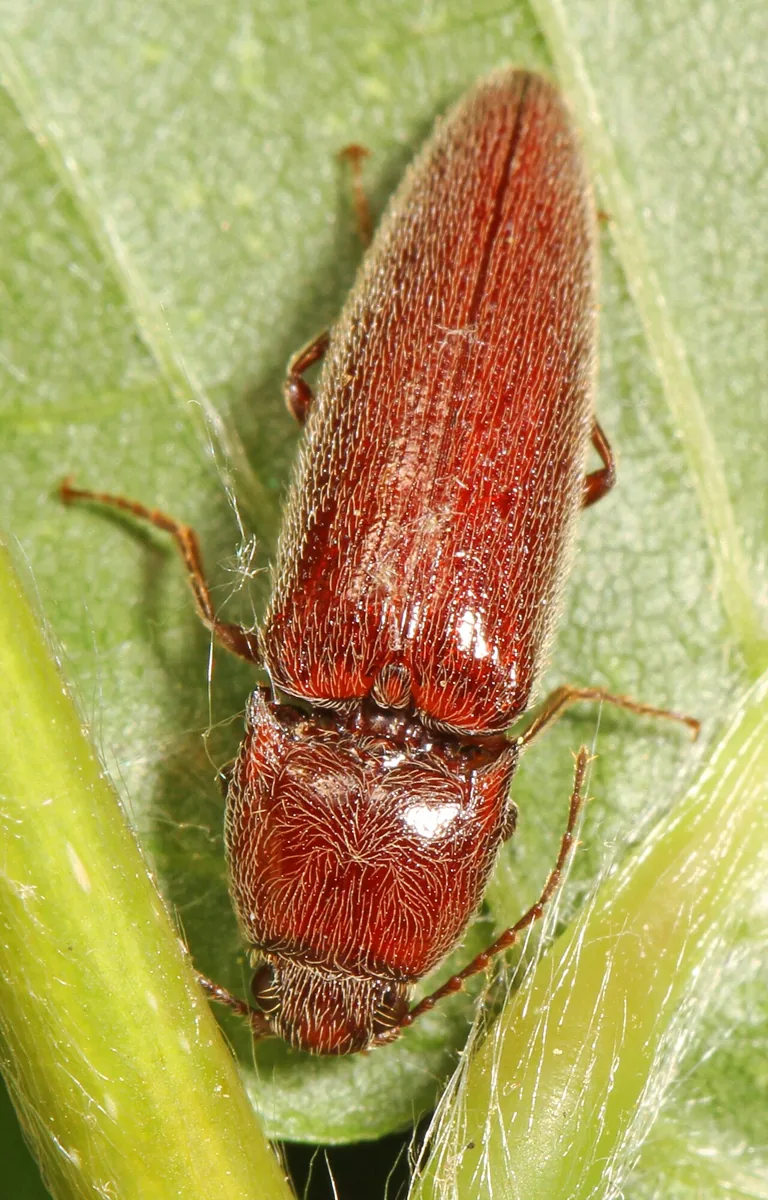
How to identify it
- Wireworms are slender, hard-bodied, wire-like beetle larvae, shiny yellow to coppery brown and 1/2 to 1 1/2 inches (13 to 38 mm) long. Purdue's corn and soybean pages list Melanotus species first among the wireworms involved, alongside the wheat wireworm (Agriotes mancus) and Limonius dubitans.[1][2]
- The adults are click beetles, named for the clicking sound they make while flipping themselves upright from their backs. Males of this species respond to the female sex pheromone 13-tetradecenyl acetate, which is now used in lures for monitoring.[1][6]
- In the field the sign is gaps in the row where seed was hollowed out, and stunted or wilted seedlings, whorl leaves wilting first, with small, cleanly bored holes at the base of the plant.[1][2]
Look-alikes
| Look-alike | How to tell them apart |
|---|---|
| Other Melanotus wireworms (M. similis, M. cribulosus, M. depressus) | A complex of closely related species across the southeastern and midwestern United States; all four were collected in Ontario corn and soybean fields, making up about a tenth of specimens there.[4] |
| Wheat wireworm (Agriotes mancus) and Limonius wireworms | The other wireworms Purdue names in Indiana corn and soybean; Limonius agonus made up more than 70 percent of specimens in the Ontario survey, and several species commonly share one field or one sample.[1][4] |
| Conoderus wireworms (southern potato and tobacco wireworms) | The other wireworms of southeastern sweetpotato; Melanotus communis was collected alongside six Conoderus species in a North Carolina sweetpotato survey.[7] |
Where it lives
Eastern United States: in the Midwest a corn and soybean wireworm, in the Southeast a pest of potato and sweetpotato in North Carolina and Virginia, and across the eastern US a pest of grain, root, tuber and vegetable crops; also collected in corn and soybean fields in Ontario. Earlier reports place it primarily in heavy loam, poorly drained soils, and the Ontario survey found Melanotus more abundant with greater clay content and less in silt soils.[3][5][4]
Biology and life cycle
Click beetles lay tiny, white, round eggs in the soil in spring, usually near the roots of grasses or grass-like crops. First-year larvae do little harm; the larger larvae of later years do the economic damage, and the life cycle of some species runs four to seven years. For corn wireworm, development averages three to five years, nearly all of it as a larva, and an Iowa study recorded eggs laid mainly in June of the first year with pupation in August of the sixth.[1][3][4]
It feeds on many hosts, with corn documented as a preferred one. In North Carolina its abundance has been greatest in fields that followed corn and soybean and lowest after sweetpotato, and a 2022 to 2024 pheromone-trapping study across 41 sites in North Carolina and Virginia found that adult catches rose with the average share of corn in the surrounding land over the previous five years, with corn production intensity the single most important predictor.[3]
Wireworm injury shows mainly in the early stages of plant growth and is more common when corn or soybean is planted early and the weather turns cold, slowing germination; infestations are usually noticed in parts of a field that stay wet for long periods and where grassy plants grow.[1][2]
Damage and signs
- In corn the larvae feed on the germ of the kernel or hollow the seed out completely, leaving gaps in the row, and cut small roots or tunnel into the underground stem of young plants, which appear stunted or wilted. In soybean they hollow seed down to the seed coat and tunnel into seedlings. Fields that were in sod or small grains the previous year or two, were in set-aside, or have a history of damage are the ones at risk.[1][2]
- In southeastern potato and sweetpotato the feeding goes unseen until harvest, by which time the crop has absorbed a season of cost; growers have low tolerance for wireworm scarring in both crops and have relied on broad-spectrum insecticides applied at planting. The loss of chlorpyrifos in 2024 left sweetpotato roots more vulnerable, and no adult or larval treatment thresholds exist for those crops.[3]
Health risk
A crop pest only; none of the sources describes any effect on people.[1][3]
Control
Prevention
Bait suspect fields two to three weeks before planting: at five random spots bury a handful each of untreated corn and wheat seed six inches deep, cover with black plastic to warm the soil, flag the spot, and dig it up after two to three weeks or just before planting. Or, about ten days before planting, dig a 2-foot by 1-foot by 6-inch block of soil at five spots and count live wireworms on a sheet. An average of one live wireworm per bait station or per cubic foot calls for control at planting. If wilted plants or gaps appear early in the season, sample the damaged areas at once.[1][2]
Rotation is the main cultural tool: in the Southeast, separating corn from sweetpotato in time is one of the most widely adopted practices, since populations are highest after corn and soybean and lowest after sweetpotato, and the five-year corn history of the surrounding land predicts risk. Pheromone traps for adult males are being developed to replace labor-intensive grain baits for estimating populations.[3][6]
Biological control
Biological control is not yet practical: in laboratory tests five entomopathogenic nematodes and two fungi (Beauveria bassiana and Cordyceps javanica) each killed fewer than 15 percent of corn wireworms within two weeks, with Steinernema carpocapsae the best of a weak set and small larvae more susceptible than large ones.[5]
Pesticides
Several insecticides are labeled for pre-plant or planting-time use in corn and soybean, and insecticidal seed treatments are labeled, but control is typically highly variable and no rescue treatment exists once a stand is damaged; if a field is replanted with wireworms still feeding, use a soil insecticide, a seed treatment or both depending on the population. Research cited in the Ontario survey found that clothianidin and imidacloprid seed treatments do not reduce wireworm populations. In potato, fipronil has been effective, but it is not registered for sweetpotato.[1][2][4][3]
Common questions
- Seed was hollowed out and there are gaps in my corn rows. Is it wireworms?
- Hollowed kernels with only the germ eaten or the whole seed gone, plus stunted seedlings with the whorl leaves wilting first and small clean holes at the base of the stem, point to wireworms, especially in a cold, wet spring after sod or small grain. Dig a cubic foot of soil at several spots and count the larvae.[1][2]
- Can I spray the field now that I see damage?
- No; there are no rescue treatments for wireworms. If you replant, use a soil insecticide or seed treatment, and bait the field before planting in future years.[1]
- Why do sweetpotato growers worry about corn in the neighborhood?
- Corn is a preferred host of corn wireworm, and trapping across North Carolina and Virginia found adult numbers climb with the share of corn in the surrounding land over the previous five years, so a sweetpotato field in corn country carries more risk.[3]
Sources
- Purdue University Extension Entomology, Field Crops IPM, “Wireworms (Corn): Melanotus spp., Agriotes mancus and Limonius dubitans (Field Crops IPM).” ag.purdue.edu/department/entm/extension/field-crops-ipm/corn/wireworms.html (accessed 2026-11-10)
- Purdue University Extension Entomology, Field Crops IPM, “Wireworms (Soybean): Melanotus spp., Agriotes mancus and Limonius dubitans (Field Crops IPM).” ag.purdue.edu/department/entm/extension/field-crops-ipm/soybean/wireworms.html (accessed 2026-11-10)
- Environmental Entomology (Entomological Society of America), “Linking crop history to Melanotus communis (Coleoptera: Elateridae) abundance in North Carolina and Virginia (North Carolina State University and USDA). Environmental Entomology (2025), PMC12716272.” pmc.ncbi.nlm.nih.gov/articles/PMC12716272/ (accessed 2026-11-10)
- Environmental Entomology (Entomological Society of America), “Wireworm species associated with corn and soybean agroecosystems in Ontario, Canada. Environmental Entomology 53 (2024), PMC11469084.” pmc.ncbi.nlm.nih.gov/articles/PMC11469084/ (accessed 2026-11-10)
- Journal of Nematology (Society of Nematologists), “Effect of host size on susceptibility of Melanotus communis (Coleoptera: Elateridae) wireworms to entomopathogens. Journal of Nematology 54 (2022), PMC9583415.” pmc.ncbi.nlm.nih.gov/articles/PMC9583415/ (accessed 2026-11-10)
- Journal of Economic Entomology (Entomological Society of America), “Schoeppner, Millar, Kuhar and colleagues (North Carolina State University, UC Riverside, Virginia Tech, University of Florida). Optimization of 13-tetradecenyl acetate sex pheromone for trapping Melanotus communis (Coleoptera: Elateridae). Journal of Economic Entomology 116 (2023), PMID 37208312.” pubmed.ncbi.nlm.nih.gov/37208312/ (accessed 2026-11-10)
- Journal of Economic Entomology (Entomological Society of America), “Willis, Abney and Kennedy (North Carolina State University). Survey of wireworms (Coleoptera: Elateridae) in North Carolina sweetpotato fields and seasonal abundance of Conoderus vespertinus. Journal of Economic Entomology 103: 1268-1276 (2010), PMID 20857736.” pubmed.ncbi.nlm.nih.gov/20857736/ (accessed 2026-11-10)
- iNaturalist, “Melanotus communis taxon page (order and family).” www.inaturalist.org/taxa/224818 (accessed 2026-11-10)