On this page
How to identify it
- The larvae are white, cream or yellowish-orange with reddish-brown heads and tails, smooth, shiny and relatively hard-bodied, 1/2 to 3/4 inch long when grown. The two species' immature stages are very similar.[1][2]
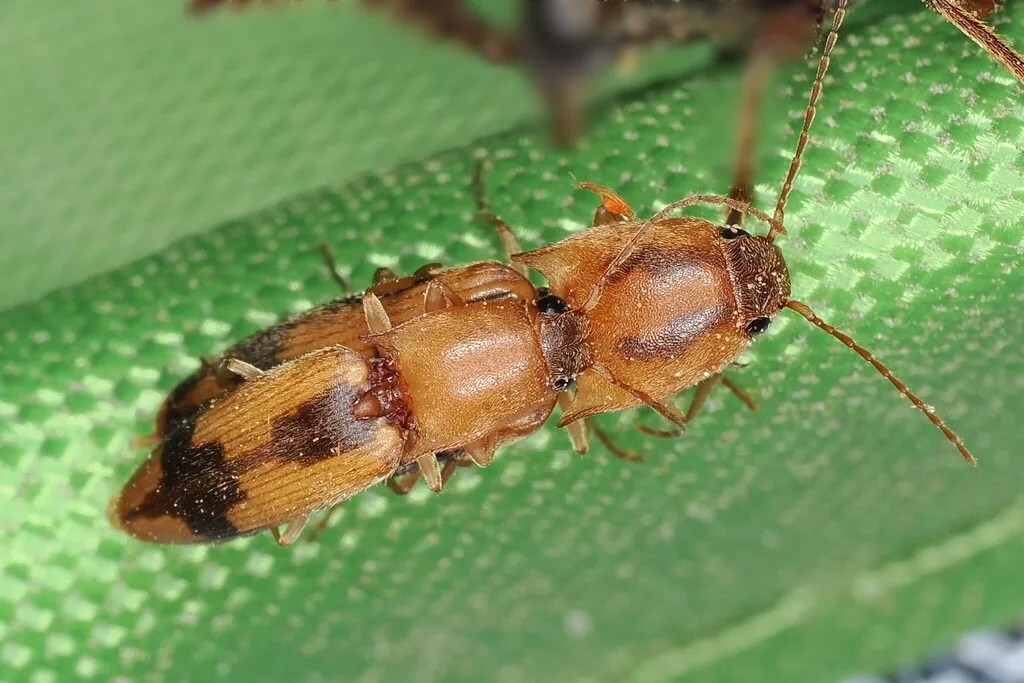
- Adult southern potato wireworms are dark brown click beetles about 1/4 inch long, found near the soil surface under leaves and trash in sweetpotato plantings; they do not feed on the plants. Tobacco wireworm adults are the same size and shape but patterned with areas of light and dark brown.[1][2]
- Wireworm injury on a root is a fairly small, irregularly shaped hole, usually less than a quarter inch deep at first but deepened and lengthened as the root grows, giving the impression of continuous feeding. Holes cluster in growth cracks if there are any and are otherwise scattered at random. Fresh holes with ragged edges containing chewed root fiber are the reliable sign.[1][2]
Look-alikes
| Look-alike | How to tell them apart |
|---|---|
| White grubs (May and June beetle larvae) | Grubs are white or cream with light tan heads and make broad, shallow gouges that do not penetrate as deeply as wireworm holes.[2] |
| Cucumber beetle larvae (banded and spotted cucumber beetles) | They eat small round holes through the skin with irregular enlarged cavities just beneath it, in groups rather than scattered, and attack early in the season so much of the damage is healed over by harvest; wireworms attack late and leave little healed-hole injury.[1] |
| Melanotus communis and other wireworms | A corn wireworm that turned up in North Carolina sweetpotato soil alongside the Conoderus species and was the most frequent wireworm in small plots after soybean and corn.[3][4] |
Where it lives
The southern potato wireworm is injurious in the Southeastern United States and is the common species in southeast Arkansas, with heavy pressure at harvest usual in September in south Arkansas and northern Mississippi. The tobacco wireworm was the most prevalent wireworm in North Carolina sweetpotato fields, and both species were among those recovered in North Florida sweet potato.[1][2][3][5]
Biology and life cycle
Adults overwinter in the soil and emerge from mid-April to early June; after mating the females burrow into the soil to lay eggs. Southern potato wireworm eggs are laid from late spring to early fall and hatch in about five days in midsummer but may take several weeks in cool spring or fall weather; Arkansas gives three to four weeks for hatch. Larvae pupate in earthen cells in the ground, and the species has one to two generations a year, though in dry weather the full cycle may take more than a year.[1][2]
The tobacco wireworm has only one generation a year. Its eggs are laid in summer and hatch in one to three weeks; the larvae overwinter and pupate the following late spring and summer. Because most overwintered larvae have pupated before sweetpotato roots begin to enlarge, the root injury is probably done by larvae from eggs laid during the current year.[1]
North Carolina trapping in 2005 and 2006 found adult tobacco wireworms most abundant in July and the larvae smaller and more numerous after mid-July, an early-summer generation turnover with egg laying in fields already planted to sweetpotato; late-season abundance of this species tracked the incidence of wireworm damage. Some wireworm species can live three to four years in the soil, moving deeper each year to overwinter and back toward the surface in spring.[3][2]
Damage and signs
- Wireworms are a serious threat to sweet potato production in the southern United States. The larvae feed on the roots, usually late in the season as the roots enlarge, so the scars are fresh and unhealed at harvest; by then the soil is not yet cold enough to slow feeding, and nothing done at harvest can undo the damage. Both species also attack Irish potatoes.[5][2][1]
- Which crop preceded the sweetpotatoes matters. In North Carolina, total wireworms in baits were highest following soybean and corn, and in commercial sweetpotato fields the tobacco wireworm was most abundant where corn had been grown the year before.[4]
Health risk
A crop pest only; none of the sources describes any effect on people.[1][2]
Control
Prevention
Avoid fields with a history of wireworm or grub activity and sample before planting. Arkansas samples once the soil at six inches reaches 55 F, digging random scattered samples at least 18 inches deep with a posthole digger or shovel, 30 samples for a 10-acre field up to 120 for 160 acres; if none turn up, double the number of samples before deciding the population is too low to treat. The count then decides between a sidedress or furrow treatment, a broadcast treatment, broadcast plus fumigation, or growing another crop in that field, with about 15 wireworms in the samples from a 10-acre field pointing to rotation.[2]
Sanitation
Rotate crops, and remember that soybean and corn ahead of sweetpotatoes were followed by the most wireworms in North Carolina studies. Plow or cultivate infested soil in late summer or autumn to kill the insects or expose them to predators, and cultivate again in spring well before planting.[1][4]
Traps and physical control
Home gardeners can trap wireworms in pieces of potato scattered around the garden. The sweetpotato varieties Nugget and All Gold have some resistance.[1]
Biological control
A single application of entomopathogenic nematodes near planting significantly reduced soil insects in North Florida sweet potato trials.[5]
Pesticides
Commercial growers broadcast a granular or emulsifiable soil insecticide before planting and disk it in immediately, or band a granular product 3 to 4 inches on each side of the row at planting; if both are called for, use two different insecticides. In North Florida trials, organophosphate, neonicotinoid, pyrethroid and botanical insecticides all reduced wireworm feeding holes, but the species differ in susceptibility, and at the rates tested chlorpyrifos killed none of the C. amplicollis. Arkansas notes that soil insecticides applied at planting in May and June have degraded and lost their effect by a late October harvest; check with the county extension office for currently approved materials.[2][5]
Common questions
- My sweetpotatoes have small ragged holes with chewed fiber in them. Wireworms or grubs?
- Ragged-edged holes less than a quarter inch deep with chewed root fiber inside are wireworm work; white grubs make broader, shallower gouges, and cucumber beetle larvae leave grouped round holes with cavities under the skin that have usually healed by harvest.[1][2]
- Can I spray at harvest to stop the damage?
- No. The injury is already done, and before harvest the soil is still too warm to hold the larvae down. Arkansas recommends soil sampling and a pre-plant or at-planting program instead, and avoiding fields with a wireworm history.[2]
- Which cover or rotation crop makes wireworms worse?
- In North Carolina studies the most wireworms followed soybean and corn, and tobacco wireworms were most abundant in sweetpotato planted after corn.[4]
Sources
- Clemson Cooperative Extension Home and Garden Information Center, “Sweetpotato and Irish Potato Insects, HGIC 2215 (updated May 23, 2025).” hgic.clemson.edu/factsheet/sweet-potato-irish-potato-insects/ (accessed 2026-11-10)
- University of Arkansas Division of Agriculture Cooperative Extension Service (University of Arkansas at Pine Bluff), “Wireworm Control in Sweet Potato, FSA-7056 (Izekor, Burleigh and English).” www.uaex.uada.edu/publications/PDF/FSA-7056.pdf (accessed 2026-11-10)
- Journal of Economic Entomology (Entomological Society of America), “Willis, Abney and Kennedy (North Carolina State University). Survey of wireworms (Coleoptera: Elateridae) in North Carolina sweetpotato fields and seasonal abundance of Conoderus vespertinus. Journal of Economic Entomology 103: 1268-1276 (2010), PMID 20857736.” pubmed.ncbi.nlm.nih.gov/20857736/ (accessed 2026-11-10)
- Journal of Economic Entomology (Entomological Society of America), “Willis, Abney, Holmes, Schultheis and Kennedy (North Carolina State University). Influence of preceding crop on wireworm (Coleoptera: Elateridae) abundance in the coastal plain of North Carolina. Journal of Economic Entomology 103: 2087-2093 (2010), PMID 21309229.” pubmed.ncbi.nlm.nih.gov/21309229/ (accessed 2026-11-10)
- Environmental Entomology (Entomological Society of America), “Seal and colleagues (University of Florida IFAS). Wireworm (Coleoptera: Elateridae) species composition and management in sweet potato grown in North Florida using chemical insecticides and entomopathogenic nematodes. Environmental Entomology 49: 1415-1426 (2020), PMID 33315075.” pubmed.ncbi.nlm.nih.gov/33315075/ (accessed 2026-11-10)
- iNaturalist, “Monocrepidius vespertinus taxon page (order and family).” www.inaturalist.org/taxa/1516353 (accessed 2026-11-10)