On this page
How to identify it
- The larvae (wireworms) are shiny, hard-bodied, slender and cylindrical, white at first and then straw-colored to yellowish or light brown, with three pairs of small, thin legs just behind the head. They are about 3/4 to 1 inch long when mature, and the last segment of the body is usually pronged or forked, with a 'keyhole' notch.[2][4][5][6]
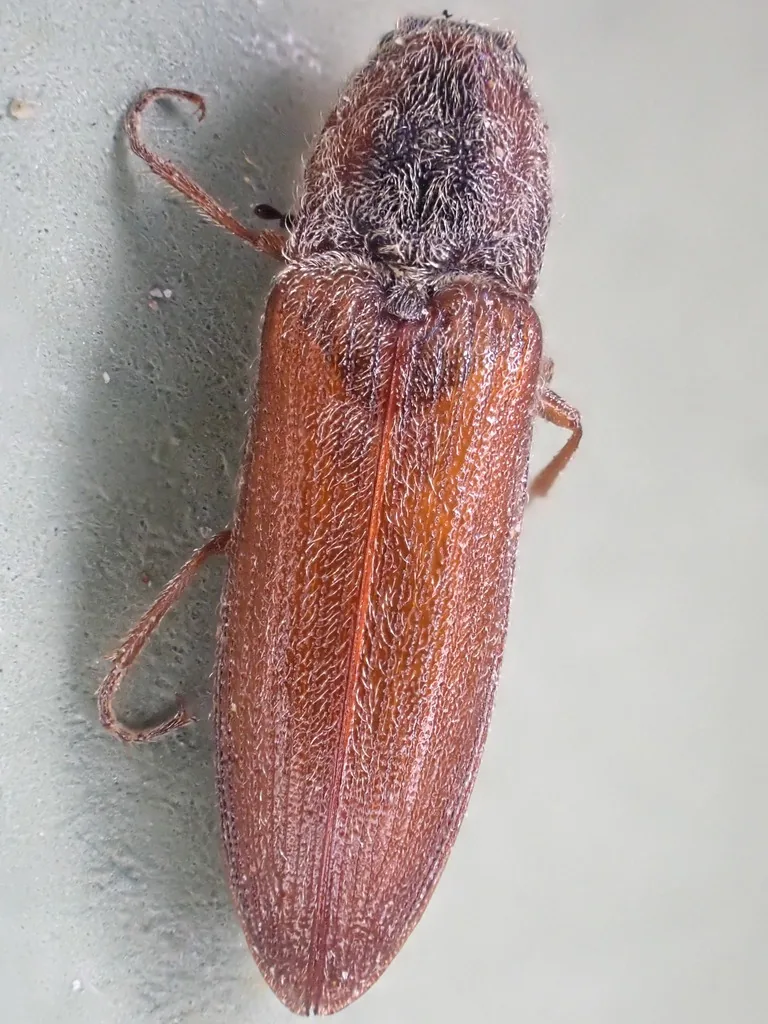
- Adults are slender, hard-shelled click beetles, tan or reddish brown to black and about 0.3 to 0.5 inch (up to 13 mm) long, with the rear corners of the thorax drawn out into points. Held in the hand, they arch backward and snap straight with an audible click.[1][5][2]
- Adults appear from spring into summer and are day-active; in vineyards they are often seen in large numbers resting on cover crops during the day.[5][1]
- The Pacific Coast, sugarbeet and western field (L. infuscatus) wireworms occur together on western farmland, and the adult males of all three respond to the same single-component sex attractant, limoniic acid, which is used in traps to monitor them.[7]
Look-alikes
| Look-alike | How to tell them apart |
|---|---|
| Great Basin wireworm (Ctenicera pruinina) | The wireworm of dryland fields receiving under 15 inches of rain. It tends to disappear after a few years of irrigation, often to be replaced by Limonius species, which favor moist soil.[4] |
| Agriotes wireworms | Other wireworms, including Agriotes species, are the pests west of the Cascades, while the Limonius species cause the most damage in irrigated land.[4] |
| Potato tuberworm | Tuberworm tunnels in potatoes are commonly confused with wireworm holes.[4] |
Where it lives
Both species are wireworms of western North America. They are the two most common of several species in western potato soils and in irrigated Pacific Northwest farmland, and they co-occur with the western field wireworm on farmland across western North America, where trapping studies have covered British Columbia, Alberta, Washington and Montana. In California, UC IPM reports wireworms most often in northern mountain areas in fields that were weedy alfalfa or pasture for years.[2][4][7]
Biology and life cycle
Depending on the species, a wireworm takes two to six years to mature; UC IPM gives three to four years for the common species, so all stages can be found in a field at once.[4][2][1]
Larvae overwinter 12 to 24 inches deep and climb toward the surface in spring once the soil at 6 inches reaches about 50 F. When soil temperatures pass 80 F they move back below 6 inches, where most stay until the next spring.[4]
Mature larvae pupate in the soil, and the new adults stay underground until the following spring, when they emerge, mate and lay eggs. Females fly very little, so infestations spread slowly from field to field. Each female lays many hundreds of eggs in both fallow and cropped ground; the eggs hatch in three to four weeks.[4][5]
Adults feed on flowers and, gut-content sequencing shows, on a wide variety of plants including the mustard-family plants common around infested plots. In grapes the adult is the problem rather than the larva: it chews buds in spring, though rarely enough to matter economically.[4][8][1]
Wireworm numbers build under grass, pasture, red and sweet clover and small grains such as barley and wheat, because the beetles prefer grasses for egg laying and the larvae feed on them. Pacific Coast and sugarbeet wireworms differ somewhat in when the adults are active during the season.[4][6][7]
Damage and signs
- Wireworms bore shallow to deep holes into potato tubers, straight in or diagonally, up to about 1/2 inch deep but not all the way through. Holes made mid-season heal over by harvest; tubers left in the field for weeks after vine death can be attacked again and may contain live wireworms at harvest, which processors will not accept.[2][4]
- Early in the season they feed on seed pieces and young roots, thinning the stand. No crop is immune, but beans, corn, grain, watermelons and other annual crops suffer most. In sugar beets they destroy germinating seed and scar, channel and tunnel the taproot; in grass seed fields they eat roots and crowns, so seedling stands yellow, brown and die by fall.[2][4][6][5]
- Adults do not damage potatoes or most other crops, apart from spring bud feeding in vineyards.[2][4][1]
Health risk
Wireworms and click beetles are plant and soil feeders; none of these sources describes any risk to people.[2][4][1]
Control
Prevention
Decide before planting. UC IPM says the best time to manage wireworms is before the crop goes in: watch for larvae while plowing or discing, especially when taking out old alfalfa, clover or pasture, and avoid planting potatoes right after clover, grass, pasture or weedy alfalfa. Planting a susceptible crop after red clover or grain is risky.[2][4]
Rotate crops. Wireworms increase under red and sweet clover and small grains, and sugar beets following grassy pasture are at the highest risk. Summer fallow with frequent tillage dries the soil and reduces their numbers, and UC IPM lists cultural controls as the organically acceptable approach.[4][2][6]
Sanitation
Harvest potatoes promptly after the vines die. Tubers left in the ground for weeks can be re-infested, leading to fresh holes and wireworms inside the tubers.[4]
Traps and physical control
Bait to detect them: bury carrots, packets of untreated corn or wheat seed, or whole wheat flour when the soil at 4 to 6 inches is about 50 F. Baiting shows whether wireworms are present but not how many; follow a positive bait with soil samples taken with a 6-inch post-hole digger. Dig deep, since larvae move up and down the profile.[2][5]
Biological control
Birds feeding in freshly plowed fields eat many wireworms but do not bring heavy infestations below damaging levels. Field tests of entomopathogenic nematodes have not controlled wireworms, and no effective parasites or biological insecticides are known.[4]
Pesticides
There are no effective rescue treatments once a crop is up; chemicals must go on as preplant or seed treatments. For home gardens the Pacific Northwest handbook lists azadirachtin (mixed with pyrethrins; some formulations OMRI-listed), bifenthrin (mixed with zeta-cypermethrin), cyfluthrin and zeta-cypermethrin. In vineyards no material is registered for the adult beetles, but sprays applied for cutworms also control them.[6][3][4][1]
Common questions
- How do I know the holes in my potatoes are from wireworms?
- Wireworm holes are bored directly into the tuber, straight or diagonal, up to about 1/2 inch deep and never through the whole potato; older holes are healed over. Dig around damaged plants to find the shiny, yellow-brown, wiry larvae. Potato tuberworm damage is the usual look-alike.[2][3][4]
- Why do I have wireworms after turning a lawn or pasture into a garden?
- Click beetles prefer grasses for egg laying and the larvae feed on grass roots for years, so ground that was pasture, sod, clover or small grains carries the biggest wireworm populations into a new planting.[6][4][2]
- How long will wireworms stay in the soil?
- Two to six years depending on the species, three to four for the common ones, so a bad field can stay infested for several seasons. Summer fallow and rotation away from grasses and clovers bring numbers down.[4][2]
Sources
- University of California Statewide IPM Program, “Pacific Coast Wireworm (Click Beetle), UC IPM Pest Management Guidelines: Grape, UC ANR Publication 3448.” ipm.ucanr.edu/agriculture/grape/pacific-coast-wireworm-click-beetle/ (accessed 2026-11-10)
- University of California Statewide IPM Program, “Wireworms, UC IPM Pest Management Guidelines: Potato, UC ANR Publication 3463.” ipm.ucanr.edu/agriculture/potato/wireworms/ (accessed 2026-11-10)
- University of California Statewide IPM Program, “Wireworms, UC IPM Pest Management Guidelines: Sugarbeet, UC ANR Publication 3469.” ipm.ucanr.edu/agriculture/sugarbeet/wireworms/ (accessed 2026-11-10)
- Pacific Northwest Pest Management Handbooks (Oregon State University, Washington State University, University of Idaho), “Potato, Irish - Wireworm (Pacific Northwest Insect Management Handbook).” pnwhandbooks.org/insect/vegetable/irish-potato/potato-irish-wireworm (accessed 2026-11-10)
- Pacific Northwest Pest Management Handbooks (Oregon State University, Washington State University, University of Idaho), “Grass seed - Wireworm (click beetle) (Pacific Northwest Insect Management Handbook).” pnwhandbooks.org/insect/legume-grass-field-seed/grass-seed/grass-seed-wireworm-click-beetle (accessed 2026-11-10)
- Pacific Northwest Pest Management Handbooks (Oregon State University, Washington State University, University of Idaho), “Sugar beet - Wireworm (Pacific Northwest Insect Management Handbook).” pnwhandbooks.org/insect/agronomic/sugar-beet/sugar-beet-wireworm (accessed 2026-11-10)
- Environmental Entomology (Entomological Society of America), “van Herk, Catton, Wanner, Lemke and Serrano. Species-dependent captures of three Limonius pest click beetle (Coleoptera: Elateridae) species in western North America with aerial and ground traps. Environmental Entomology 54: 1060-1069 (2025), doi:10.1093/ee/nvaf078.” doi.org/10.1093/ee/nvaf078 (accessed 2026-11-10)
- Environmental Entomology (Entomological Society of America), “Serrano, Cook, Headrick and Cooper (USDA-ARS, Wapato). Dietary history of click beetles and wireworms in the genus Limonius (Coleoptera: Elateridae) revealed by molecular gut content analysis. Environmental Entomology 53: 173-179 (2024), doi:10.1093/ee/nvad114.” doi.org/10.1093/ee/nvad114 (accessed 2026-11-10)
- iNaturalist, “Limonius canus taxon page (order and family).” www.inaturalist.org/taxa/322898 (accessed 2026-11-10)