On this page
How to identify it
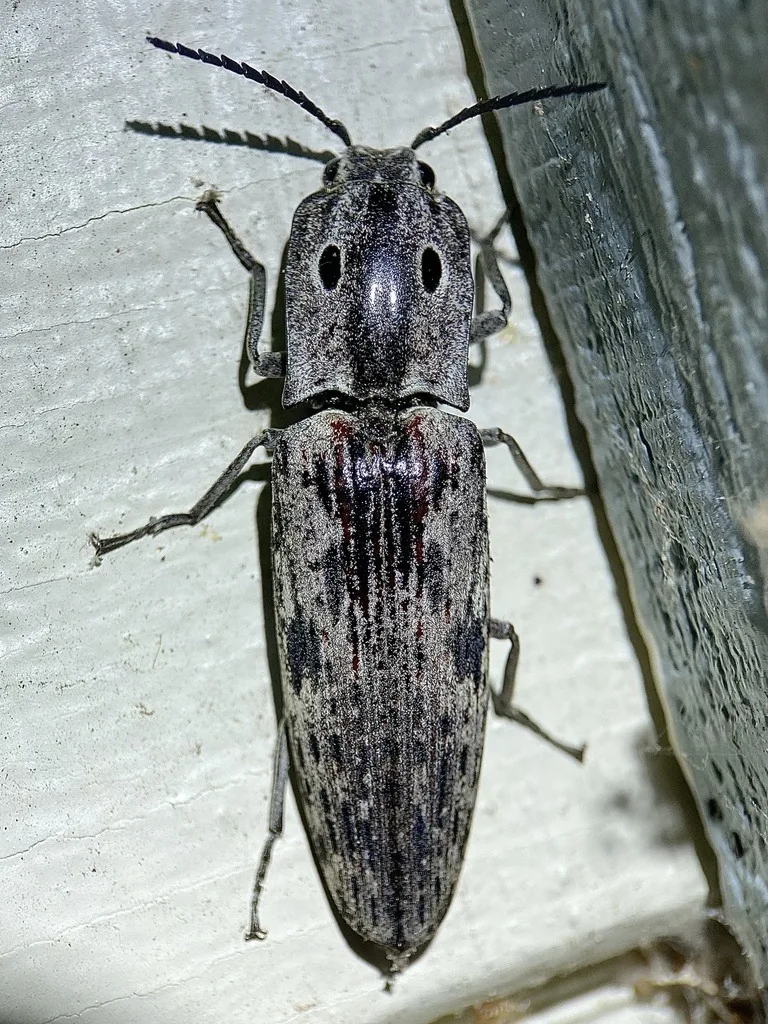
- A large click beetle: adults of the two Florida Alaus species are 24 to 45 mm long, about 1 to 1 3/4 inches. Large 'false eyes' on the pronotum, the shield behind the head, mark the genus. The real eyes are much smaller and sit on the head, in front of the false ones.[1]
- In this species the eyespots are small, less than a quarter the length of the pronotum. The back is brownish and mottled with tiny scales, mostly gray, that cover more than half the surface.[1]
- Like other click beetles, an adult that lands on its back can flip itself into the air by snapping a spinelike structure into a groove on the underside of its thorax.[4]
Look-alikes
| Look-alike | How to tell them apart |
|---|---|
| Eastern eyed click beetle (Alaus oculatus) | Its eyespots are bigger, about a third the length of the pronotum, and its back is black, with mostly white scales covering less than half the surface. It goes with hardwoods and is found most often in rotting oak, cherry and apple stumps.[1] |
Where it lives
Most common in the southeastern United States, with occasional records farther north, including Indiana and New York; a 1910 guide to Indiana beetles called it rare north of the Ohio River. In Florida, collection records come from 11 counties, from Baker and Liberty in the north to Dade and Monroe in the south.[1]
Biology and life cycle
It is usually found in pine stumps and logs. Alaus larvae are effective predators of many kinds of wood-boring beetle larvae, while the adults probably feed little. When the University of Florida account was written, no description of this species' larva had been found.[1]
Adults come to funnel traps baited with the compound (-)-alpha-pinene, and adding ethanol to the lure draws more of them. In trapping across Alabama, Florida, Georgia and the Carolinas they were caught alongside other large wood borers of pines, such as a pine sawyer (Monochamus titillator) and the pales weevil (Hylobius pales).[2]
It is among the common beetles of southern pine forests caught in these baited funnel traps, which researchers recommend for detecting and monitoring large wood-boring beetles.[3][2]
Adult click beetles are mostly active at night, living near plants or under bark, and are often drawn to lights. Click beetle larvae grow for 1 to 4 years before they pupate.[4]
The false eyes are thought to frighten would-be predators, and the mottled pattern of tiny scales helps the beetle blend in.[1]
Damage and signs
- It is not a pest. The University of Florida notes that the large beetle and its fierce-looking larva might be expected to do harm, but the adults probably feed little and the larvae prey on wood-boring beetle larvae.[1]
Health risk
Neither the University of Florida nor the Missouri Department of Conservation describes any risk to people. Alaus beetles mostly come to the attention of nursery inspectors and extension agents because they are big and striking.[1][4]
Control
Prevention
No control is needed. The University of Florida describes Alaus larvae as predators of wood-boring beetle larvae, and the adults probably feed little.[1]
Common questions
- How do I tell a small-eyed click beetle from an eastern eyed click beetle?
- Compare the eyespots and the background. The small-eyed click beetle's eyespots are less than a quarter the length of the pronotum, on a brownish back with mostly gray scales. The eastern eyed click beetle's are about a third as long, on a black back with mostly white scales.[1]
- Will it hurt my pine trees?
- The University of Florida does not treat it as a pest. It is usually found in pine stumps and logs, and Alaus larvae prey on the larvae of wood-boring beetles.[1]
- Why does a click beetle jump and snap?
- A click beetle on its back snaps a spinelike structure into a groove under its thorax and flips into the air. The sudden jump startles predators and helps the beetle get back on its feet.[4]
Sources
- University of Florida IFAS Extension (Featured Creatures), “Click Beetles, Alaus spp. (Insecta: Coleoptera: Elateridae), EENY-085 (R. E. Woodruff; June 1999).” journals.flvc.org/edis/article/view/108217 (accessed 2026-11-09)
- Journal of Chemical Ecology (Springer), indexed in PubMed (PMID 16586033), “Miller. Ethanol and (-)-alpha-pinene: attractant kairomones for some large wood-boring beetles in southeastern USA. Journal of Chemical Ecology 32: 779-794 (2006), doi:10.1007/s10886-006-9037-8 (abstract).” doi.org/10.1007/s10886-006-9037-8 (accessed 2026-11-09)
- Journal of Economic Entomology (Entomological Society of America), indexed in PubMed (PMID 18330123), “Miller and Duerr. Comparison of arboreal beetle catches in wet and dry collection cups with Lindgren multiple funnel traps. Journal of Economic Entomology 101: 107-113 (2008) (abstract).” pubmed.ncbi.nlm.nih.gov/18330123/ (accessed 2026-11-09)
- Missouri Department of Conservation, “Click Beetles (Elaterids) (Field Guide).” mdc.mo.gov/discover-nature/field-guide/click-beetles-elaterids (accessed 2026-11-09)
- iNaturalist, “Alaus myops taxon page (order and family).” www.inaturalist.org/taxa/212921 (accessed 2026-11-09)