On this page
How to identify it
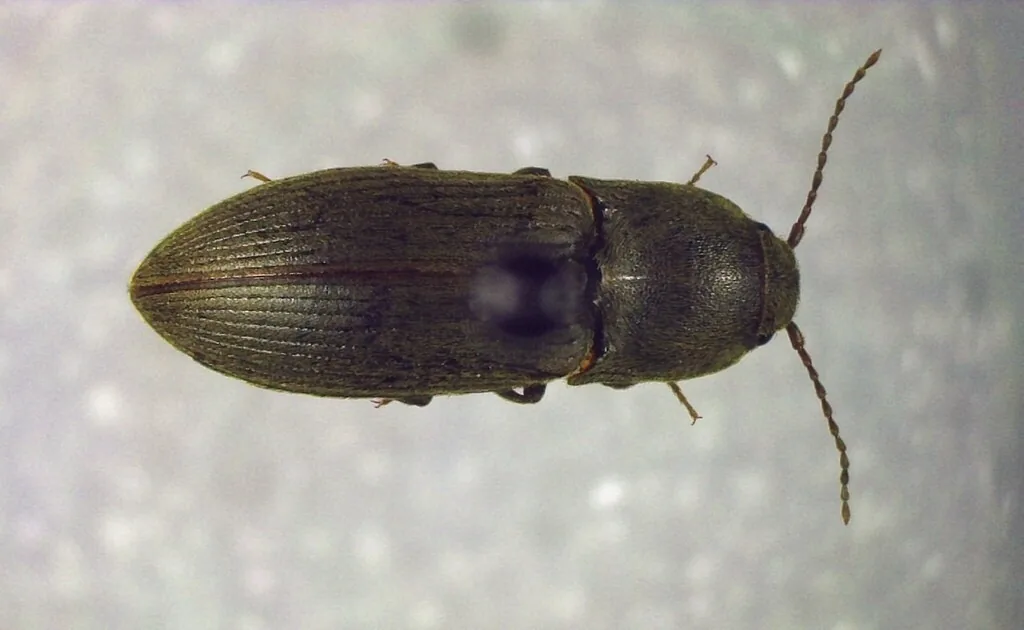
- The adults are slender, hard-shelled click beetles, tan to dark brown, that snap a spine on the thorax to flip themselves upright with an audible click. Pacific Northwest click beetles run about 8 to 20 mm depending on species; PNW 607 pictures the dusky wireworm and lined click beetle adults alongside the native Limonius species. The practical way to confirm these two is a pheromone trap, since lures exist for A. lineatus and A. obscurus but not for the native species.[1]
- Wireworm larvae are white when they hatch and darken to tan or reddish brown, with a hard, shiny, almost hairless body, a distinct head, three pairs of legs just behind it and a segmented abdomen ending in prongs or processes. They range from 2 mm at hatching to 4 cm or more when mature.[1]
- In the trap, the species separate by lure: a 1:1 blend of geranyl octanoate and geranyl hexanoate catches the most A. obscurus, while geranyl octanoate with geranyl butanoate at 9 or 10:1 catches A. lineatus. Both are caught in ground-level pitfall-style traps because the beetles disperse mainly by walking.[4][5]
Look-alikes
| Look-alike | How to tell them apart |
|---|---|
| Limonius wireworms (Pacific Coast and sugar beet wireworms) | The native click beetles that dominate irrigated land east of the Cascades; they favor moist soil and have no pheromone lures, so they are monitored with cereal-seed bait traps only.[1] |
| Great Basin wireworm (Ctenicera pruinina) | The dryland wireworm of sagebrush and dry wheat ground, which usually disappears after a few years of continuous irrigation.[1][2] |
Where it lives
Three European Agriotes species were introduced into British Columbia beginning in the 19th century, thought to have arrived in soil used as ship ballast and possibly in plant material. The dusky wireworm and lined click beetle have been in various parts of BC since 1950 and were found near Washington's northern border by 1997; Washington State Department of Agriculture surveys in 2000, 2004 and 2005 found rising numbers at several western Washington sites, and the beetles reached southwest Washington in 2005. In 2004 to 2006 Oregon surveys found low numbers of both species at port, nursery and potato-field sites in Multnomah and Clackamas counties near Portland and none in 17 other counties.[1]
Biology and life cycle
Pacific Northwest wireworms overwinter in the soil as larvae or adults, 12 to 24 inches down, and move back toward the surface in spring once soil at 6 inches reaches about 50 F. Adults mate from mid-April to early June, in or on the soil, and the females lay 50 to more than 350 eggs singly or in small clusters 1 to 6 inches deep in moist soil, preferring grassy ground. Eggs hatch in three to four weeks. The larvae feed on seeds and underground plant parts for two to five years, pupate in the soil from spring to midsummer, and the adults emerge from late spring through summer. Because the female beetles fly very little, infestations spread slowly from field to field.[1][2]
Dissections of nearly 3,000 female A. obscurus and A. lineatus collected in southwestern British Columbia over six seasons show how egg laying unfolds: beetles caught early in the swarming period are fat with stored lipid and carry no eggs; immature and then mature eggs appear as the lipid is used up; and the ovaries stay active to the end of the season, so a female may keep laying until the swarming period ends, with her total depending on the fat she emerged with and what she eats afterward.[3]
Long-term grass is the nursery. A British survey of Agriotes in 62 fields found few or no wireworms in grass up to four years old but infestation in nearly every field that had been in grass for more than ten years, with larger populations in lighter soils. Fields coming out of grass pasture, grass hay or small grains carry the greatest risk, and wireworms also build up under red and sweet clover.[1][2]
The larvae find food by following carbon dioxide gradients over the last few inches, which is why buried bait and trap crops work, and why baits are least effective in fields full of decaying residue or living cover that also give off carbon dioxide.[1]
Damage and signs
- Wireworms eat planted seeds, bore into roots and crowns and even tunnel up into stems. Injury is worst to seeds and seedlings, where it causes stand loss; root feeding wilts, stunts and distorts seedlings and usually kills them. In potatoes the larvae tunnel the tubers. The main crops hit are potatoes, corn, cereals and carrots, with melons, beets and strawberry fruit attacked less often, and damage is usually worst in poorly drained spots on upland soils.[1]
- The two European species have been major economic pests in Europe for a long time and are causing growing damage in Canada to potatoes, corn and small fruits, especially strawberries. Organic vegetable production is particularly exposed, and organic growers in Canada have suffered heavy losses in row crops.[1]
- Larvae live three to five years and the oldest are the most damaging, so a field's wireworm problem is built up over years, and managing it means working on the whole life cycle rather than just the season of a vulnerable crop.[1]
Health risk
Wireworms and click beetles are crop pests only; none of these sources describes any risk to people.[1][2]
Control
Prevention
Know the field's history. Potatoes planted straight after red clover, grain or long-term grass are at risk, and rotating a field out of grass and cultivating it has cut click beetle numbers by more than 90 percent over five years in European work. Because adults barely fly, a clean field tends to stay clean.[2][1]
Traps and physical control
Monitor with bait traps in spring once the top two inches of soil pass 43 to 50 F, usually mid-April through May: presoaked spring wheat with corn or barley buried 6 to 8 inches deep, ideally in a pot of vermiculite, covered with plastic, at least 25 stations per 30 acres or four in a smaller field, left undisturbed 10 to 14 days, and set in a bare field because living or decaying plant material competes for the wireworms' attention. Where Agriotes are established, add pheromone traps for the adults: lures and a ground trap suited to both species have been tested in the Fraser Valley. Fixed traps can deplete A. obscurus around them later in the season, especially after cold weather and at peak swarming, so counts from a single permanent trap can run low.[1][4][5]
Flooding kills wireworms if the soil is warm: in Agassiz soil it took 55 days under water at 41 to 50 F to kill 90 percent of larvae but only 16.5 days at 68 F, and in a nutrient-rich Delta soil the 90 percent mark came in under nine days at 50 to 68 F. A wheat trap crop sown eight days ahead of interplanted strawberries reduced damage to the transplants in BC trials.[1]
Biological control
Indigenous natural enemies, including birds that follow the plow and predatory ground beetles, do not bring populations below damaging levels, and entomopathogenic nematodes have given very limited control in field tests. BC researchers found the fungus Metarhizium anisopliae strain F52 effective as a corn seed treatment against these two species, while spinosad added nothing in the field; economic analyses are still pending.[1][2]
Pesticides
For home gardens the PNW handbook lists azadirachtin mixed with pyrethrins (some formulations OMRI-listed), bifenthrin with zeta-cypermethrin, cyfluthrin and zeta-cypermethrin; commercial growers should use its potato pesticide tables. Canadian trials on A. obscurus show why product choice matters: organophosphates (phorate, chlorpyrifos) and fipronil both protected tubers and killed most of the resident wireworms, whereas neonicotinoid seed treatments protected tubers mainly by intoxicating the larvae, which later recovered. The newer meta-diamide broflanilide, registered in Canada in 2020, matched phorate for tuber protection and cut resident wireworms by 95 to 99 percent in six years of Agassiz trials. Registrations differ between countries; follow the current label where you farm.[2][6][7]
Common questions
- How do I know whether my wireworms are the European species?
- Larvae of the different click beetles look much alike, so the practical check is a pheromone trap, which exists for A. obscurus and A. lineatus but not for the native Pacific Northwest species. Location helps too: these two are a west-of-the-Cascades problem, spreading south from British Columbia through western Washington, with low numbers found near Portland.[1][4]
- My new garden was lawn for years. Should I expect wireworms?
- Quite possibly. In a British survey, fields in grass for more than ten years were usually infested with Agriotes, and the larvae live three to five years, so the population will persist after the sod is turned. Set cereal-seed bait traps in April or May before planting potatoes or other susceptible crops.[1]
- Will flooding or drying the soil get rid of them?
- Flooding works in warm soil, when 90 percent of larvae died in about 16 days at 68 F, but takes nearly two months in cold soil. Rotation out of grass, trap crops and insecticide seed treatments are the other tools; there is no quick fix for a pest with a multi-year larval stage.[1]
Sources
- Oregon State University Extension (Pacific Northwest Extension Publication with Washington State University and University of Idaho), “Andrews, Ambrosino, Fisher and Rondon. Wireworm Biology and Nonchemical Management in Potatoes in the Pacific Northwest. PNW 607 (December 2008).” extension.oregonstate.edu/sites/default/files/documents/pnw607.pdf (accessed 2026-11-10)
- Pacific Northwest Pest Management Handbooks (Oregon State University, Washington State University, University of Idaho), “Potato, Irish - Wireworm (Pacific Northwest Insect Management Handbook).” pnwhandbooks.org/insect/vegetable/irish-potato/potato-irish-wireworm (accessed 2026-11-10)
- Environmental Entomology (Entomological Society of America), “van Herk, Vernon, McGowan, Driver, Schrack and Davie (Agriculture and Agri-Food Canada, Agassiz). Maturation of field-collected female Agriotes obscurus and Agriotes lineatus (Coleoptera: Elateridae) over the swarming period. Environmental Entomology (2024), doi:10.1093/ee/nvae080.” pubmed.ncbi.nlm.nih.gov/39235981/ (accessed 2026-11-10)
- Journal of Chemical Ecology (Springer), “Vernon and Toth (Agriculture and Agri-Food Canada). Evaluation of pheromones and a new trap for monitoring Agriotes lineatus and Agriotes obscurus in the Fraser Valley of British Columbia. Journal of Chemical Ecology 33: 345-351 (2007), doi:10.1007/s10886-006-9217-6.” pubmed.ncbi.nlm.nih.gov/17191156/ (accessed 2026-11-10)
- Environmental Entomology (Entomological Society of America), “van Herk and Vernon (Agriculture and Agri-Food Canada). Local depletion of click beetle populations by pheromone traps is weather and species dependent. Environmental Entomology 49: 449-460 (2020), doi:10.1093/ee/nvaa005.” pubmed.ncbi.nlm.nih.gov/32002536/ (accessed 2026-11-10)
- Journal of Economic Entomology (Entomological Society of America), “Vernon, van Herk, Clodius and Harding (Agriculture and Agri-Food Canada). Further studies on wireworm management in Canada: damage protection versus wireworm mortality in potatoes. Journal of Economic Entomology 106: 786-799 (2013), doi:10.1603/EC12180.” pubmed.ncbi.nlm.nih.gov/23786066/ (accessed 2026-11-10)
- Journal of Economic Entomology (Entomological Society of America), “van Herk, Vernon, Goudis and Mitchell (Agriculture and Agri-Food Canada). Protection of potatoes and mortality of wireworms (Agriotes obscurus) with various application methods of broflanilide, a novel meta-diamide insecticide. Journal of Economic Entomology 115: 2010-2020 (2022), doi:10.1093/jee/toac155.” pubmed.ncbi.nlm.nih.gov/36222544/ (accessed 2026-11-10)
- iNaturalist, “Agriotes obscurus taxon page (order and family).” www.inaturalist.org/taxa/456218 (accessed 2026-11-10)