On this page
How to identify it
- Wireworm larvae are slender, jointed and hard-bodied, with three pairs of legs just behind the head and a flattened last abdominal segment carrying a keyhole-shaped notch. Size separates the two prairie species: a full-grown prairie grain wireworm reaches about 2 to 2.5 cm, while Hypnoidus bicolor tops out near 1 cm.[1][2]
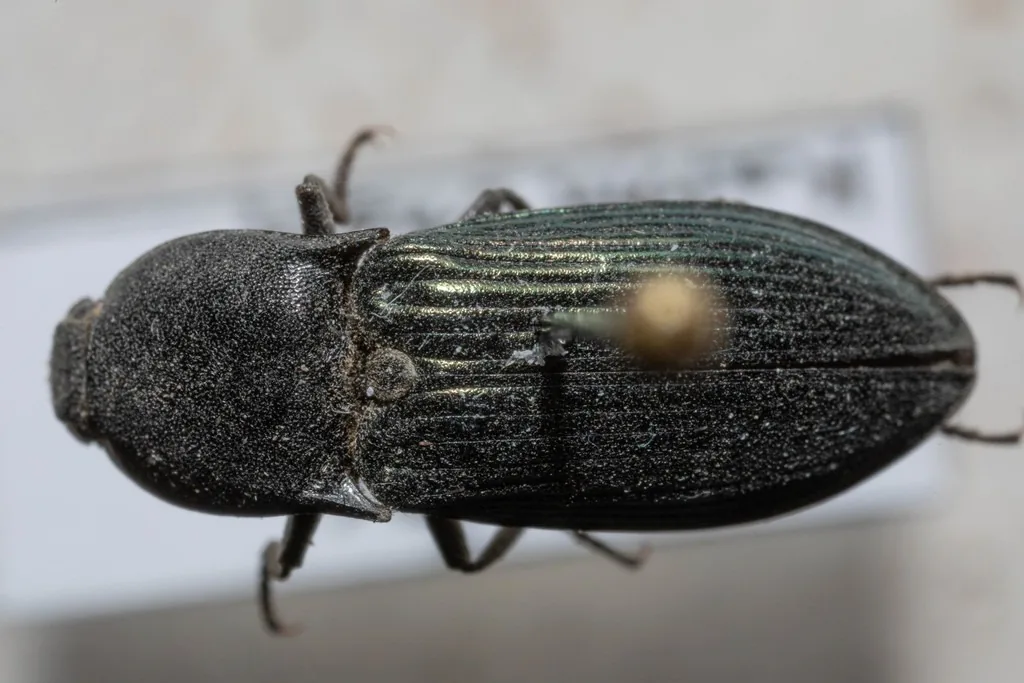
- The adults are click beetles, slender black beetles 8 to 12 mm long that click and somersault to right themselves when placed on their backs. They emerge from the soil in April and early May and become active once the air is above 10 C.[1]
- The feeding sign is distinctive: wireworms shred the stem of a germinating cereal below ground but seldom cut it off, so the central leaves die while the outer leaves stay green for a time. A cutworm, by contrast, usually cuts the whole plant off below the surface, so pulling up damaged seedlings tells the two apart. Alberta notes that many infestations are passed off as poor germination or dry conditions.[1]
Look-alikes
| Look-alike | How to tell them apart |
|---|---|
| Sugarbeet wireworm (Limonius californicus) | The third-ranked wireworm in the prairie survey; it prefers irrigated land where the two dryland species prefer non-irrigated fields, becomes active later in spring, and in cooling tests stayed at cooler, shallower depths while H. bicolor was found throughout the soil profile.[1][3][4] |
| Aeolus mellillus | An occasional prairie wireworm that is both a plant feeder and a predator of other wireworms; it feeds at the soil surface and cuts cereal stems off completely rather than boring into and shredding them.[2] |
| Cutworms | Moth larvae with three pairs of true legs plus five pairs of fleshy prolegs on the abdomen; they curl into a tight C when disturbed and cut plants off at or below the surface.[2] |
| Stiletto fly, crane fly and seedcorn maggot larvae | Legless soil larvae; stiletto fly larvae resemble wireworms but thrash about when disturbed and are predators rather than crop pests.[2] |
Where it lives
Dryland grain country of the Canadian prairie provinces: Alberta surveys found Hypnoidus and Selatosomus across many areas on non-irrigated land, with H. bicolor in 74 percent of 2010 samples against 11 percent for S. destructor, and the 2004 to 2019 three-province survey found the two species frequently within a kilometer of each other.[1][3]
Biology and life cycle
Adult females lay 200 to 400 eggs from late May through June in loose soil or under soil lumps, anywhere from just below the surface to 15 cm deep. Eggs hatch in three to seven weeks, and the hatchlings must find live roots or seeds within one to four weeks or die; only 2 to 8 percent of eggs and young larvae survive. Survivors join the resident population and can live four to 11 years as larvae, though most take three to five, and the prairie grain wireworm normally spends three to four years in the larval stage.[1][2]
Larvae hibernate 5 to 25 cm down and can survive at least two years on soil humus alone. Cool, wet weather brings them toward the surface and hot, dry weather drives them deeper; they move up and down far more than sideways, so an infestation can vary greatly within a field. Pupation takes place 5 to 10 cm deep, usually in July and for less than a month, and the new adult stays in the soil until the following spring.[1]
Fields sampled through the 2020 and 2021 seasons in Manitoba showed both Hypnoidus species active from spring through summer, and Hypnoidus larvae recovered from chill coma faster than sugarbeet wireworms, pointing to a seasonal turnover in which species is present near the surface.[4]
Damage and signs
- Both species are destructive pests of grain crops, preferring cereals and grasses but also attacking potatoes, pulses, canola, sugar beets, corn, lettuce, sunflower, onions, carrots and strawberries. In Alberta, annual wheat damage ranges from 1 to 50 percent. Larvae are drawn to the carbon dioxide given off by germinating seed, and one larva can easily eat two or more seeds, so damaged plants wilt and die and the stand comes up thin or patchy; heavy infestations can force reseeding.[1][2]
- Wireworms do not swallow solid plant tissue: they chew it, regurgitate enzyme-laden fluid and drink the dissolved juices. Most damage comes in early spring while the larvae are near the surface. Potato seed pieces are seldom ruined, but new tubers can be severely tunneled, and the tunnels let disease in and lower the grade.[1][2]
- The longer a field has been in cereals or pasture, the larger the population, and crops on newly broken sod can suffer heavy losses for one or two years. Damage is generally highest in silty, medium-textured, well-drained soils cultivated for at least 12 years and lower in very heavy or very light soils. The survey work found soil organic matter, cation exchange capacity and water retention each influenced which species was present.[1][3]
Health risk
A crop pest only; neither agriculture department describes any effect on people or animals.[1][2]
Control
Prevention
Monitor every year where wireworms are a concern, and read a low catch cautiously: no sampling method fully captures how many wireworms are present or where. Options are burying whole potatoes 10 to 15 cm deep in spring or early August and digging them up after a couple of weeks to look for tunnels, sieving the top 15 cm of soil from 50 by 50 cm plots, or burying about 20 bait balls per acre (1 to 1.5 cups of oatmeal or wheat flour, two tablespoons of honey and up to half a cup of water, tied in mesh) in 4- to 6-inch holes and checking them every four or five days. Manitoba buries presoaked grain, oat or potato baits 7.5 to 15 cm deep and checks them after seven to ten days. An old threshold of about 32 wireworms per square meter is now questioned; Manitoba says thresholds are not known, and Alberta reports that some entomologists treat any wireworms found as cause for concern.[1][2]
Seed into warm, moist soil 2 to 5 cm deep and delay seeding in dry soil until it rains: Alberta records 90 to 95 percent of a crop destroyed when seeded into dry soil against 5 to 10 percent loss in moist soil. Increase the seeding rate in infested fields, by as much as an extra bushel per acre of wheat, and double-seed patchy areas. Pack the seed row: wireworms are poor travellers, moving only a few meters in nine or ten years, and firm soil pushes them into the looser soil between rows. Avoid very early or very late seeding.[1][2]
Rotate out of cereals: do not plant susceptible crops such as cereals on the same land two years running, and lean on crops wireworms seldom damage, such as buckwheat and flax, with fall rye and winter wheat more resistant than spring cereals because they grow vigorously in early spring. If wireworms destroy a crop on newly broken land, reseed at once with a resistant crop rather than leaving it fallow. Plant sweetclover and alfalfa with a light nurse crop or in a grass mixture, keep root and row crops such as potatoes, corn, onions and beans out of rotations with a wireworm history, and apply rotted manure or phosphate fertilizer to speed root growth.[1]
Traps and physical control
Shallow spring cultivation exposes eggs and injures larvae, and cultivating summerfallow in the second half of July destroys pupae and larvae, but summerfallow itself is not recommended: mature larvae survive two years on humus and damage is worse after fallow. Keep tillage to the top 5 to 8 cm so a compact layer below forces adults to lay eggs near the surface, where 92 to 98 percent of eggs and young larvae die as moisture and temperature swing.[1]
Biological control
Ground beetles, rove beetles, stiletto fly larvae and some nematodes feed on wireworms; birds, moles and shrews take larvae near the surface and adults as they lay eggs. Wireworms also succumb to bacterial and fungal disease, more so in moist soil, and a granular formulation of the fungus Metarhizium anisopliae has been under test as a microbial insecticide. The parasitic nematodes that kill pupating wireworms are not commercially available.[1][2]
Pesticides
Seed treatment is the main chemical option and there is no post-emergence treatment. The lindane seed treatments that once killed resident and newly hatched larvae were phased out in 2004; current neonicotinoid seed treatments (thiamethoxam, imidacloprid or clothianidin) protect seeds and seedlings by leaving resident larvae moribund rather than killing them, do nothing against newly hatched larvae, and should be used only where wireworms or other seed pests are known to be at damaging levels, since overuse invites resistance and has raised spider mite numbers in soybeans in dry years. Species also differ in insecticide susceptibility. Check the current provincial crop protection guide for registered products.[1][2]
Common questions
- My wheat came up thin and patchy. How do I know it was wireworms and not bad seed?
- Pull up seedlings in the bare areas. Wireworm-shredded stems are frayed below ground but seldom cut through, with dead central leaves and green outer leaves; cutworms sever the plant, and poor germination leaves no chewed tissue. Then bait or sieve the soil, since Alberta notes many infestations are written off as poor germination.[1][2]
- Which of the two species do I have?
- Size is the quickest clue: a full-grown prairie grain wireworm is about 2 to 2.5 cm long, while Hypnoidus bicolor reaches only about 1 cm. Surveys since 2004 found H. bicolor is now the predominant species, with the two often collected within a kilometer of each other.[1][2][3]
- Will fallowing the field for a year starve them out?
- No. Mature larvae survive at least two years on soil humus, and Alberta reports damage is more severe after fallow. Rotate to a resistant crop such as buckwheat or flax instead.[1]
Sources
- Government of Alberta (Alberta.ca), “Wireworm (Major crop insect pests).” www.alberta.ca/wireworm (accessed 2026-11-10)
- Manitoba Agriculture, “Wireworms on Crops in the Canadian Prairies.” www.gov.mb.ca/agriculture/crops/insects/wireworms.html (accessed 2026-11-10)
- Environmental Entomology (Entomological Society of America), “van Herk, Vernon, Labun, Sevcik and Schwinghamer (Agriculture and Agri-Food Canada). Distribution of pest wireworm (Coleoptera: Elateridae) species in Alberta, Saskatchewan, and Manitoba (Canada). Environmental Entomology 50: 663-672 (2021), PMID 33560338.” pubmed.ncbi.nlm.nih.gov/33560338/ (accessed 2026-11-10)
- Pest Management Science (Wiley), “Drahun, Poole, Hunt, van Herk, LeMoine and Cassone (Brandon University and Agriculture and Agri-Food Canada). Seasonal turnover and insights into the overwintering biology of wireworms (Coleoptera: Elateridae) in the Canadian Prairies. Pest Management Science 79: 526-536 (2023), PMID 36196672.” pubmed.ncbi.nlm.nih.gov/36196672/ (accessed 2026-11-10)
- iNaturalist, “Selatosomus aeripennis taxon page (order and family).” www.inaturalist.org/taxa/557891 (accessed 2026-11-10)