On this page
How to identify it
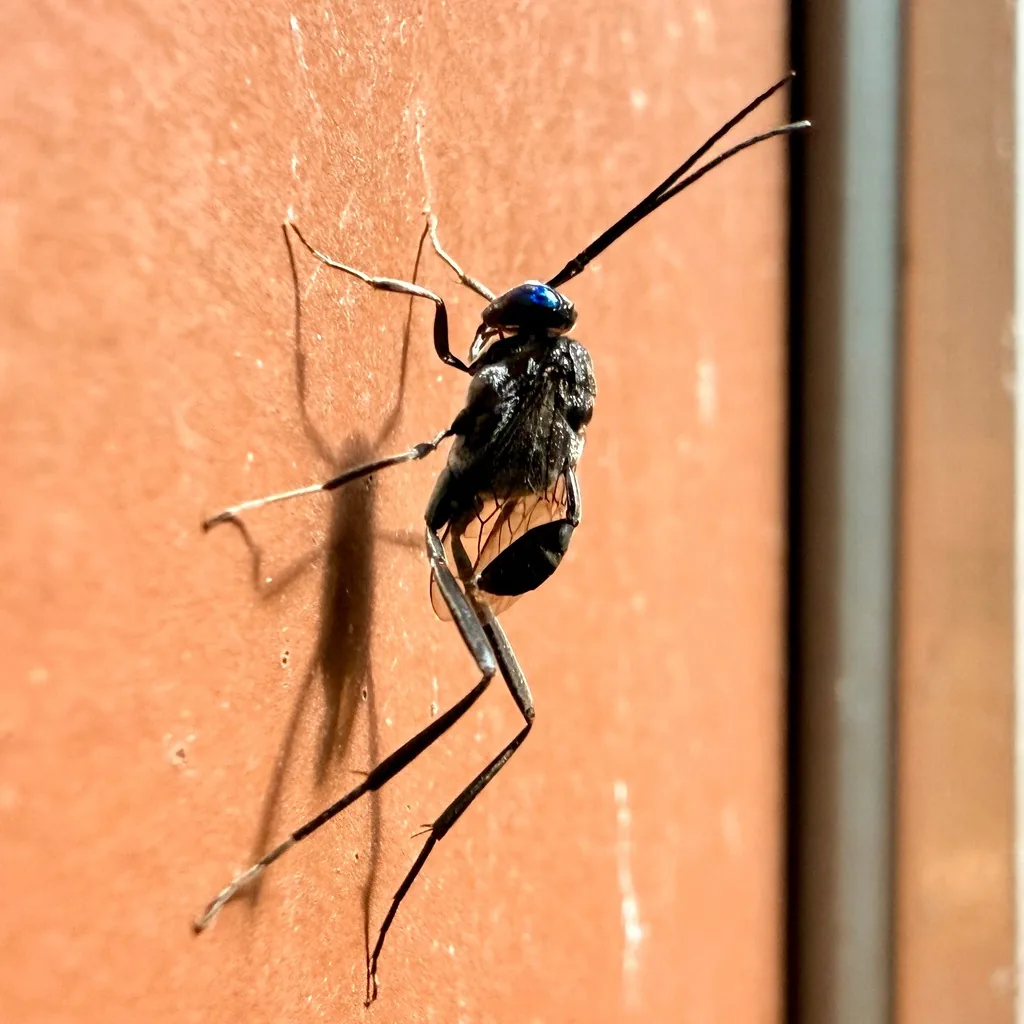
- Adults are usually entirely black, with fairly long legs; people sometimes mistake them for a spider or a small cricket that flies.[2][3]
- The abdomen is small, flattened from side to side and black, and it sits on a narrow stalk attached high on the thorax instead of down near the hind legs, so it looks like a little signal flag. Galveston County Master Gardeners describe it as oval or somewhat triangular.[2][3]
- Females wave the abdomen up and down as they search for cockroach egg cases.[1][2]
Look-alikes
| Look-alike | How to tell them apart |
|---|---|
| Other ensign wasps | Eleven ensign wasp species are known from the U.S. and Canada. This one is the most conspicuous and the largest, with forewings 1/4 to 1/3 inch long.[2] |
Where it lives
A 2025 review calls it cosmopolitan, and it has turned up as far afield as Madeira. Hong Kong's FEHD says it is occasionally seen in buildings and homes there, and in Texas it is found in homes and office buildings; Galveston County Master Gardeners call it widespread across that county.[4][3][1][2]
Biology and life cycle
Its hosts are household cockroaches. Texas A&M says it attacks at least three, the American cockroach most often, and Hong Kong's FEHD names the American and Australian cockroaches.[1][3][5]
The female hunts for cockroach egg cases (oothecae), not the cockroaches. She taps an egg case with her antennae, lies down on her side beside it with her legs braced against it, and works her slender ovipositor through the tough case to lay a single egg.[1][3]
The egg is laid inside one of the cockroach eggs, which feeds the first-stage larva; four more larval stages eat the rest, a dozen or more eggs, so no cockroaches hatch. The larva pupates inside the case without a cocoon, and the adult cuts a small hole near one end to get out.[2][1][3]
Adults normally live outdoors, visit flowers and honeydew, and live 2 to 3 weeks.[2]
In a Malaysian laboratory study, females preferred freshly laid American cockroach egg cases: they parasitized 45% of 1-day-old cases against 1.6 to 20% of cases 10 to 40 days old, even though the cockroaches themselves ate 30 to 60% of the 1-day-old cases. Wasps from older cases developed more slowly and were smaller and shorter-lived.[5]
Offered a humidity gradient from 44 to 87%, both sexes spent more time at the humid end, and females lived longer in moist air unless they had sugar water.[6]
Damage and signs
Health risk
It does not sting or bite people or pets. Its presence indoors points to a larger cockroach, such as the American, smokybrown or Oriental cockroach, somewhere in the structure.[1][3][2]
Control
Prevention
There's no need to panic about the wasps or to kill them. If you also see cockroaches regularly, take action against the cockroaches, not the wasps.[1][3]
Sanitation
Basic cockroach control, removing hiding places along with food and water, cuts the hosts and with them the ensign wasps.[3]
Traps and physical control
Open a window and let it fly out, or carry it back outdoors.[3][2]
Where sources disagree
Size: Texas A&M gives a length of 5 to 7 mm, Galveston County Master Gardeners give 1/4 to 3/4 inch for ensign wasps generally, and Hong Kong's FEHD says adults are about 9 to 11 mm.[1][2][3]
Indoors or out: Galveston County Master Gardeners say adults are normally outdoors and only wander inside, while Texas A&M's entomologist sees one or two every year in his office building and traces them to American cockroaches living in its walls and ceilings.[2][1]
Common questions
- What is the little black wasp with a tiny flag-shaped abdomen in my house?
- Probably an ensign wasp: an all-black wasp with a small, flattened abdomen on a slender stalk that it waves like a flag.[1][2]
- Will an ensign wasp sting me?
- No. Texas A&M, Galveston County Master Gardeners and Hong Kong's FEHD all say it does not sting or bite people.[1][2][3]
- Does an ensign wasp mean I have cockroaches?
- Usually it means one of the larger cockroaches, such as American, smokybrown or Oriental cockroaches, is breeding somewhere in the building, because the wasp develops inside their egg cases.[1]
Sources
- Texas A&M AgriLife Extension Service, “Flag waving for Americans (Insects in the City).” citybugs.tamu.edu/2015/05/05/flag-waving-for-americans/ (accessed 2026-11-11)
- Galveston County Master Gardeners, Texas A&M AgriLife Extension, “Ensign Wasp (Beneficials in the Garden and Landscape).” txmg.org/galveston/beneficials-in-the-garden-and-landscape/ensign-wasp/ (accessed 2026-11-11)
- Food and Environmental Hygiene Department, Hong Kong SAR Government, “Pest Control Newsletter Issue No. 50 (July 2020): ensign wasp article.” www.fehd.gov.hk/english/pestcontrol/images/Pestnews_50e.pdf (accessed 2026-11-11)
- Zootaxa, via PubMed, “A review of the ensign wasps (Hymenoptera: Evaniidae) from Macaronesia (Silva et al. 2025).” pubmed.ncbi.nlm.nih.gov/41119033/ (accessed 2026-11-11)
- Journal of Economic Entomology, via PubMed, “Cockroach Oothecal Parasitoid, Evania appendigaster, Exhibits Oviposition Preference Towards Oothecal Age Most Vulnerable to Host Cannibalism (Tee and Lee 2017).” pubmed.ncbi.nlm.nih.gov/29029091/ (accessed 2026-11-11)
- Journal of Insect Physiology, via PubMed, “Water balance profiles, humidity preference and survival of two sympatric cockroach egg parasitoids Evania appendigaster and Aprostocetus hagenowii (Tee and Lee 2015).” pubmed.ncbi.nlm.nih.gov/25921676/ (accessed 2026-11-11)
- iNaturalist, “Evania appendigaster taxon page (order and family).” www.inaturalist.org/taxa/264674 (accessed 2026-11-08)