On this page
How to identify it
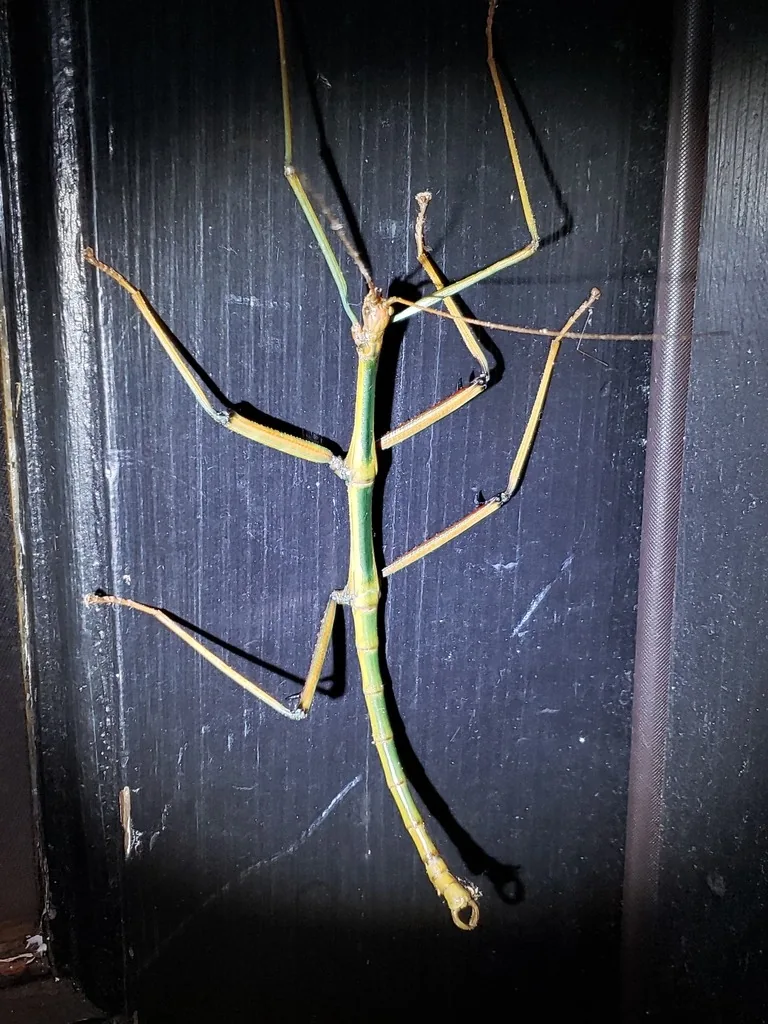
- Its size is the giveaway: females can be more than 6 inches and up to 7 inches long. Males are usually considerably smaller than females.[1][2]
- The middle and hind legs carry spines, and each male has a single large spine on each hind leg.[1]
- Color ranges from greenish to tan, brown or rusty brown. Like other North American walkingsticks it looks like a stick and has no wings.[1][2]
- The eggs, scattered loose on the ground, are about 4 mm long, two-toned light and dark brown, finely bumpy, with a small grill-like cap at one end.[2]
Look-alikes
| Look-alike | How to tell them apart |
|---|---|
| Northern walkingstick (Diapheromera femorata) | Missouri's more common stick insect. The giant walkingstick is easy to tell apart by its much larger size and the spines on its middle and hind legs.[1] |
Where it lives
Mostly found in forested areas of the south-central United States. Its range reaches Indiana, Kentucky and Alabama in the east and extends to an area bounded by Wisconsin, Iowa, Kansas and New Mexico. It is common in Arkansas woodlands and occurs in Missouri.[2][1]
Biology and life cycle
It feeds on leaves. Plants in its habitat and diet include grasses, grape, oak, elm and mesquite, and captive giant walkingsticks have eaten elm leaves.[2][1]
It lives among the foliage of trees and shrubs, where single insects and mating pairs are often found. It sways back and forth to look like a twig moving in the breeze.[2][1]
Males do not fight over females, and mating pairs stay together for several hours.[2]
A female produces around a dozen eggs a day for several months and simply drops them to the ground. There is one generation a year, and the eggs spend the winter on the ground.[2]
Walkingsticks can shed a leg when a predator grabs it and, unlike most insects, can at least partly regrow it.[2]
Captive males have been seen drinking by dipping their heads under water for several minutes.[2]
Damage and signs
Health risk
Neither source describes any risk to people. It is a slow-moving plant-eater.[2][1]
Control
Prevention
No control is needed; leave it alone. It is a slow-moving leaf-eater that normally stays hidden in trees and shrubs.[1][2]
Common questions
- Is this really the biggest insect in North America?
- By length, yes. The Missouri Department of Conservation calls the giant walkingstick the largest insect in North America, with females up to 7 inches long.[1]
- How is it different from the walkingsticks I usually see?
- The common northern walkingstick is much smaller and lacks the spines that the giant walkingstick has on its middle and hind legs.[1]
- Why did one show up on my house?
- Walkingsticks normally stay hidden in trees and shrubs; people rarely notice them unless they wander onto buildings or sidewalks, where their camouflage stops working.[1]
Sources
- Missouri Department of Conservation, “Giant Walkingstick (Field Guide).” mdc.mo.gov/discover-nature/field-guide/giant-walkingstick (accessed 2026-11-09)
- University of Arkansas Arthropod Museum, “Giant walking stick, Megaphasma denticrus (Stal).” arthropod.uark.edu/?p=27368 (accessed 2026-11-09)
- iNaturalist, “Megaphasma denticrus taxon page (order and family).” www.inaturalist.org/taxa/52766 (accessed 2026-11-09)