On this page
How to identify it
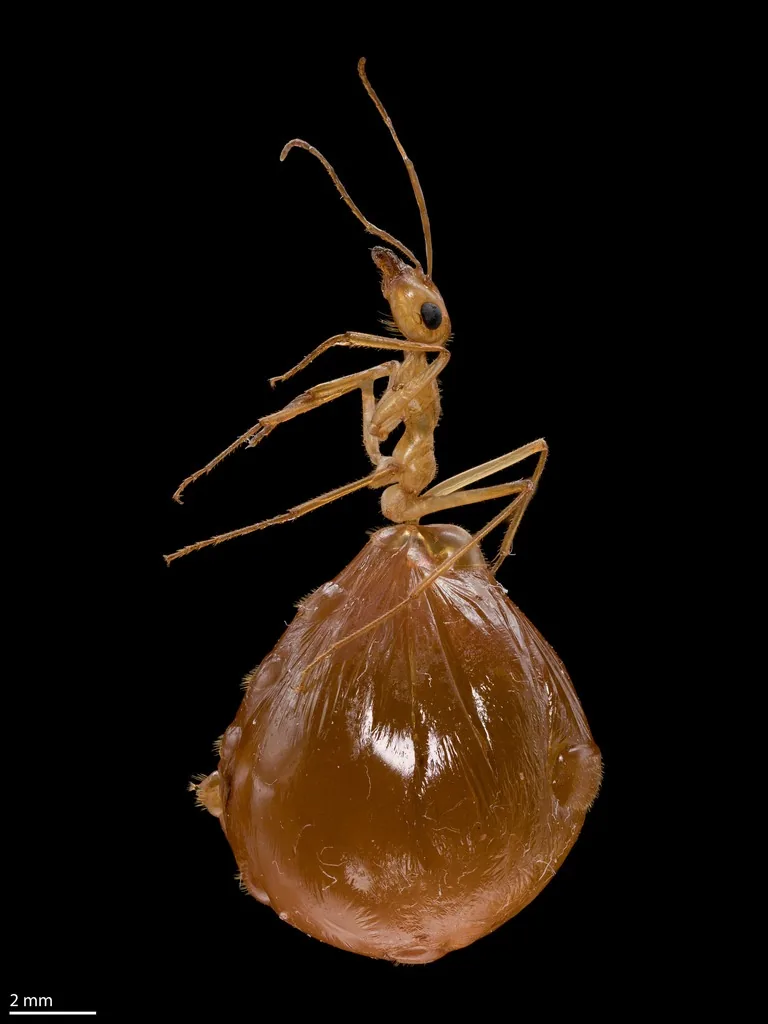
- The giveaway is the replete: a specialized worker whose gaster is engorged into a sphere of stored liquid food, kept in the nest as a living storage vessel from which other colony members take reserves.[1]
- Color tracks activity time within the genus: species that forage above ground at night have little cuticle pigment and look pale, with larger eyes and larger eye facets, while day-active species are heavily pigmented and dark.[5]
- Winged reproductives are recognizable by their wings; new queens look like workers but are two to three times as big, while males are smaller than workers with smaller heads and gasters. Some honeypot species fly in winter rather than after the summer rains.[1]
Look-alikes
| Look-alike | How to tell them apart |
|---|---|
| Veromessor pergandei (desert harvester ant) | A shiny jet-black seed harvester of the same deserts that also flies in winter; honeypot ants are nectar and insect-juice feeders with repletes in the nest, and the day-active species are dark while night foragers are pale.[1][5] |
| Harvester ants (Pogonomyrmex) | Square-headed, stinging seed harvesters with cleared nest discs. Honeypot ants of the species M. mimicus actually ambush Pogonomyrmex foragers at their nest entrances and rob them of insect prey, mostly termites.[1][3] |
Where it lives
Myrmecocystus is one of the ant genera of the Sonoran Desert, where several species coexist; M. mimicus and its sister species M. depilis live side by side at the same study sites.[1][4]
Biology and life cycle
Nectar and the juices of other insects are available in the desert only seasonally. Honeypot ants solve this with repletes, specialized colony members that store liquid food in their engorged gasters and share it with nestmates that need food.[1]
Myrmecocystus mimicus colonies conduct ritualized tournaments instead of outright fighting over territory: hundreds of ants perform stereotyped display fights, with each colony summoning its workers to the tournament ground by alarm recruitment. When one colony is considerably stronger, the tournament ends quickly and the stronger colony raids the weaker one and enslaves its ants, the first intraspecific slavery recorded in ants.[2]
Genetic markers confirmed that raided brood emerges in the raiding colony and joins its workforce. Enslaved ants also turn up in M. depilis colonies, which even hold raided M. mimicus workers, so the slavery runs between as well as within species; queens of both species mate effectively once.[4]
M. mimicus workers also rob food: they waylay Pogonomyrmex harvester ants returning to their nests and take their insect prey, particularly termites, succeeding more often against P. desertorum and P. maricopa than against P. barbatus. Only harvester nests within about 10 meters of the honeypot nest are affected, and some workers specialize in robbing.[3]
Like other desert ants, some Myrmecocystus queens found colonies cooperatively, several new queens digging in together to get underground faster and raise more workers; founding is when most colonies fail, and an established colony may live a decade or more. Most desert ants fly right after summer rains, but some honeypot species fly in winter.[1]
Night-foraging species have pale cuticle, bigger eyes and larger facets than their dark, day-active relatives; among the larger-bodied species the pale ones also have a smaller front ocellus.[5]
Damage and signs
Health risk
None of the sources reports stings or bites to people; the genus is treated as a natural part of the Sonoran Desert community.[1]
Control
Prevention
No control is needed. Honeypot ants are native desert ants that store nectar and raid other ants; the museum presents them as part of the desert's natural history, not as pests.[1]
Common questions
- What is the swollen ant hanging from the nest ceiling?
- A replete, a specialized worker that stores liquid food in its engorged gaster. When nestmates need food, the replete shares its reserves, which carries the colony through seasons when nectar and insect juices are scarce.[1]
- Do honeypot ants fight each other?
- M. mimicus colonies hold ritual tournaments of stereotyped display fights rather than killing matches. If one colony is much stronger, it raids the weaker nest and takes its brood and workers into its own workforce.[2][4]
- Why are some honeypot ants pale and others dark?
- Pale species forage at night and have evolved larger eyes and facets for low light; dark, heavily pigmented species are active by day.[5]
Sources
- Arizona-Sonora Desert Museum, “Ants, in A Natural History of the Sonoran Desert (D. E. Wheeler and S. W. Rissing).” www.desertmuseum.org/books/nhsd_ants.php (accessed 2026-11-10)
- Science, abstract via PubMed, “Tournaments and slavery in a desert ant (Holldobler 1976, Science 192:912-914; PubMed 17817765).” doi.org/10.1126/science.192.4242.912 (accessed 2026-11-10)
- Oecologia, abstract via PubMed, “Food robbing in ants, a form of interference competition (Holldobler 1986, Oecologia 69:12-15; PubMed 28311678).” doi.org/10.1007/BF00399031 (accessed 2026-11-10)
- Proceedings of the Royal Society B, abstract via PubMed, “Genetic evidence for intra- and interspecific slavery in honey ants (genus Myrmecocystus) (Kronauer, Holldobler and Gadau 2003, Proceedings of the Royal Society B 270:805-810; PubMed 12737658).” doi.org/10.1098/rspb.2002.2288 (accessed 2026-11-10)
- PLoS One, abstract via PubMed, “Color, activity period, and eye structure in four lineages of ants: pale, nocturnal species have evolved larger eyes and larger facets (PLoS One 17:e0257779, 2022; PubMed 36137088).” doi.org/10.1371/journal.pone.0257779 (accessed 2026-11-10)
- iNaturalist, “Myrmecocystus taxon page (order and family).” www.inaturalist.org/taxa/69331 (accessed 2026-11-10)