On this page
How to identify it
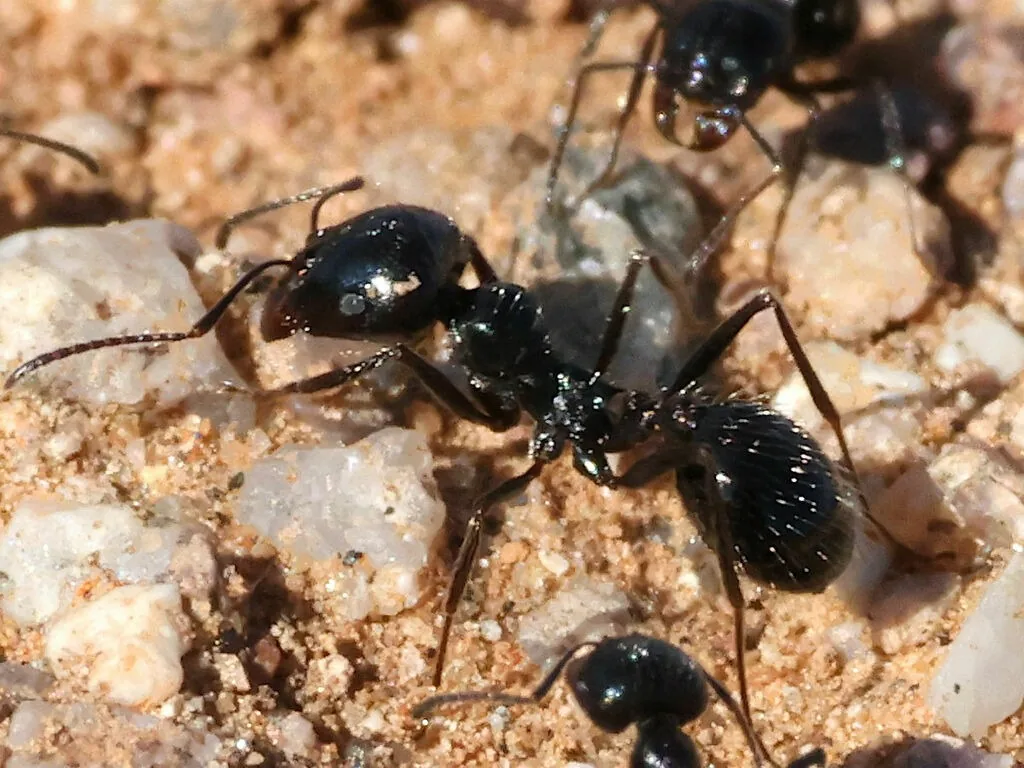
- Workers are a quarter to a half inch (6 to 13 mm) long and a shiny, jet black. They do not sting.[1]
- Veromessor pergandei is the only species of its worldwide genus that extends into the Sonoran Desert, so a large glossy black seed-harvester there is this species rather than a brick-red to black, square-headed Pogonomyrmex.[1]
- Colonies forage in long daily columns of tens of thousands of ants, with the direction of the column shifting from day to day; a single trunk trail of black ants carrying seeds is characteristic.[3][4]
- Winged reproductives can be recognized by their wings: new queens look like workers but are two to three times as big, while males are smaller than workers with smaller heads and gasters. Unlike most desert ants, which fly right after summer rains, this species flies in the milder winter and spring.[1][2]
Look-alikes
| Look-alike | How to tell them apart |
|---|---|
| Rough harvester ant and other Pogonomyrmex | Pogonomyrmex workers are about a half inch long, brick red to black, with large squarish heads and unforgettable stings; their nests have a cleared disc with permanent trails radiating from it. Veromessor is shiny jet black and stingless. The two often share the same deserts but sort by soil: P. rugosus holds the coarse, clay-richer soils near mountains, V. pergandei the finer soils farther out.[1][2] |
| Western harvester ant | Another red to black Pogonomyrmex with a sting. Veromessor pergandei flies in winter and spring; Pogonomyrmex rugosus flights follow the summer monsoon rains.[2] |
| Honeypot ants (Myrmecocystus) | Desert ants that store liquid food in swollen workers rather than harvesting seeds; some also fly in winter.[1] |
Where it lives
A desert seed-harvester of the Sonoran and Mojave Deserts, where it coexists with Pogonomyrmex rugosus in many areas but predominates on finer-textured soils away from the mountains. Long-term study colonies are in central Arizona; the Arizona-Sonora Desert Museum treats it as a Sonoran Desert species.[2][5][1]
Biology and life cycle
Like other desert seed-harvesters it gathers seeds, preferring those of grasses and annual plants rather than cacti, and stores them in chambers toward the top of the nest, where dry conditions discourage sprouting; the seeds feed the larvae.[1]
Colonies send out daily foraging columns made up of tens of thousands of ants. Each day the column may head in a new direction depending on where seeds are and where the neighbors are; when columns of neighboring colonies meet, the ants fight and foraging in that direction is suppressed.[3]
Foraging is squeezed into a brief daily temperature window, and a large colony must bring in enough seeds to produce about 650 new ants every day to replace its short-lived workers. Foragers that get caught in the webs of cobweb spiders are carried home and groomed free of silk by nestmates, and the larger foragers cooperatively dismantle the webs, but only once a nestmate has been trapped.[4]
Mating flights take place in the milder winter and spring rather than after summer rains. Newly mated queens start colonies either alone or in cooperating groups, depending on where they live: the two strategies occupy geographically distinct regions joined by a narrow transition zone, and queens from solitary-founding areas are more aggressive toward other queens.[2][6][1]
Group founding is tied to dry conditions. In laboratory tests water strongly affected queen survival and brood production, queens dug up after two weeks of desiccating conditions were dehydrated, and over 20 years of monitoring in central Arizona new colonies were recruited in only four years, all years in which both early and late spring rainfall exceeded the long-term mean.[5]
Desert ant colonies that survive founding, the stage at which most fail, may live for a decade or more.[1]
Damage and signs
Health risk
Workers do not sting.[1]
Control
Prevention
No control is needed. This is a stingless native desert ant whose colonies gather wild seeds in open desert; none of the sources describes it as a pest.[1][4]
Common questions
- Is this the harvester ant with the painful sting?
- No. The stinging harvester ants are Pogonomyrmex, brick red to black with big square heads. Veromessor pergandei is shiny jet black and does not sting.[1]
- Why do I see a river of black ants crossing the desert?
- That is a foraging column. Colonies send out tens of thousands of workers each day in a column that may point a different way each day depending on seed supply and the position of neighboring colonies.[3]
- When do they swarm?
- Unlike most desert ants, which fly right after summer rains, this species holds its reproductive flights in the milder winter and spring, and new colonies establish mainly in years with above-average rain from January through June.[1][2][5]
Sources
- Arizona-Sonora Desert Museum, “Ants, in A Natural History of the Sonoran Desert (D. E. Wheeler and S. W. Rissing).” www.desertmuseum.org/books/nhsd_ants.php (accessed 2026-11-10)
- Oecologia, abstract via PubMed, “Soil texture as an influence on the distribution of the desert seed-harvester ants Pogonomyrmex rugosus and Messor pergandei (Johnson 1992, Oecologia 89:118-124; PubMed 28313403).” doi.org/10.1007/BF00319023 (accessed 2026-11-10)
- Journal of Theoretical Biology, abstract via PubMed, “An empirically based simulation of group foraging in the harvesting ant, Messor pergandei (Plowes et al. 2014, Journal of Theoretical Biology 340:186-198; PubMed 23978772).” doi.org/10.1016/j.jtbi.2013.07.014 (accessed 2026-11-10)
- American Naturalist, abstract via PubMed, “Destruction of spiderwebs and rescue of ensnared nestmates by a granivorous desert ant (Veromessor pergandei) (Kwapich and Holldobler 2019, American Naturalist 194:395-404; PubMed 31553216).” doi.org/10.1086/704338 (accessed 2026-11-10)
- Ecology and Evolution, abstract via PubMed, “Desiccation limits recruitment in the pleometrotic desert seed-harvester ant Veromessor pergandei (Johnson 2021, Ecology and Evolution 11:294-308; PubMed 33437430).” doi.org/10.1002/ece3.7039 (accessed 2026-11-10)
- Animal Behaviour, abstract via PubMed, “An abrupt transition in colony founding behaviour in the ant Messor pergandei (Cahan, Helms and Rissing 1998, Animal Behaviour 55:1583-1594; PubMed 9642002).” doi.org/10.1006/anbe.1997.0699 (accessed 2026-11-10)
- iNaturalist, “Veromessor pergandei taxon page (order and family).” www.inaturalist.org/taxa/371172 (accessed 2026-11-10)