On this page
How to identify it
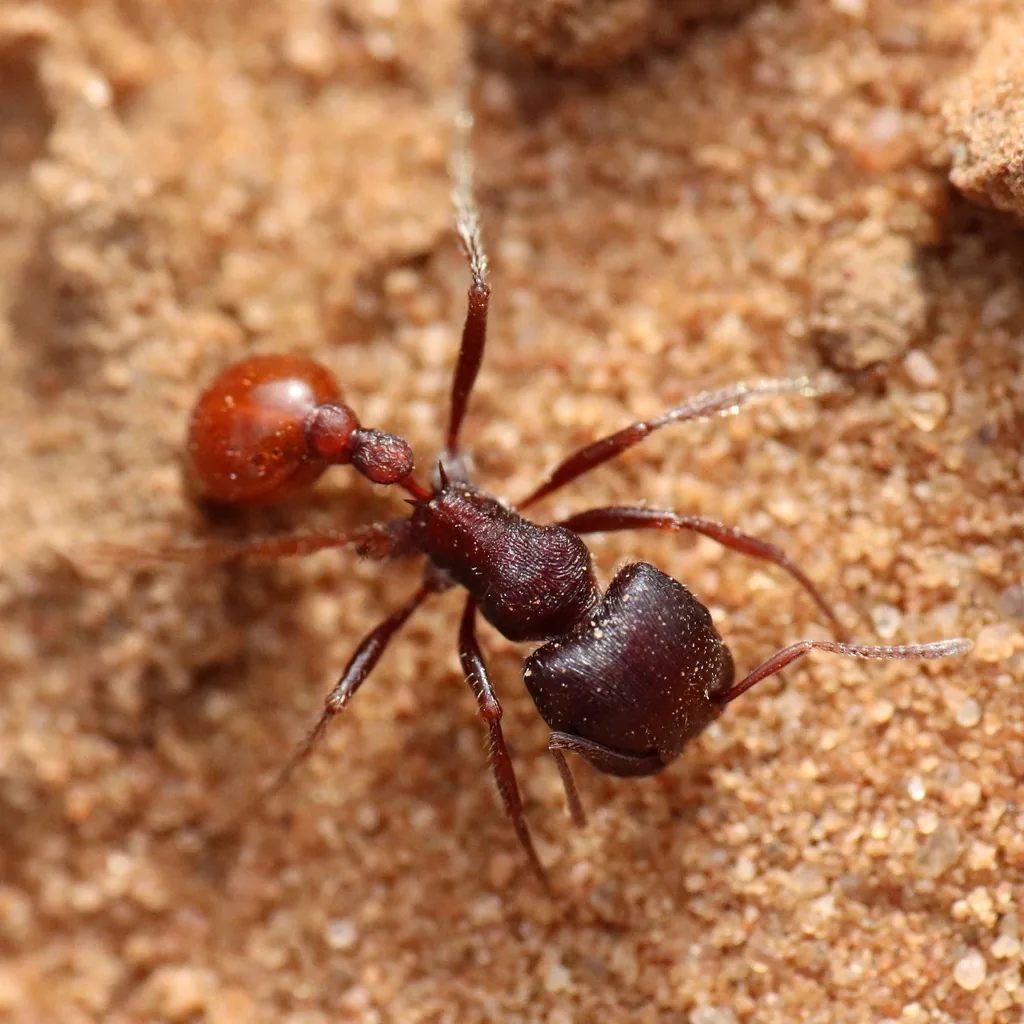
- A Pogonomyrmex: workers about half an inch (13 mm) long, brick red to black, with large squarish heads that hold the powerful muscles used to crush seeds. All workers are one size; the species has no soldier caste.[1][6]
- Nests of this genus show a prominent cleared area with a central opening and several permanent trails radiating from it. In northern Arizona rangeland, rough harvester ant nests were smaller and cleared less ground than those of the western harvester ant, with nests typically 18 to 24 meters apart.[1][3]
- Workers carry seeds back along the trails; in coastal sage scrub, 85 percent of returning foragers carried seeds of the exotic Erodium cicutarium.[4]
- Winged queens and males appear after summer monsoon rains, the queens looking like workers but two to three times as big and the males smaller than workers.[1][2]
Look-alikes
| Look-alike | How to tell them apart |
|---|---|
| Veromessor pergandei (desert harvester ant) | The other common desert seed harvester, but shiny jet black and stingless, flying in winter and spring rather than after the monsoon. The two share many areas yet sort by soil: P. rugosus alone where soils are coarser and richer in clay near mountains, Veromessor on finer soils farther out.[1][2] |
| Red harvester ant (Pogonomyrmex barbatus) | A close relative with the same square head, cleared nest disc and sting. The sources used here do not describe how to separate the two by eye; location and soil are the practical clues, since P. rugosus is the species documented in the Sonoran, Mojave and Chihuahuan Deserts and in coastal sage scrub.[2][5][4] |
| Western harvester ant (Pogonomyrmex occidentalis) | Shares northern Arizona rangeland with the rough harvester ant but builds larger nests, clears more ground and packs colonies closer together, peaking at 37 nests per hectare against 16 for P. rugosus.[3] |
Where it lives
Documented across the Sonoran and Mojave Deserts, where it coexists with Veromessor pergandei, in the Chihuahuan Desert alongside banner-tailed kangaroo rats, in northern Arizona rangeland and in coastal sage scrub. Within the deserts it predominates on coarser-textured soils with more clay near the mountains.[2][5][3][4]
Biology and life cycle
Like other desert seed harvesters it collects seeds, preferring grasses and annual plants over cacti, and stores them in chambers toward the top of the nest where dry conditions discourage sprouting; the seeds feed the larvae. In coastal sage scrub the ants selected the exotic Erodium cicutarium over native seeds and avoided the native Encelia farinosa, yet their foraging had no major effect on the seed bank.[1][4]
Reproductive flights follow the summer monsoon rains. Many desert ants, including some Pogonomyrmex, start colonies with several cooperating queens; founding is when most colonies fail, but an established colony may live a decade or more and queens can live past 20 years.[2][1]
In the Chihuahuan Desert young colonies survive better within about 10 meters of a banner-tailed kangaroo rat mound, apparently because the rodents' digging and seed foraging change the soil and plant cover around them.[5]
Workers divide tasks by age: nest maintenance workers are younger than foragers, with heavier bodies and less-worn mandibles, while workers recruited to a temporary food source had the most worn mandibles, suggesting they double as seed millers.[6]
Whether a larva becomes a worker or a queen depends partly on trophic eggs, eggs without an embryo that serve as food. First-instar larvae given trophic eggs mostly became workers, and larvae denied them became queens; the trophic eggs differ from fertile eggs in protein, fat, sugar and small RNA content.[7]
Harvester ants act as ecosystem engineers by clearing vegetation from their nest discs; in northern Arizona, colony density was marginally higher where cattle grazing was excluded.[3]
Damage and signs
Health risk
Pogonomyrmex workers have unforgettable stings; give nests and trails a wide berth.[1]
Control
Prevention
No control is described. This is a native desert ant whose colonies, spaced roughly 18 to 24 meters apart, gather wild seeds in open country; avoid standing on the cleared nest disc or its trails because of the sting.[1][3]
Common questions
- How do I tell a rough harvester ant from the black harvester ant on the same ground?
- Pogonomyrmex are brick red to black with big square heads and a painful sting, and they fly after the summer rains; Veromessor pergandei is shiny jet black, stingless and flies in winter and spring. Where both occur, P. rugosus favors the coarser, clay-richer soils near mountains.[1][2]
- What is the bare circle around the nest?
- A cleared disc that the ants strip of vegetation, with the nest entrance at its center and permanent trails leading out. Rough harvester ant discs are smaller than the western harvester ant's; across five northern Arizona sites their nests covered at most about 0.2 percent of the land.[1][3]
- Do they sting?
- Yes. The Desert Museum describes Pogonomyrmex stings as unforgettable.[1]
Sources
- Arizona-Sonora Desert Museum, “Ants, in A Natural History of the Sonoran Desert (D. E. Wheeler and S. W. Rissing).” www.desertmuseum.org/books/nhsd_ants.php (accessed 2026-11-10)
- Oecologia, abstract via PubMed, “Soil texture as an influence on the distribution of the desert seed-harvester ants Pogonomyrmex rugosus and Messor pergandei (Johnson 1992, Oecologia 89:118-124; PubMed 28313403).” doi.org/10.1007/BF00319023 (accessed 2026-11-10)
- Environmental Entomology, abstract via PubMed, “Colony densities and spatial patterns of harvester ants (Pogonomyrmex occidentalis and Pogonomyrmex rugosus) in grazed and ungrazed rangeland (Environmental Entomology 54:764-772, 2025; PubMed 40576961).” doi.org/10.1093/ee/nvaf044 (accessed 2026-11-10)
- Environmental Entomology, abstract via PubMed, “Seed selection by the harvester ant Pogonomyrmex rugosus in coastal sage scrub (Briggs and Redak 2016, Environmental Entomology 45:983-990; PubMed 27257121).” doi.org/10.1093/ee/nvw042 (accessed 2026-11-10)
- PLoS One, abstract via PubMed, “Positive interactions between desert granivores: localized facilitation of harvester ants by kangaroo rats (Edelman 2012, PLoS One 7:e30914; PubMed 22348030).” doi.org/10.1371/journal.pone.0030914 (accessed 2026-11-10)
- Journal of Insect Behavior, abstract via PubMed, “The old ladies of the seed harvester ant Pogonomyrmex rugosus: foraging performed by two groups of workers (Oettler and Johnson 2009, Journal of Insect Behavior 22:217-226; PubMed 21654914).” doi.org/10.1007/s10905-008-9167-7 (accessed 2026-11-10)
- eLife, abstract via PubMed, “Trophic eggs affect caste determination in the ant Pogonomyrmex rugosus (Genzoni et al. 2025, eLife 12:RP86899; PubMed 40741944).” doi.org/10.7554/eLife.86899 (accessed 2026-11-10)
- iNaturalist, “Pogonomyrmex rugosus taxon page (order and family).” www.inaturalist.org/taxa/69517 (accessed 2026-11-10)